- 397 pages
- English
- ePUB (mobile friendly)
- Available on iOS & Android
eBook - ePub
Information
Year
2010eBook ISBN
9780870032851
Subtopic
Arms Control1
Introduction: Identity and Ideology
Pakistan for more than a decade has been accused of supporting terrorism, mainly because of its support for militants opposing Indian rule in the disputed Himalayan territory of Jammu and Kashmir and also its backing of the Taliban government in Afghanistan. After September 11, 2001, when terrorists attacked the World Trade Center and the Pentagon, Pakistan heeded U.S. pressure to reverse course and take a stand against terrorism. Pakistan became a key U.S. ally, facilitating U.S. military operations in Afghanistan and sharing intelligence about Al Qaeda operatives. Nevertheless, terrorists continue to operate in, and from, Pakistan. The country is now a target and a staging ground for terrorism while it is simultaneously seen by U.S. policy makers as the key to ending terrorism in South Asia.
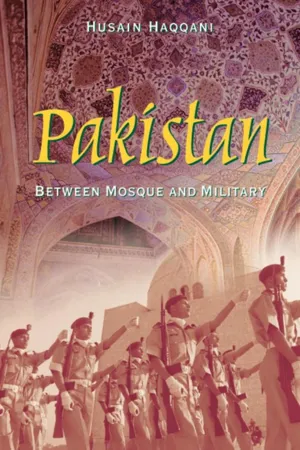
Pakistan’s future direction is crucial to the U.S.-led war against terror, not least because of Pakistan’s declared nuclear-weapons capability. The historic alliance between Islamists and Pakistan’s military, which is the subject of this book, has the potential of frustrating antiterrorist operations, radicalizing key segments of the Islamic world, and bringing India and Pakistan yet again to the brink of war.
Pakistan’s Islamists made their strongest showing in a general election during parliamentary polls held in October 2002, when they secured 11.1 percent of the popular vote and 20 percent of the seats in the lower house of Parliament. Since then, they have pressed for Taliban-style Islamization in the North-West Frontier Province (NWFP) bordering Afghanistan, where they control the provincial administration. Pakistan’s military ruler, General Pervez Musharraf, has made repeated pronouncements to reassure the world of his intention to radically alter Pakistan’s policy direction away from its recent Islamist and jihadi past. In a major policy speech on January 12, 2002, Musharraf announced measures to limit the influence of Islamic militants at home, including those previously described by him as “Kashmiri freedom fighters.” “No organizations will be able to carry out terrorism on the pretext of Kashmir,” he declared. “Whoever is involved with such acts in the future will be dealt with strongly whether they come from inside or outside the country.”1
Musharraf’s supporters described his speech as revolutionary.2 He received international applause and support as well. Pakistanis tired of years of religious and sectarian violence agreed with Musharraf’s statement that “Violence and terrorism have been going on for years and we are weary and sick of this Kalashnikov culture … The day of reckoning has come.” But soon it became apparent that Musharraf’s government continues to make a distinction between “terrorists” (a term applied to Al Qaeda members who are mainly of foreign origin as well as members of Pakistan’s sectarian militant groups) and “freedom fighters” (the officially preferred label in Pakistan for Kashmiri militants). The Musharraf government also remains tolerant of remnants of Afghanistan’s Taliban regime, hoping to use them in resuscitating Pakistan’s influence in Afghanistan in case the U.S.-installed regime of President Hamid Karzai falters.
This duality in Pakistani policy is a structural problem, rooted in history and a consistent policy of the state. It is not just the inadvertent outcome of decisions by some governments (beginning with that of General Muhammad Zia ul-Haq in 1977), as is widely believed.
Since the country’s inception, Pakistan’s leaders have played upon religious sentiment as an instrument of strengthening Pakistan’s identity. Under ostensibly pro-Western rulers, Islam has been the rallying cry against perceived Indian threats. Such rulers have attempted to “manage” militant Islamism, trying to calibrate it so that it serves its nation-building function without destabilizing internal politics or relations with Western countries. General Zia ul-Haq went farther than others in “Islamizing” Pakistan’s legal and educational system, but his policy of Islamization was the extension of a consistent state ideology, not an aberration.
Islamist groups have been sponsored and supported by the state machinery at different times to influence domestic politics and support the military’s political dominance. In the South Asian region, the Islamists have been allies in the Pakistan military’s efforts to seek strategic depth in Afghanistan and to put pressure on India for negotiations over the future of Kashmir. Relations between ideologically motivated clients and their state patrons are not always smooth, which partly explains the inability of Pakistan’s generals to completely control the Islamists in the post-9/11 phase. The alliance between the mosque and the military in Pakistan was forged over time, and its character has changed with the twists and turns of Pakistani history.
Pakistan’s state institutions, especially its national security institutions such as the military and the intelligence services, have played a leading role in building Pakistani national identity on the basis of religion since Pakistan’s emergence as an independent country in August 1947. This political commitment to an ideological state gradually evolved into a strategic commitment to jihadi ideology—ideology of holy war—especially during and after the Bangladesh war of 1971, when the Pakistani military used Islamist idiom and the help of Islamist groups to keep secular leaders who were supported by and elected by the majority Bengali-speaking population out of power. Rebellion by the Bengalis and their brutal suppression by Pakistan’s military followed. In the 1971 war, Pakistan was split apart with the birth of an independent Bangladesh.
After the 1971 war, in the original country’s western wing, the effort to create national cohesion between Pakistan’s disparate ethnic and linguistic groups through religion took on greater significance, and its manifestations became more militant. Religious groups, both armed and unarmed, have become gradually more powerful as a result of this alliance between the mosque and the military. Radical and violent manifestations of Islamist ideology, which sometimes appear to threaten Pakistan’s stability, are in some ways a state project gone wrong.
The emergence of Pakistan as an independent state in 1947 was the culmination of decades of debate and divisions among Muslims in British India about their collective future. After the consolidation of British rule in the nineteenth century, Muslims found themselves deprived of the privileged status they enjoyed under Mughal rule. Some of their leaders embraced territorial nationalism and did not define their collective personality through religion. They opposed British rule and called for full participation in the Indian nationalist movement led by the Indian National Congress of Mohandas Gandhi and Jawaharlal Nehru. Others felt that Muslims had a special identity that would be erased over time by ethnic and territorial nationalism centered primarily on the Hindu majority in India.
Coalescing in the All-India Muslim League and led by Muhammad Ali Jinnah, these Muslim nationalists asserted that India’s Muslims constituted a nation separate from non-Muslim Indians and subsequently demanded a separate homeland in areas with a Muslim majority. British India’s Muslim-majority provinces lay in its northwest and northeast, leading to Pakistan comprising two wings separated by India until the eastern wing became the new state of Bangladesh in December 1971. Pakistan’s creation represented the acceptance of the two-nation theory, which had been periodically articulated long before the formal demand for recognition of a Muslim nation in 1940 but had never been fully explained in terms of how it would be applied. Although Pakistan was intended to save South Asia’s Muslims from being a permanent minority, it never became the homeland of all South Asia’s Muslims. One-third of the Indian subcontinent’s Muslims remained behind as a minority in Hindu-dominated India even after partition in 1947. The other two-thirds now lives in two separate countries, Pakistan and Bangladesh, confirming the doubts expressed before independence about the practicality of the two-nation theory.
Pakistan’s freedom struggle had been relatively short, beginning with the demand by the All-India Muslim League for separate Muslim and non-Muslim states in 1940 and ending with the announcement of the partition plan in June 1947. Although the Muslim League claimed to speak for the majority of Indian Muslims, its strongest support and most of its national leadership came from regions where Muslims were in a minority.3 Even after the Muslim League won over local notables in the provinces that were to constitute Pakistan, it did not have a consensus among its leaders over the future direction of the new country. Issues such as the new nation’s constitutional scheme, the status of various ethno-linguistic groups within Pakistan, and the role of religion and theologians in matters of state were still unresolved at independence.
Leaders of the Muslim League had given little thought to, and had made no preparations for, how to run a new country. One possible explanation for this lack is that the demand for Pakistan was “devised for bargaining purposes to gain political leverage for Muslims.”4 Several Muslim leaders, notably poet-philosopher Muhammad Iqbal in 1930, proposed schemes for power sharing between the religious majority and minorities in independent India. They claimed that India’s Muslims constituted a separate nation by virtue of their unique history and cultural differences with the Hindu majority. This claim to nationhood, however, was not necessarily a claim to separate statehood. A separate Muslim nation could have remained part of a federal or confederal India under special power sharing arrangements and that may have been the original intention of the Muslim League leadership.5 According to this argument, the refusal of the Indian National Congress to contemplate such power-sharing and to accept the notion of a multination state led inadvertently to partition and the creation of a sovereign Pakistan.
While seeking recognition of a separate Muslim nation, Jinnah had managed to pull together various elements of Muslim leadership in India, creating communal unity through ambiguity about the final goal. He was “using the demand for Pakistan to negotiate a new constitutional arrangement in which Muslims would have an equal share of power”6 once the British left the subcontinent. Historian Ayesha Jalal has elaborated on the impact that Indian Muslim politics of the time made on the demand for Pakistan as well as the nature and contradictions of that demand:
Once the principle of Muslim provinces being grouped to form a separate state was conceded, Jinnah was prepared to negotiate whether that state would seek a confederation with the non-Muslim provinces, namely Hindustan, on the basis of equality at the all-India level, or whether, as a sovereign state, it would make treaty arrangements with the rest of India … If they were to play their role in the making of India’s constitutional future, Jinnah and the Muslim League had to prove their support in the Muslim-majority provinces. Such support could not have been won by too precise a political programme since the interests of Muslims in one part of India did not suit Muslims in others … Jinnah could not afford to wreck the existing structure of Muslim politics, especially since he had nothing plausible to replace it with. This is where religion came to the rescue … Yet Jinnah’s resort to religion was not an ideology to which he was ever committed or even a device to use against rival communities; it was simply a way of giving a semblance of unity and solidity to his divided Muslim constituents. Jinnah needed a demand that was specifically ambiguous and imprecise to command general support, something specifically Muslim though unspecific in every other respect. The intentionally obscure cry for a “Pakistan” was contrived to meet this requirement … Jinnah could not afford to state precisely what the demand for “Pakistan” was intended to accomplish. If the demand was to enjoy support from Muslims in the minority provinces it had to be couched in uncompromisingly communal terms. But the communal slant to the demand cut against the grain of politics in the Muslim provinces, particularly the Punjab and Bengal, where Muslim domination over undivided territories depended upon keeping fences mended with members of other communities.7
One result of Jinnah’s elaborate strategy was that India’s Muslims demanded Pakistan without really knowing the results of that demand. Once Jinnah’s demand for recognition of Muslim nationhood had been characterized as a demand for India’s division, Jinnah’s critics pointed out that any division of India along communal lines would inevitably have to include a division of the two major provinces, Punjab and Bengal, along similar lines.8 A few months before independence, Khwaja Nazimuddin, who later became Pakistan’s second governor general as well as its second prime minister, candidly told a British governor that he did not know “what Pakistan means and that nobody in the Muslim League knew.”9 What may have been an effort to seek recognition for Muslims as a nation in minority moved millions of Indian Muslims into expecting a separate country, the running of which Muslim leaders had made no preparations for. By May 1947, Jinnah was telling a foreign visitor that “even if ‘driven into the Sind desert,’ he would insist on a sovereign state.”10
Jinnah and his colleagues in the Muslim League had not contemplated a Pakistan that did not include all of Punjab and Bengal. If the entire scheme was designed to increase the Muslims’ bargaining power in post-British India, the division of India had to be between Muslim-majority provinces and Hindu-majority provinces. “Without the non-Muslimmajority districts of these two provinces [Bengal and Punjab], the [Muslim] League could not expect to bargain for parity between ‘Pakistan’ and ‘Hindustan.’”11
The British agreement to concede the demand for Pakistan was based partly on the outcome of the 1945–1946 elections for a Constituent Assembly and various provincial assemblies. The elections were organized on the basis of limited franchise and separate electorates for various religious communities, a practice in vogue in India since 1909. The Muslim League won 75 percent of the Muslim vote and all the Muslim seats in the constituent assembly. Only 15 percent of the population had the right to vote on the basis of literacy, property, income, and combatant status.12 It can be said with some certainty that literate, salaried, and propertied Muslims as well as those who had served in the British army supported the Muslim League. The views of the Muslim peasantry and illiterate masses were less clear.
To shore up Muslim support, the Muslim League appealed to religious and communal sentiment. Although Jinnah—by then known as Quaid-i-Azam (the great leader)—and most of his principal deputies in the campaign for Pakistan were secular individuals, the Muslim League’s 1945–1946 election campaign was based almost entirely on Islamic rhetoric. The Indian National Congress secured the assistance of “nationalist” Muslim clerics organized in the Jamiat Ulema Hind (Society of Indian Scholars) to attack the Islamic credentials of Jinnah and other Muslim League leaders. The Muslim League responded by rolling out its own theologians. The result was the almost total identification of Pakistan with Islam in the course of the campaign. The rural Muslim masses were encouraged to develop “a vague feeling that they would all become better Muslims once a Muslim state was established.”13 Before extending their support to the Muslim League, some religious leaders demanded assurances from Jinnah that Pakistan would follow Islamic laws. Jinnah offered these assurances, as professor Khalid bin Sayeed notes:
In a letter to the Pir of Manki Sharif, the [Muslim] League leader clearly stated in November 1945: “It is needless to emphasize that the constituent Assembly which would be predominantly Muslim in its composition would be able to enact laws for Muslims, not inconsistent with the Shariat laws and the Muslims will no longer be obliged to abide by the Un-Islamic laws… .” In the League meetings that the Quaid-i-Azam addressed, particularly in the Muslim majority areas, Islam with its symbols and slogans figured very prominently in all his speeches. Addressing the Pathans, he said, “Do you want Pakistan or not?” (shouts of Allah-o-Akbar) (God is great). Well, if you want Pakistan, vote for the League candidates. If we fail to realize our duty today you will be reduced to the status of Sudras (low castes) and Islam will be vanquished from India. I shall never allow Muslims to be slaves of Hindus. (Allaho-Akbar.)14
In Punjab, where the Muslim elite had been reluctant followers of Jinnah, the tide was turned with the help of conservative religious elements. A Pakistani scholar and former diplomat explains:
The spectacular victory of the Muslim League in the Punjab electio...
Table of contents
- Praise for Pakistan: Between Mosque and Military
- Title Page
- Copyright Page
- Contents
- Foreword by Jessica T. Mathews
- Acknowledgments
- Map of the Region
- 1. Introduction: Identity and Ideology
- 2. Defending Ideological Frontiers
- 3. Old and New Pakistan
- 4. From Islamic Republic to Islamic State
- 5. Afghan Jihad
- 6. Military Rule by Other Means
- 7. Jihad without Borders
- 8. Conclusion: From Ideological to Functional State
- Notes
- Index
- About the Author
- The Carnegie Endowment for International Peace
Trusted by 375,005 students
Access to over 1.5 million titles for a fair monthly price.
Study more efficiently using our study tools.
Frequently asked questions
Yes, you can cancel anytime from the Subscription tab in your account settings on the Perlego website. Your subscription will stay active until the end of your current billing period. Learn how to cancel your subscription
No, books cannot be downloaded as external files, such as PDFs, for use outside of Perlego. However, you can download books within the Perlego app for offline reading on mobile or tablet. Learn how to download books offline
Perlego offers two plans: Essential and Complete
- Essential is ideal for learners and professionals who enjoy exploring a wide range of subjects. Access the Essential Library with 800,000+ trusted titles and best-sellers across business, personal growth, and the humanities. Includes unlimited reading time and Standard Read Aloud voice.
- Complete: Perfect for advanced learners and researchers needing full, unrestricted access. Unlock 1.5M+ books across hundreds of subjects, including academic and specialized titles. The Complete Plan also includes advanced features like Premium Read Aloud and Research Assistant.
We are an online textbook subscription service, where you can get access to an entire online library for less than the price of a single book per month. With over 1.5 million books across 990+ topics, we’ve got you covered! Learn about our mission
Look out for the read-aloud symbol on your next book to see if you can listen to it. The read-aloud tool reads text aloud for you, highlighting the text as it is being read. You can pause it, speed it up and slow it down. Learn more about Read Aloud
Yes! You can use the Perlego app on both iOS and Android devices to read anytime, anywhere — even offline. Perfect for commutes or when you’re on the go.
Please note we cannot support devices running on iOS 13 and Android 7 or earlier. Learn more about using the app
Please note we cannot support devices running on iOS 13 and Android 7 or earlier. Learn more about using the app
Yes, you can access Pakistan by Husain Haqqani in PDF and/or ePUB format, as well as other popular books in Politics & International Relations & Arms Control. We have over 1.5 million books available in our catalogue for you to explore.