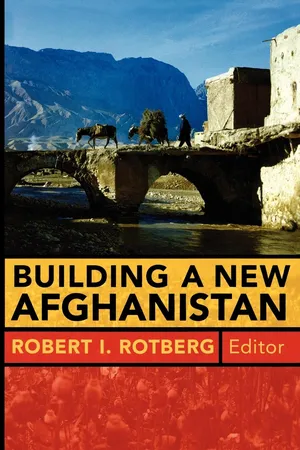
In the wake of the Taliban nightmare, Afghanistan must tackle serious problems before it can emerge as a confident, independent nation. Security in this battered state continues to deteriorate; suicide bombings, convoy ambushes, and insurgent attacks are all too common. Effective state building will depend upon eliminating the national security crisis and enhancing the rule of law. This book offers a blueprint for moving the embattled nation toward greater democracy and prosperity. Robert Rotberg and his colleagues argue that the future success of state building in Afghanistan depends on lessening its dependence on opium and enhancing its economic status. Many of Afghanistan's security problems are related to poppy growing, opium and heroin production, and drug trafficking. Building a New Afghanistan suggests controversial new alternatives to immediate eradication, which is foolish and counter-productive. These options include monetary incentives for growing wheat, a viable local crop. Greater wheat production would feed hungry Afghans while reducing narco-trafficking and the terror that comes with it. Integrating this land-locked country into the Central Asia or greater Eurasia economy would open up trading partnerships with its northern and western neighbors as well as with Pakistan, India, and possibly China. Developing a sense of common purpose among citizens would benefit the economy and could help to unite the nation. Perhaps most important, bolstering better governance in Afghanistan is necessary in order to eliminate chaos and corruption and enact nationwide reforms. Fresh and insightful, Building a New Afghanistan shows what the country's leadership and the international community should do to resolve dangerous issues and bolster a still fragile state. Contributors include Cindy Fazey (University of Liverpool), Ali Jalali (former minister of the interior, Afghanistan, and National Defense University), Hekmat Karzai (Centre for Conflict and Peace Studies, Afghanistan, and Institute of Defense and Strategic Studies, Singapore), Alistair J. McKechnie (World Bank Country Director for Afghanistan), Paula Newburg (Skidmore College), and S. Frederick Starr (Central Asia-Caucasus Institute and School of Advanced International Studies, Johns Hopkins University).
- 256 pages
- English
- PDF
- Available on iOS & Android
eBook - PDF
Building a New Afghanistan
About this book
Information
Table of contents
- Front Cover
- Title Page
- Copyright Page
- Table of Contents
- Preface
- Chapter 1: Renewing the Afghan State
- Chapter 2: The Legacy of War and the Challenge of Peace Building
- Chapter 3: Strengthening Security in Contemporary Afghanistan: Coping with the Taliban
- Chapter 4: Neither Stable nor Stationary: The Politics of Transition and Recovery
- Chapter 5: Rebuilding a Robust Afghan Economy
- Chapter 6: Revitalizing Afghanistan's Economy: The Government's Plan
- Chapter 7: Regional Development in Greater Central Asia: The Afghan Pivot
- Chapter 8: Responding to the Opium Dilemma
- Chapter 9: The Place of the Province in Afghanistan's Subnational Governance
- Contributors
- Index
- Back Cover
Trusted by 375,005 students
Access to over 1.5 million titles for a fair monthly price.
Study more efficiently using our study tools.
Frequently asked questions
Yes, you can cancel anytime from the Subscription tab in your account settings on the Perlego website. Your subscription will stay active until the end of your current billing period. Learn how to cancel your subscription
No, books cannot be downloaded as external files, such as PDFs, for use outside of Perlego. However, you can download books within the Perlego app for offline reading on mobile or tablet. Learn how to download books offline
Perlego offers two plans: Essential and Complete
- Essential is ideal for learners and professionals who enjoy exploring a wide range of subjects. Access the Essential Library with 800,000+ trusted titles and best-sellers across business, personal growth, and the humanities. Includes unlimited reading time and Standard Read Aloud voice.
- Complete: Perfect for advanced learners and researchers needing full, unrestricted access. Unlock 1.5M+ books across hundreds of subjects, including academic and specialized titles. The Complete Plan also includes advanced features like Premium Read Aloud and Research Assistant.
We are an online textbook subscription service, where you can get access to an entire online library for less than the price of a single book per month. With over 1.5 million books across 990+ topics, we’ve got you covered! Learn about our mission
Look out for the read-aloud symbol on your next book to see if you can listen to it. The read-aloud tool reads text aloud for you, highlighting the text as it is being read. You can pause it, speed it up and slow it down. Learn more about Read Aloud
Yes! You can use the Perlego app on both iOS and Android devices to read anytime, anywhere — even offline. Perfect for commutes or when you’re on the go.
Please note we cannot support devices running on iOS 13 and Android 7 or earlier. Learn more about using the app
Please note we cannot support devices running on iOS 13 and Android 7 or earlier. Learn more about using the app
Yes, you can access Building a New Afghanistan by Robert I. Rotberg in PDF and/or ePUB format, as well as other popular books in Politics & International Relations & Diplomacy & Treaties. We have over 1.5 million books available in our catalogue for you to explore.