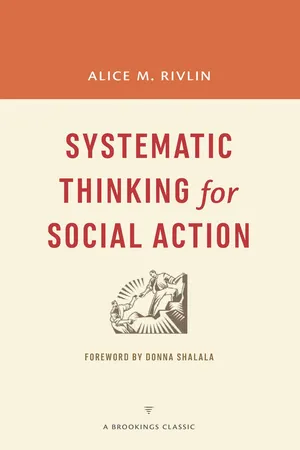
In January 1970 Alice M. Rivlin spoke to an audience at the University of California-Berkeley. The topic was developing a more rational approach to decisionmaking in government. If digital video, YouTube, and TED Talks had been inventions of the 1960s, Rivlin's talk would have been a viral hit. As it was, the resulting book, Systematic Thinking for Social Action, spent years on the Brookings Press bestseller list. Is is a very personal and conversational volume about the dawn of new ways of thinking about government.
As deputy assistant secretary for program coordination, and later as assistant secretary for planning and evaluation, at the Department of Health, Education and Welfare from 1966 to 1969, Rivlin was an early advocate of systems analysis, which had been introduced by Robert McNamara at the Department of Defense as PPBS (planning-programming-budgeting-system).
While Rivlin brushes aside the jargon, she digs into the substance of systematic analysis and a 'quiet revolution in government. In an evaluation of the evaluators, she issues mixed grades, pointing out where analysts had been helpful in finding solutions and where—because of inadequate data or methods—they had been no help at all.
Systematic Thinking for Social Action offers important insights for anyone interested in working to find the smartest ways to allocate scarce funds to promote the maximum well-being of all citizens.
- 142 pages
- English
- ePUB (mobile friendly)
- Available on iOS & Android
eBook - ePub
Systematic Thinking for Social Action
About this book
Information
INDEX
Ability to cope, 41
Academic testing: cultural and linguistic biases in, 40; inadequacies of, 58, 62, 68
Accountability mechanisms, 108–11, 118–19
Aging populations. See Elderly and aging populations
Aid for Families with Dependent Children (AFDC), 14–15, 24, 51–52, 126–27n14
Alienation from society, 42
Assessment. See Academic testing
Bank Street College of Education program, 87
Bateman, Worth, 128n25
Becker-Engelmann program, 87
Behavioral studies: of higher education, 36; of income maintenance programs, 26, 28, 86
Benefit-cost analysis, 42–52; of cancer research vs. reading programs, 42–49; of dam sites, 50–51; in disease control study, 44–45; of education, 31–32, 36–37, 45–46; for income maintenance programs, 23–24, 26, 27–28; in manpower training study, 45; methods used in, 43–46; political process variables in, 48–49; usefulness of, 50–52; weaknesses of, 42–43, 46–49; of welfare programs, 52–53
Biases, in educational testing, 40
Blind populations, public assistance for, 14, 24
Bowles, Samuel S., 60
Burkhead, Jesse, 60, 61
Bushell program, 88
California, public subsidies for higher education in, 33
Campbell, Donald T., 93–94
Cancer research, benefit-cost analysis of, 42–49
Carnegie Commission on Higher Education, 36
Children: AFDC program for, 14–15, 24, 51–52, 126–27n14; allowance proposals for, 18, 19, 20, 22; and poverty, 10
Cohen, Wilbur J., 17, 21
Coleman, John R., 47, 60
Coleman Report, 11–12, 59, 60, 65
Community action programs, 74
Community control proposals, 111–14
Compensatory education programs, 67, 68–71
Computer technology: attitudes toward, 4; growth of, 8; for Medicare fraudulent claim analysis, viii; and privacy issues, 13; in surveys, 12; and tax model, 28–29
Congressional Budget Office, vii
Cost analysis. See Benefit-cost analysis
Council of Economic Advisers, 9, 10
Cultural biases, in educational testing, 40
Dam sites, benefit-cost analysis of, 50–51
Decentralization proposals, 104–11; accountability mechanisms for, 108–11; attitudes toward, 104–05; federal role in, 106–08
Decision-making process: barriers to, 39; judgment and values in, 2; PPBS approach to, 3–5; systematic analysis in, 2
Denison, Edward F., 33–34
Department of. See specific name of department
Disabled populations: lack of information on, 12; public assistance for, 14, 24
Disease...
Table of contents
- Cover Page
- Title Page
- Copyright Page
- Contents
- Foreword
- Preface to the New Edition
- One - Introduction
- Two - Who Wins and who Loses?
- Three - What does the Most Good?
- Four - Producing Effective Services: What do we Know?
- Five - Can we Find Out what Works?
- Six - Accountability: What does it Mean?
- Notes
- Index
- About the Author
- Back Cover
Trusted by 375,005 students
Access to over 1.5 million titles for a fair monthly price.
Study more efficiently using our study tools.
Frequently asked questions
Yes, you can cancel anytime from the Subscription tab in your account settings on the Perlego website. Your subscription will stay active until the end of your current billing period. Learn how to cancel your subscription
No, books cannot be downloaded as external files, such as PDFs, for use outside of Perlego. However, you can download books within the Perlego app for offline reading on mobile or tablet. Learn how to download books offline
Perlego offers two plans: Essential and Complete
- Essential is ideal for learners and professionals who enjoy exploring a wide range of subjects. Access the Essential Library with 800,000+ trusted titles and best-sellers across business, personal growth, and the humanities. Includes unlimited reading time and Standard Read Aloud voice.
- Complete: Perfect for advanced learners and researchers needing full, unrestricted access. Unlock 1.5M+ books across hundreds of subjects, including academic and specialized titles. The Complete Plan also includes advanced features like Premium Read Aloud and Research Assistant.
We are an online textbook subscription service, where you can get access to an entire online library for less than the price of a single book per month. With over 1.5 million books across 990+ topics, we’ve got you covered! Learn about our mission
Look out for the read-aloud symbol on your next book to see if you can listen to it. The read-aloud tool reads text aloud for you, highlighting the text as it is being read. You can pause it, speed it up and slow it down. Learn more about Read Aloud
Yes! You can use the Perlego app on both iOS and Android devices to read anytime, anywhere — even offline. Perfect for commutes or when you’re on the go.
Please note we cannot support devices running on iOS 13 and Android 7 or earlier. Learn more about using the app
Please note we cannot support devices running on iOS 13 and Android 7 or earlier. Learn more about using the app
Yes, you can access Systematic Thinking for Social Action by Alice M. Rivlin in PDF and/or ePUB format, as well as other popular books in Politics & International Relations & Politics. We have over 1.5 million books available in our catalogue for you to explore.