- 29 pages
- English
- ePUB (mobile friendly)
- Available on iOS & Android
eBook - ePub
About this book
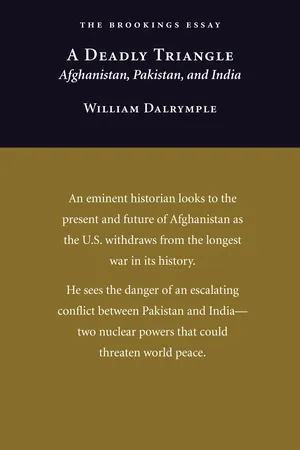
An eminent historian looks to the present and future of Afghanistan as the U.S. withdraws from the longest war in its history. THE BROOKINGS ESSAY: In the spirit of its commitment to high-quality, independent research, the Brookings Institution has commissioned works on major topics of public policy by distinguished authors, including Brookings scholars. The Brookings Essay is a multi-platform product aimed to engage readers in open dialogue and debate. The views expressed, however, are solely those of the author. Available in ebook only.
Information
The Indian-Pakistani Conflict Over Afghanistan
The February 2010 attack on the Indian guest houses was a rare overt act of hostility in the long covert struggle India and Pakistan have been waging on and off for more than sixty years over their competing influence in Afghanistan. But it was not the only such act. In fact it was the third in less than three years.
Fifteen months before, on October 8, 2009, a massive car bomb had been set off outside the Indian embassy in Kabul killing 17 people and wounding 63. Most of the dead were ordinary Afghans caught walking near the target. A few Indian security personnel were wounded, but blast walls built following a much deadlier bombing the previous year which killed 40 and wounded more than 100—also thought to have been sponsored by Pakistan—deflected the force of the explosion, so that physical damage to the embassy was limited to some of the doors and windows being blown out. In the case of the 2009 attack, American officials went public with details from phone intercepts which they said revealed the involvement of the ISI.
The hostility between India and Pakistan lies at the heart of the current war in Afghanistan.
The hostility between India and Pakistan lies at the heart of the current war in Afghanistan. Most observers in the West view the Afghanistan conflict as a battle between the U.S. and the NATO-led International Security Assistance Force (ISAF) on one hand, and al-Qaida and the Taliban on the other. In reality this has long since ceased to be the case. Instead our troops are now caught up in a complex war shaped by two pre-existing and overlapping conflicts: one local and internal, the other regional.
Within Afghanistan, the war is viewed primarily as a Pashtun rebellion against President Hamid Karzai's regime, which has empowered three other ethnic groups—the Tajiks, Uzbeks and Hazaras of the north—to a degree that the Pashtuns resent. For example, the Tajiks, who constitute only 27% of the Afghan population, still make up 70% of the officers in the Afghan army.
Although Karzai himself is a Pashtun, many of his fellow tribesmen view his presence as mere window-dressing for a U.S.-devised realignment of long-established power relations in the country, dating back to 2001 when the U.S. toppled the overwhelmingly Pashtun Taliban.
The Pashtuns had held sway in Afghan politics ever since the state assumed its current boundaries in the 1860s. By aligning with the Tajiks of the northern provinces against the Pashtuns of the south, the U.S. saw itself making common cause with the forces of secularism against militant Islam; but it was unwittingly taking sides in a complex civil war that has been going on since the 1970s—and that had roots going back much further than that. To this day, because the Pashtuns feel dominated by their ancestral enemies, many support or at least feel some residual sympathies for the Taliban.
There is also an age-old Pashtun-on-Pashtun element to the conflict. It pits Taliban from the Ishaqzai tribe, parts of the Nurzais, Achakzais, and most of the Ghilzais, especially the Hotak and Tokhi Ghilzais, against the more “establishment” Durrani Pashtun tribes: the Barakzais, Popalzais and Alikozais.
Beyond this indigenous conflict looms the much more dangerous hostility between the two regional powers—both armed with nuclear weapons: India and Pakistan. Their rivalry is particularly flammable as they vie for influence over Afghanistan. Compared to that prolonged and deadly contest, the U.S. and ISAF are playing little more than a bit part—and they, unlike the Indians and Pakistanis, are heading for the exit.
Since the Partition of the Subcontinent in 1947, India and Pakistan have fought three wars—the most recent in 1971—and they seemed on the verge of going nuclear against each other during a crisis in 1999, when Pakistani troops crossed a ceasefire line and occupied 500 square miles of Indian Kashmir, including a Himalayan border post near the town of Kargil. As tensions rose, the Pakistanis took ominous steps with their nuclear arsenal. President Bill Clinton mediated a solution. In intense negotiations at Blair House in Washington over the Fourth of July weekend, Clinton persuaded Prime Minister Nawaz Sharif to order a pullback of his country's forces to the Pakistani side of the line. That concession cost Nawaz his job and, very nearly, his life. The army commander, Pervez Musharraf, mounted a coup and sentenced Nawaz to death. Clinton intervened and Nawaz was exiled to Saudi Arabia.
It is easy to understand why Pakistan might feel insecure. India's population (1.2 billion) and its economy (GDP of $1.4 trillion) are about eight times the size of Pakistan's (180 million Pakistanis ...
Table of contents
- Cover Page
- Copyright Page
- Contents
- The Sole Survivor
- The Indian-Pakistani Conflict over Afghanistan
- Twibn States: Enemies since Birth
- 9/11 Changed Everything
- Post-American Afghanistan
- About the Author
- Further Reading
Trusted by 375,005 students
Access to over 1.5 million titles for a fair monthly price.
Study more efficiently using our study tools.
Frequently asked questions
Yes, you can cancel anytime from the Subscription tab in your account settings on the Perlego website. Your subscription will stay active until the end of your current billing period. Learn how to cancel your subscription
No, books cannot be downloaded as external files, such as PDFs, for use outside of Perlego. However, you can download books within the Perlego app for offline reading on mobile or tablet. Learn how to download books offline
Perlego offers two plans: Essential and Complete
- Essential is ideal for learners and professionals who enjoy exploring a wide range of subjects. Access the Essential Library with 800,000+ trusted titles and best-sellers across business, personal growth, and the humanities. Includes unlimited reading time and Standard Read Aloud voice.
- Complete: Perfect for advanced learners and researchers needing full, unrestricted access. Unlock 1.5M+ books across hundreds of subjects, including academic and specialized titles. The Complete Plan also includes advanced features like Premium Read Aloud and Research Assistant.
We are an online textbook subscription service, where you can get access to an entire online library for less than the price of a single book per month. With over 1.5 million books across 990+ topics, we’ve got you covered! Learn about our mission
Look out for the read-aloud symbol on your next book to see if you can listen to it. The read-aloud tool reads text aloud for you, highlighting the text as it is being read. You can pause it, speed it up and slow it down. Learn more about Read Aloud
Yes! You can use the Perlego app on both iOS and Android devices to read anytime, anywhere — even offline. Perfect for commutes or when you’re on the go.
Please note we cannot support devices running on iOS 13 and Android 7 or earlier. Learn more about using the app
Please note we cannot support devices running on iOS 13 and Android 7 or earlier. Learn more about using the app
Yes, you can access A Deadly Triangle by William Dalrymple in PDF and/or ePUB format, as well as other popular books in Politica e relazioni internazionali & Relazioni internazionali. We have over 1.5 million books available in our catalogue for you to explore.