- 28 pages
- English
- ePUB (mobile friendly)
- Available on iOS & Android
eBook - ePub
About this book
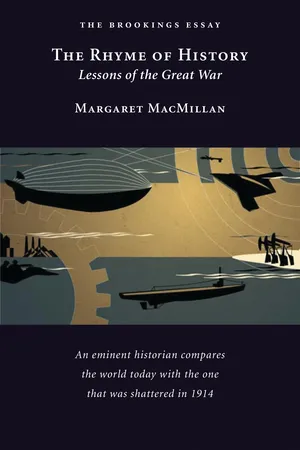
As the 100th anniversary of World War I approaches, historian Margaret MacMillan compares current global tensions—rising nationalism, globalization's economic pressures, sectarian strife, and the United States' fading role as the world's pre-eminent superpower—to the period preceding the Great War. In illuminating the years before 1914, MacMillan shows the many parallels between then and now, telling an urgent story for our time. THE BROOKINGS ESSAY: In the spirit of its commitment to high-quality, independent research, the Brookings Institution has commissioned works on major topics of public policy by distinguished authors, including Brookings scholars. The Brookings Essay is a multi-platform product aimed to engage readers in open dialogue and debate. The views expressed, however, are solely those of the author. Available in ebook only.
Information
EARLIER THIS YEAR I was on holiday in Corsica and happened to wander into the church of a tiny hamlet in the hills where I found a memorial to the dead from World War I. Out of a population that can have been no more than 150, eight young men, bearing among them only three last names, had died in that conflict. Such lists can be found all over Europe, in great cities and in small villages. Similar memorials are spread around the globe, for the Great War, as it was known prior to 1940, also drew soldiers from Asia, Africa, and North America.
World War I still haunts us, partly because of the sheer scale of the carnage—10 million combatants killed and many more wounded. Countless civilians lost their lives, too, whether through military action, starvation, or disease. Whole empires were destroyed and societies brutalized.
But there's another reason the war continues to haunt us: we still cannot agree why it happened. Was it caused by the overweening ambitions of some of the men in power at the time? Kaiser Wilhelm II and his ministers, for example, wanted a greater Germany with a global reach, so they challenged the naval supremacy of Great Britain. Or does the explanation lie in competing ideologies? National rivalries? Or in the sheer and seemingly unstoppable momentum of militarism? As an arms race accelerated, generals and admirals made plans that became ever more aggressive as well as rigid. Did that make an explosion inevitable?
Or would it never have happened had a random event in an Austro-Hungarian backwater not lit the fuse? In the second year of the conflagration that engulfed most of Europe a bitter joke made the rounds: “Have you seen today's headline? ‘Archduke Found Alive: War a Mistake.’ ” That is the most dispiriting explanation of all—that the war was simply a blunder that could have been avoided.
The search for explanations began almost as soon as the guns opened fire in the summer of 1914 and has never stopped. Scholars have combed through archives from Belgrade to Berlin looking for the causes. An estimated 32,000 articles, treatises, and books on World War I have been published in English alone. So when a British publisher took me out to lunch on a lovely spring day in Oxford five years ago and asked me if I would like to try my hand at one of history's greatest puzzles, my first reaction was a firm no. Yet afterward I could not stop thinking about this question that has haunted so many. In the end I succumbed. The result is yet another book, my own effort to understand what happened a century ago and why.
It was not just academic curiosity that drove me, but a sense of urgency as well. If we cannot determine how one of the most momentous conflicts in history happened, how can we hope to avoid another such catastrophe in the future?
…if we can see past our blinders and take note of the telling parallels between then and now, the ways in which our world resembles that of a hundred years ago, history does give us valuable warnings.
Just look at the actual and potential conflicts that dominate the news today. The Middle East, made up largely of countries that received their present borders as a consequence of World War I, is but one of many areas around the globe that is in turmoil, and has been for decades. Now there's a civil war in Syria, which has raised the spectre of a wider conflict in the region while also troubling relations among the major powers and testing their diplomatic skills. The Bashar al-Assad regime's use of poison gas—a weapon first deployed in the trench warfare of 1914, then outlawed because world opinion viewed it as barbaric—nearly precipitated American airstrikes. Commentary on these developments was filled with references to the guns of that long-ago August. Just as policymakers then discovered they had started something they could not stop, so this past summer we feared that such airstrikes might lead to a wider and more long-lasting conflict than anyone in President Barack Obama's administration could foresee.
The one-hundredth anniversary of 1914 should make us reflect anew on our vulnerability to human error, sudden catastrophes, and sheer accident. So we have good reason to glance over our shoulders even as we look ahead. History, said Mark Twain, never repeats itself but it rhymes. The past cannot provide us with clear blueprints for how to act, for it offers such a multitude of lessons that it leaves us free to pick and choose among them to suit our own political and ideological inclinations. Still, if we can see past our blinders and take note of the telling parallels between then and now, the ways in which our world resembles that of a hundred years ago, history does give us valuable warnings.
The Promise and Peril of Globalization, Then and Now
Though the era just before World War I, with its gas lighting and its horse-drawn carriages, seems very far off and quaint, it is similar in many ways—often unsettlingly so—to ours, as a look below the surface reveals. The decades leading up to 1914 were, like our own time, a period of dramatic shifts and upheavals, which those who experienced them thought of as unprecedented in speed and scale. The use of electricity to light streets and homes had become widespread; Einstein was developing his general theory of relativity; radical new ideas like psychoanalysis were finding a following; and the roots of the predatory ideologies of fascism and Soviet communism were taking hold.
Globalization—which we tend to think of as a modern phenomenon, created by the spread of international businesses and investment, the growth of the Internet, and the widespread migration of peoples—was also characteristic of that era. Made possible by many of the changes that were taking place at the time, it meant that even remote parts of the world were being linked by new means of transport, from railways to steamships, and by new means of communication, including the telephone, telegraph, and wireless. Then, as now, there was a huge expansion in global trade and investment. And then as now waves of immigrants were finding their way to foreign lands—Indians to the Caribbean and Africa, Japanese and Chinese to North America, and millions of Europeans to the New World and the Antipodes.
Taken together, all these changes were widely seen, particularly in Europe and America, as clear evidence of humanity's progress, suggesting to many that Europeans, at least, were becoming too interconnected and too civilized to resort to war as a means of settling disputes. The growth of international law, the Hague disarmament conferences of 1899 and 1907, and the increasing use of arbitration between nations (of the 300 arbitrations between 1794 and 1914 more than half occurred after 1890) lulled Europeans into the comforting belief that they had moved beyond savagery.
The fact that there had been an extraordinary period of general peace since 1815, when the Napoleonic wars ended, further reinforced this illusion, as did the idea that the interdependence of the countries of the world was so great that they could never afford to go to war again. This was the argument made by Norman Angell, a small, frail, and intense Englishman who had knocked around the world as everything from a pig farmer to a cowboy in the American West before he found his calling as a popular journalist. National economies were bound so tightly together, he maintained in his book, The Great Illusion, that war, far from profiting anyone, would ruin everyone. Moreover, in a view widely shared by bankers and economists at the time, a large-scale war could not last very long because there would be no way of paying for it (though we now know that societies have, when they choose, huge resources they can tap for destructive purposes). A sensational best-seller after it was published in Britain in 1909 and in the United States the following year, its title—meant to make the point that it was an illusion to believe there was anything to be gained by taking up arms—took on a cruel and unintended irony only a few short years later.
What Angell and others failed to see was the downside of interdependence. In Europe a hundred years ago the landowning classes saw their prosperity undermined by cheap agricultural imports from abroad and their dominance over much of society undercut by a rising middle class and a new urban plutocracy. As a result, many of the old upper classes flocked to conservative, even reactionary, political movements. In the cities, artisans and small shopkeepers whose services were no longer needed were also drawn to radical right-wing movements. Anti-Semitism flourished as Jews were made the scapegoat for the march of capitalism and the modern world.
The world is witnessing unsettling parallels today. Across Europe and North America, radical right-wing movements like the British National Party and the Tea Party provide outlets for the frustration and fears that many feel as the world changes around them and the jobs and security they had counted on disappear. Certain immigrants—such as Muslims—come to stand in as the enemy in some communities.
Globalization can also have the paradoxical effect of fostering intense localism and nativism, frightening people into taking refuge in the comfort of small, like-minded groups. One of the unexpected results of the Internet, for example, is how it can narrow horizons so that users seek out only those whose views echo their own and avoid websites that might challenge their assumptions.
Globalization also makes possible the widespread transmission of radical ideologies and the bringing together of fanatics who will stop at nothing in their quest for the perfect society. In the period before World War I, anarchists and revolutionary socialists across Europe and North America read the same works and had the same aim: to overthrow the existing social order. The young Serbs who assassinated Archduke Ferdinand of Austria at Sarajevo were inspired by Nietzsche and Bakunin, just as their Russian and French counterparts were. Terrorists from Calcutta to Buffalo imitated each other as they hurled bombs onto the floors of stock exchanges, blew up railway lines, and stabbed and shot those they saw as oppressors, whether the Empress Elizabeth of Austria-Hungary or U.S. President William McKinley. Today new technologies and social media platforms provide new rallying points for fanatics, enabling them to spread their messages even more rapidly and to even wider audiences around the globe. Often they claim divine inspiration. All of the world's major religions—Buddhism, Hinduism, Judaism, Christianity, and Islam—have produced their share of terrorists prepared to commit murder and mayhem in their name. Thus we see the young offspring of Muslim parents from Pakistan and Bangladesh, even those born or raised in the United Kingdom and North America, going off to make common cause with Syrian rebels, the Taliban in Afghanistan, or one of the branches of al Qaeda in North Africa or Yemen, despite sharing almost nothing—culturally or ethnically—with those whose cause they have taken up.
At the national level, globalization can heighten rivalries and fears between countries one might otherwise expect to be friends. One hundred years ago, on the eve of World War I, Britain, the world's greatest naval power, and Germany, the world's greatest land power, were each other's largest trading partners. British children played with toys, including lead soldiers, made in Germany, and Covent Garden resounded with the voices of German singers performing German operas. Moreover, the two nations shared a religion—the majority in both was Protestant—and family ties, right up to their respective monarchs. But all that did not translate into friendship. Quite the contrary. With Germany cutting into Britain's traditional markets and vying with it for colonies and power, the British felt threatened. As early as 1896, a best-selling British pamphlet, Made in Germany, painted an ominous picture: “A gigantic commercial State is arising to menace our prosperity, and contend with us for the trade of the world.”
It is tempting—and sobering—to compare today's relationship between China and the U.S. with that between Germany and England a century ago. Now, as then, the march of globalization has lulled us into a false sense of safety.
Many Germans held reciprocal views. Germany, they said, was due its place in the sun—and an empire on which the sun would never set—but Britain and the British navy were standing in its way. When Kaiser Wilhelm and his naval secretary Admiral Alfred von Tirpitz decided to build a deep-water navy to challenge British naval supremacy, the unease in Britain about Germany's growing commercial and military power turned into something close to panic.
Erskine Childers’ 1903 best-seller, The Riddle of the Sands, described a German invasion plot, stirring British fears about their lack of military preparedness. Rumours spread, fanned by the new mass circulation newspapers, of German guns buried under London in preparation for war, and 50,000 waiters in British restaurants who were really German soldiers. For its part, the German government seriously feared a pre-emptive attack on its fleet by the British navy, and the German public had its own share of invasion scares. On several occasions before 1914 parents in coastal towns kept their children home from school in anticipation of an imminent landing by British marines.
Cooler heads on both sides hoped to wind down the increasingly expensive naval race, but in each country, public opinion, then a new and incalculable factor in the making of policy, pushed in the direction of hostility rather than friendship. Even the blood ties between the German and the British royal families, which might have been expected to ameliorate these mutual antipathies, did quite the opposite. Kaiser Wilhelm, that strange and erratic ruler, hated his uncle King Edward VII, “the arch-intriguer and mischief-maker in Europe,” who, in turn, dismissed his nephew as a bully and a show-off.
It is tempting—and sobering—to compare today's relationship between China and the U.S. with that between Germany and England a century ago. Now, as then, the march of globalization has lulled us into a false sense of safety. Countries that have McDonald's, we are told, will never fight each other. Or as President George W. Bush put it when he issued his National Security Strategy in 2002, the spread of democracy and free trade across the world is the surest guarantee of international stability and peace.
Yet the extraordinary growth in trade and investment between China and the U.S. since the 1980s has not served to allay mutual suspicions. Far from it. As China's investment in the U.S. increases, especially in sensitive sectors such as electronics and biotechnology, so does public apprehension that the Chinese are acquiring information that will put them in a position to threaten American security. For their part, the Chinese complain that the U.S. treats them as a second-rate power and, while objecting to the continuing American support for Taiwan, they seem dedicated to backing North Korea, no matter how great the provocations of that maverick state. At a time when the two countries are competing for markets, resources, and influence from the Caribbean to Central Asia, China has become increasingly ready to translate its economic strength into military power. Increased Chinese military spending and the build-up of its naval capacity suggest to many American strategists that China intends to challenge the U.S. as a Pacific power, and we are now seeing an arms race between the two countries in that region. The Wall Street Journal has published authoritative reports that the Pentagon is preparing war plans against China—just in case.
Will popular feeling, fanned and inflamed by the mass media in the same way that it was in the early years of the 20th century, make these hostilities even more difficult to control? Today the speed of communications puts greater than ever pressure on governments to respond to crises, and to do so quickly, often before they have time to formulate a measured response.
Rising Tides of Nationalism and Sectarianism
We are witnessing, as much as the world of 1914, shifts in the international power structure, with emerging powers challenging the established ones. Just as national rivalries led to mutual suspicions between Britain and the newly ascendant Germany before 1914, the same is happening between the U.S. and China now, and also between China and Japan. And now as then, public opinion can make it difficult for statesmen to maneuver and defuse hostilities. Although political leaders like to think they can use popular feeling for their own ends, they often find that it can be unpredictable. In the 1990s, the Chinese Communist Party launched what it called a Patriotic Education Campaign to inculcate the young with nationalist sentiments, but the leaders lost control of their followers. A propaganda campaign against Japan inspired mobs to sack Japanese businesses and offices. For their part the Japanese, who have attempted to lower the temperature in the past—apologizing for Japanese crimes during World War II for example—are less willing to do so today. The new prime minister, Shinzo Abe, plays to a growing and vociferous Japanese nationalism. He has announced that he intends to revise the constitution so that he can increase Japan's military spending, and during this year's election campaign he made a point of visiting one of the obscure and largely uninhabited islands which is in dispute with China in the East China Sea. As a result of the current standoff and occasional naval muscle flexing there and in the South China Sea over these islands, attitudes in both countries are hardening, limiting the options for their leaders. And there is potential for conflict between China and two of its other neighbors—Vietnam and Malaysia—as well.
Once lines are drawn between nations, it can be difficult to reach across them. The U.S. and Iran have had a difficult relationship ever since the Shah was overthrown in 1979 (and indeed it was not all that easy even during his reign). The events of subsequent years—including the hostage taking, the American shooting down of an Iranian airliner, Iran's quest for its own bomb, and the U.S.'s attempt to block it, all to the accompaniment of much angry rhetoric—have kept them far apart. When one side does make conciliatory noises, as Iran's new President Hassan Rouhani has done recently, memories of past wrongs perpetuate suspicions about present intentions, complicating such attempts.
Misreadings and manipulations of history can also fuel national grievances and bring war closer. In the Europe of a hundred years ago the growth of nationalist feeling—encouraged from above but rising from the grass roots where historians, linguists, and folklorists were busy creating stories of ancient and eternal enmities—did much to cause ill will among nations who might otherwise have been friends. Teutons had always been menaced by Slavs from the east, or so learned German professors assured their audiences before 1914, and therefore peace between Germany and Russia must be impossible. In the Balkans, competing nationalisms, each with its own story of triumphs and defeats, drove apart peoples such as Serbs, Albanians, and Bulgars who had lived in relative harmony for centuries—and are still driving them apart today.
Often, as in families, the most bitter of these sectarian quarrels arise among those most similar to each other. Witness the religious and ethnic wars in the former Yugoslavia, or the spreading civil wars in the Middle East, and indeed throughout the Muslim world, where the doctrinal differences between Sunni and Shia are hardening into ideological and political conflict. What Freud called the “narcissism of small differences” can lead to violence and death—a danger amplified if the greater powers choose to intervene as protectors of groups outside their own borders who share a religious or ethnic identity with them. Here too we can see ominous parallels between present and past. Before World War I Serbia financed and armed Serbs within the Austrian Empire, while both Russia and Austria stirred up the peoples along each other's borders. And we all know how Hitler used the existence of German minorities in Poland and Czechoslovakia to dismember those countries. Today Saudi Arabia backs Sunnis—and Sunni-majority states—around the world, while Iran has made itself the protector of the Shia, funding radical movements such as Hezbollah.
The Temptations of the Client State
Enmities between lesser powers can have unexpected and far-reaching consequences when outside powers choose sides to promote their own interests. In the years before World War I, Russia chose to become Serbia's protector, both in the name of Pan-Slavism and also to extend its...
Table of contents
- Cover Page
- Copyright Page
- Contents
- The Promise and Peril of Globalization, Then and Now
- Further Reading
- The Brookings Essay
Trusted by 375,005 students
Access to over 1.5 million titles for a fair monthly price.
Study more efficiently using our study tools.
Frequently asked questions
Yes, you can cancel anytime from the Subscription tab in your account settings on the Perlego website. Your subscription will stay active until the end of your current billing period. Learn how to cancel your subscription
No, books cannot be downloaded as external files, such as PDFs, for use outside of Perlego. However, you can download books within the Perlego app for offline reading on mobile or tablet. Learn how to download books offline
Perlego offers two plans: Essential and Complete
- Essential is ideal for learners and professionals who enjoy exploring a wide range of subjects. Access the Essential Library with 800,000+ trusted titles and best-sellers across business, personal growth, and the humanities. Includes unlimited reading time and Standard Read Aloud voice.
- Complete: Perfect for advanced learners and researchers needing full, unrestricted access. Unlock 1.5M+ books across hundreds of subjects, including academic and specialized titles. The Complete Plan also includes advanced features like Premium Read Aloud and Research Assistant.
We are an online textbook subscription service, where you can get access to an entire online library for less than the price of a single book per month. With over 1.5 million books across 990+ topics, we’ve got you covered! Learn about our mission
Look out for the read-aloud symbol on your next book to see if you can listen to it. The read-aloud tool reads text aloud for you, highlighting the text as it is being read. You can pause it, speed it up and slow it down. Learn more about Read Aloud
Yes! You can use the Perlego app on both iOS and Android devices to read anytime, anywhere — even offline. Perfect for commutes or when you’re on the go.
Please note we cannot support devices running on iOS 13 and Android 7 or earlier. Learn more about using the app
Please note we cannot support devices running on iOS 13 and Android 7 or earlier. Learn more about using the app
Yes, you can access The Rhyme of History by Margaret MacMillan in PDF and/or ePUB format, as well as other popular books in Politics & International Relations & International Relations. We have over 1.5 million books available in our catalogue for you to explore.