The Constitution states that ""no title of nobility shall be granted by the United States,"" yet it seems political nobility is as American as apple pie.
America was founded in rebellion against nobility and inherited status. Yet from the start, dynastic families have been conspicuous in national politics. The Adamses. The Lodges. The Tafts. The Roosevelts. The Kennedys. And today the Bushes and the Clintons.
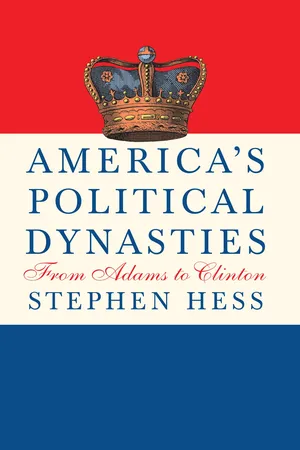
Longtime presidential historian Stephen Hess offers an encyclopedic tour of the families that have loomed large over America's political history.
Starting with John Adams, who served as the young nation's first vice president and earned the nickname ""His Rotundity,"" Hess paints the portraits of the men and women who, by coincidence, connivance, or sheer sense of duty, have made up America's political elite. There are the well-known dynasties such as the Roosevelts and the Kennedys, and the names that live on only in history books, such as the Bayards (six generations of U.S. senators) and the Breckinridges (a vice president, two senators, and six representatives).
Hess fills the pages of America's Political Dynasties with anecdotes and personality-filled stories of the families who have given the United States more than a fair share of its presidents, senators, governors, ambassadors, and cabinet members.
This book also tells us the stories of the Bushes and what looks to be a political dynasty in waiting, the Clintons. Emblematic of America's growing diversity, Hess also examines how women, along with ethnic and racial minorities, have joined the ranks of dynastic political families.
- 800 pages
- English
- ePUB (mobile friendly)
- Available on iOS & Android
eBook - ePub
About this book
Information
NOTES

The Adams Dynasty
1. Quoted in William Manchester, Portrait of a President: John F. Kennedy in Profile (Boston: Little, Brown, 1962), p. 218.
2. Henry Cabot Lodge Sr., memorial address, November 17, 1915, published with Charles Francis Adams Jr., in An Autobiography (Boston: Houghton Mifflin, 1916), p. xiii.
3. Lodge, memorial address, in An Autobiography, p. 30.
4. Quoted in Ferris Greenslet, The Lowells and Their Seven Worlds (Boston: Houghton Mifflin, 1946), p. 415.
5. John Quincy Adams, Memoirs (Philadelphia: J. B. Lippincott, 1874–77), vol. 4, p. 388.
6. Quoted in Martin B. Duberman, Charles Francis Adams (Boston: Houghton Mifflin, 1961), p. 143.
7. See also George W. Corner, ed., The Autobiography of Benjamin Rush (Princeton University Press, 1948), pp. 255–56. Rush, a good friend of John Adams and a fellow signer of the Declaration of Independence, dined with John Quincy Adams on September 10, 1801, and wrote: “Mr. J. Q. Adams was very entertaining. [He said] that temperance in eating was very common [in Prussia], that 6 persons had died at table while he was in Berlin of appoplexy, and one at a dance, a young man of 21, from too tight cloathes, especially a cravat tied round his neck by his servant.”
8. J. Q. Adams, Memoirs, vol. 7, pp. 331–36.
9. Quoted in Samuel Flagg Bemis, John Quincy Adams and the Union (New York: Knopf, 1956), p. 139n.
10. Cleveland Amory, The Proper Bostonians (New York: Dutton, 1947), p. 144.
11. Henry Adams, The Education of Henry Adams (New York: Modern Library, 1931), p. 21.
12. The remark predates Charles Francis Adams. Charles II said of Prince George of Denmark, “I have tried George drunk and I have tried him sober, and drunk or sober, there is nothing in him!” See John A. Garraty, Henry Cabot Lodge (New York: Knopf, 1953), p. 14n.
13. During the presidential campaign of 1828, John Quincy Adams's opponents added up his compensations, salary, and allowance for eight years of diplomatic service. He had received about $12,500 a year, which proved conclusively that he had grown fat at the public trough. See Bemis, John Quincy Adams and the Union, p. 134.
14. In his diary, Minister Adams suggests the cost of being accredited to the imperial court of Tsar Alexander: “We have a maitre d'hotel, or steward; a cook, who has under him two scullions—mujiks; a Swiss, or porter; two footmen; a mujik to make the fires; a coachman and postillion; and Thomas, the black man, to be my valet-de-chambre; Martha Godfred, the maid we brought with us from America; a femme-de-chambre of Mrs. Adams, a housemaid and a laundry-maid. The Swiss, the cook, and one of the footmen are married, and their wives all live in the house. The steward has two children, and the washerwoman a daughter, all of whom are kept in the house.” John Quincy Adams later fired the cook, engaged a caterer to furnish dinners, and somehow managed to live within his modest means. See J. Q. Adams, Memoirs, vol. 2, p. 193.
15. Quoted in Arthur F. Beringause, Brooks Adams (New York: Knopf, 1955), pp. 189–90.
16. Quoted in Page Smith, John Adams (Garden City, N.Y.: Doubleday, 1962), p. 915.
17. Ibid., p. 857.
18. Quoted in Ernest Samuels, The Young Henry Adams (Harvard University Press, 1948), pp. 183, 184. Italics added.
19. Quoted in Bemis, John Quincy Adams and the Union, p. 136.
20. Lodge, memorial address, in An Autobiography, p. xv.
21. Quoted in Bemis, John Quincy Adams and the Union, pp. 192–93n.
22. Quoted in Smith, John Adams, p. 992.
23. When the first Henry Cabot Lodge was a young man, he visited the Adams home at Quincy and wrote in his diary: “I mooned over a lovely portrait of J. Adams daughter. If she looked like her picture everyone must have fallen in love with her straightway. I did. Grew profoundly jealous of her husband Col. Smith on the opposite [wall] and longed to write verses to her…. I acquired a solid hate for Smith. Common name to give such a lovely woman.” Quoted in Garraty, Henry Cabot Lodge, pp. 39–40. Also see Lida Mayo, “Miss Adams in Love,” American Heritage, February 1965, pp. 36–39, 80–89.
24. Quoted in Duberman, Charles Francis Adams, p. 22.
25. Quoted in Samuel Flagg Bemis, John Quincy Adams and the Foundations of American Foreign Policy (New York: Knopf, 1949), p. 85.
26. Quoted in Bemis, John Quincy Adams and the Union, p. 116.
27. Ibid., p. 180.
28. Ibid., p. 183n.
29. Ibid., p. 189.
30. Quoted in Smith, John Adams, p. 850.
31. Ibid., p. 838.
32. Ibid., p. 298.
33. Ibid., p. 333.
34. Woody Holton, Abigail Adams (Glencoe, Ill.: Free Press, 2009), pp. 141–55.
35. Smith, John Adams, pp. 174–75.
36. Ibid., pp. 262–63.
37. Ibid., pp. 183–84.
38. Ibid., pp. 268–69.
39. Ibid., p. 966.
40. Quoted in James Truslow Adams, The Adams Family (Boston: Little, Brown, 1930), p. 85.
41. Quoted in Smith, John Adams, p. 844.
42. When John Quincy Adams was minister to Russia he took with him his sister Abby's son William Steuben Smith; in Great Britain, his assistant was another nephew, John Adams Smith. His own son John was his private secretary when he was president. In the next generation, Charles Francis Adams made his son Henry his secretary when he was a congressman and minister to Great Britain, and took son Brooks with him to Geneva for the Alabama claims arbitration.
43. Quoted in Bemis, John Quincy Adams and the Foundations of American Foreign Policy, p. 63.
44. Quoted in Frank Van Der Linden, The Turning Point (Washington: Luce, 1962), pp. 26–27.
45. Quoted in Bemis, John Quincy Adams and the Foundations of American Foreign Policy, pp. 88–89.
46. The president had John Quincy bypass the secretary of state and report directly to him on sensitive matters. “I wish you to continue the practice of writing freely to me, and cautiously to the office of State,” he told his diplomat son. Ibid., p. 91.
47. Quoted in Van Der Linden, The Turning Point, p. 219.
48. Quoted in Smith, John Adams, p. 1057.
49. See Bemis, John Quincy Adams and the Foundations of Amer...
Table of contents
- Cover Page
- Title Page
- Copyright Page
- Dedication Page
- Contents
- Acknowledgments
- One - The Dynastic Impulse
- Two - The Adams Dynasty
- Three - The Lee Dynasty
- Four - The Livingston Dynasty
- Five - The Washburn Dynasty
- Six - The Muhlenberg Dynasty
- Seven - The Roosevelt Dynasty
- Eight - The Harrison Dynasty
- Nine - The Breckinridge Dynasty
- Ten - The Bayard Dynasty
- Eleven - The Taft Dynasty
- Twelve - The Frelinghuysen Dynasty
- Thirteen - The Tucker Dynasty
- Fourteen - The Stockton Dynasty
- Fifteen - The Long Dynasty
- Sixteen - The Lodge Dynasty
- Seventeen - The Kennedy Dynasty
- Eighteen - The Bush Dynasty
- Nineteen - The Clinton Dynasty
- Epilogue - Ending in Mid-Sentence
- Notes
- Appendix: Notable American Political Families
- Index
- About the Author
- Back Cover
Trusted by 375,005 students
Access to over 1.5 million titles for a fair monthly price.
Study more efficiently using our study tools.
Frequently asked questions
Yes, you can cancel anytime from the Subscription tab in your account settings on the Perlego website. Your subscription will stay active until the end of your current billing period. Learn how to cancel your subscription
No, books cannot be downloaded as external files, such as PDFs, for use outside of Perlego. However, you can download books within the Perlego app for offline reading on mobile or tablet. Learn how to download books offline
Perlego offers two plans: Essential and Complete
- Essential is ideal for learners and professionals who enjoy exploring a wide range of subjects. Access the Essential Library with 800,000+ trusted titles and best-sellers across business, personal growth, and the humanities. Includes unlimited reading time and Standard Read Aloud voice.
- Complete: Perfect for advanced learners and researchers needing full, unrestricted access. Unlock 1.5M+ books across hundreds of subjects, including academic and specialized titles. The Complete Plan also includes advanced features like Premium Read Aloud and Research Assistant.
We are an online textbook subscription service, where you can get access to an entire online library for less than the price of a single book per month. With over 1.5 million books across 990+ topics, we’ve got you covered! Learn about our mission
Look out for the read-aloud symbol on your next book to see if you can listen to it. The read-aloud tool reads text aloud for you, highlighting the text as it is being read. You can pause it, speed it up and slow it down. Learn more about Read Aloud
Yes! You can use the Perlego app on both iOS and Android devices to read anytime, anywhere — even offline. Perfect for commutes or when you’re on the go.
Please note we cannot support devices running on iOS 13 and Android 7 or earlier. Learn more about using the app
Please note we cannot support devices running on iOS 13 and Android 7 or earlier. Learn more about using the app
Yes, you can access America's Political Dynasties by Stephen Hess in PDF and/or ePUB format, as well as other popular books in History & North American History. We have over 1.5 million books available in our catalogue for you to explore.