Burma had the brightest prospects of any Southeast Asian nation after World War II. In the years since, however, it has dropped to the bottom of the world's socioeconomic ladder. The grossly misruled nation—officially known as Myanmar—is in the midst of a political transition based on a new constitution and its first multiparty elections in twenty years. That transition, together with a recent change in U.S. policy, prompted this book.
Two military dictators have ruled Myanmar with an iron fist for nearly fifty years. A popular uprising in 1988 was brutally suppressed, but it forced the generals to hold an election in 1990. When an anti-regime party led by Nobel Peace Prize Laureate Aung San Suu Kyi won by a landside, however, the generals rejected the results, put Suu Kyi under house arrest for most of two decades, and continued to exploit the country's abundant resources for their own benefit while depriving citizens of basic services. Years of Western sanctions had no measurable impact, but in 2009 the Obama administration adopted a new policy of ""pragmatic engagement,"" encouraging greater respect of democratic principles and human rights as a basis for eventual removal of sanctions.
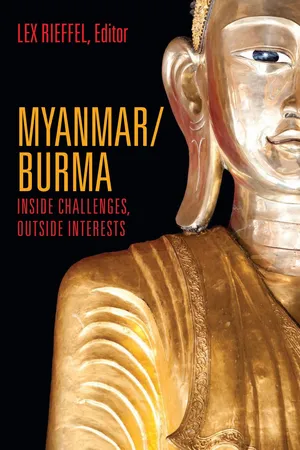
This thoughtful volume examines Burma today primarily through the eyes of its ASEAN partners, its superpower neighbors China and India, and its own people. It provides insights into the overarching problem of national reconciliation, the strategic competition between China and India, the role of ASEAN, and the underperforming, resource-cursed economy.
Contributors include Pavin Chachavalpongpun (Institute of Southeast Asian Studies, Singapore), Termsak Chalermpalanupap (ASEAN Secretariat, Jakarta), David Dapice (Tufts University), Xiaolin Guo (Institute for Security & Development Policy, Stockholm), Gurmeet Kanwal (Centre for Land Warfare Studies, New Delhi), Kyaw Yin Hlaing (City University of Hong Kong), Li Chenyang (Institute of Southeast Asian Studies and Yunnan University, Kunming), Andrew Selth (Griffith University, Brisbane), Michael Vatikiotis (Henry Dunant Centre for Humanitarian Dialogue, Singapore), Maung Zarni (London School of Economics)
- 234 pages
- English
- PDF
- Available on iOS & Android
eBook - PDF
About this book
Information
Table of contents
- Front Cover
- Copyright Information
- Table of Contents
- Foreword
- Acknowledgments
- A Note on the Name of the Country
- Political Timeline
- Administrative Divisions of the Republic of the Union of Myanmar according to the 2008 Constitution
- Administrative Map of Myanmar/Burma according to the 2008 Constitution
- The Moment
- Part I: Inside Challenges
- Problems with the Process of Reconciliation
- An Inside View of Reconciliation
- Recapitalizing the Rural Economy
- Boom on the Way from Ruili to Mandalay
- Three Scenarios for Myanmar's Future
- Part II: Outside Interests
- The Policies of China and India toward Myanmar
- A Strategic Perspective on India-Myanmar Relations
- ASEAN's Policy of Enhanced Interactions
- The Last Bus to Naypyidaw
- Myanmar, North Korea, and the Nuclear Question
- The New U.S. Policy of Pragmatic Engagement
- About the Contributors
- Index
- Back Cover
Trusted by 375,005 students
Access to over 1.5 million titles for a fair monthly price.
Study more efficiently using our study tools.
Frequently asked questions
Yes, you can cancel anytime from the Subscription tab in your account settings on the Perlego website. Your subscription will stay active until the end of your current billing period. Learn how to cancel your subscription
No, books cannot be downloaded as external files, such as PDFs, for use outside of Perlego. However, you can download books within the Perlego app for offline reading on mobile or tablet. Learn how to download books offline
Perlego offers two plans: Essential and Complete
- Essential is ideal for learners and professionals who enjoy exploring a wide range of subjects. Access the Essential Library with 800,000+ trusted titles and best-sellers across business, personal growth, and the humanities. Includes unlimited reading time and Standard Read Aloud voice.
- Complete: Perfect for advanced learners and researchers needing full, unrestricted access. Unlock 1.5M+ books across hundreds of subjects, including academic and specialized titles. The Complete Plan also includes advanced features like Premium Read Aloud and Research Assistant.
We are an online textbook subscription service, where you can get access to an entire online library for less than the price of a single book per month. With over 1.5 million books across 990+ topics, we’ve got you covered! Learn about our mission
Look out for the read-aloud symbol on your next book to see if you can listen to it. The read-aloud tool reads text aloud for you, highlighting the text as it is being read. You can pause it, speed it up and slow it down. Learn more about Read Aloud
Yes! You can use the Perlego app on both iOS and Android devices to read anytime, anywhere — even offline. Perfect for commutes or when you’re on the go.
Please note we cannot support devices running on iOS 13 and Android 7 or earlier. Learn more about using the app
Please note we cannot support devices running on iOS 13 and Android 7 or earlier. Learn more about using the app
Yes, you can access Myanmar/Burma by Lex Rieffel, Alexis Rieffel in PDF and/or ePUB format, as well as other popular books in Politics & International Relations & Indian & South Asian History. We have over 1.5 million books available in our catalogue for you to explore.