A Brookings Institution Press and Yale Center for the Study of Globalization publication
The latest report from the Intergovernmental Panel on Climate Change (IPCC) reflects the growing international consensus that the earth's climate is being changed by anthropogenic greenhouse gasses. Evidence presented by the IPCC and others points to the potential for increasingly dangerous weather, new disease outbreaks, regional water shortages, the loss of habitat and species, and other disturbing developments that could have profound social and economic impacts. Opinions on what should be done, however, remain sharply divided within and among countries. Though monumental in its efforts, the Kyoto Protocol has left much to be agreed upon and achieved, with the world's largest emitter of carbon dioxide—the United States—rejecting it.
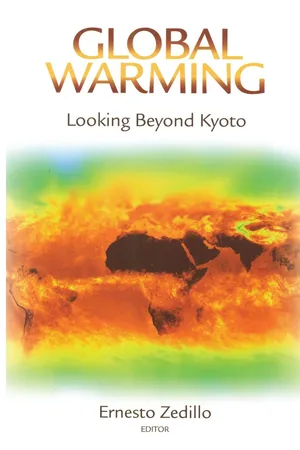
In Global Warming: Looking Beyond Kyoto, some of the best-known and respected authorities in climate policy provide a comprehensive agenda for global collective action. Representing both industrialized and developing nations, the contributors present a thought-provoking examination of the economic, social, and political context of climate policy within their countries. With Kyoto's emissions targets set to expire in 2012, these authors call for a multilateral approach that goes beyond the mitigation-focused Kyoto policies, balancing them with strategies for adaptation. They also stress the importance of generating policies that work within a time frame commensurate with that of climate change itself.
Informed, insightful, and even-handed, this book gives a new impetus to the increasingly important global climate policy debate.
Contributors include R.K. Pachauri (Energy Resources Institute and the IPCC), Richard S. Lindzen (Massachusetts Institute of Technology), Stefan Rahmstorf (Potsdam Institute for Climate Impact Research), Stephen H. Schneider and Thomas Heller (Stanford University), Robert Mendelsohn and William D. Nordhaus (Yale University), Gernot Klepper and Sonja Peterson (Kiel Institute for World Economics), Robert N. Stavins (Harvard University), Alexander Golub (Environmental Defense), Howard Dalton (U.K. Department for Environment, Food and Rural Affairs), John Stone (Carleton University, Ottawa), Jyoti Parikh (Integrated Research and Action for Development), and Shen Longhai (China Energy Conservation Association)
- 250 pages
- English
- PDF
- Available on iOS & Android
eBook - PDF
About this book
Information
Table of contents
- Front Cover
- Title Page
- Copyright Information
- Table of Contents
- Acknowledgments
- Introduction
- Part One: Climate Change Detection and Scenarios: Reexamining the Evidence
- Part Two: Measuring our Vulnerabilities to Climate Change
- Part Three: The Kyoto Protocol: Consequences and Opportunities for Transformation
- Part Four: Alternative Climate Policy Options
- Part Five: Climate Policy in the Industrialized Countries
- Part Six: Linking Climate Change Control and Development Policies
- Contributors
- Index
- Back Cover
Trusted by 375,005 students
Access to over 1.5 million titles for a fair monthly price.
Study more efficiently using our study tools.
Frequently asked questions
Yes, you can cancel anytime from the Subscription tab in your account settings on the Perlego website. Your subscription will stay active until the end of your current billing period. Learn how to cancel your subscription
No, books cannot be downloaded as external files, such as PDFs, for use outside of Perlego. However, you can download books within the Perlego app for offline reading on mobile or tablet. Learn how to download books offline
Perlego offers two plans: Essential and Complete
- Essential is ideal for learners and professionals who enjoy exploring a wide range of subjects. Access the Essential Library with 800,000+ trusted titles and best-sellers across business, personal growth, and the humanities. Includes unlimited reading time and Standard Read Aloud voice.
- Complete: Perfect for advanced learners and researchers needing full, unrestricted access. Unlock 1.5M+ books across hundreds of subjects, including academic and specialized titles. The Complete Plan also includes advanced features like Premium Read Aloud and Research Assistant.
We are an online textbook subscription service, where you can get access to an entire online library for less than the price of a single book per month. With over 1.5 million books across 990+ topics, we’ve got you covered! Learn about our mission
Look out for the read-aloud symbol on your next book to see if you can listen to it. The read-aloud tool reads text aloud for you, highlighting the text as it is being read. You can pause it, speed it up and slow it down. Learn more about Read Aloud
Yes! You can use the Perlego app on both iOS and Android devices to read anytime, anywhere — even offline. Perfect for commutes or when you’re on the go.
Please note we cannot support devices running on iOS 13 and Android 7 or earlier. Learn more about using the app
Please note we cannot support devices running on iOS 13 and Android 7 or earlier. Learn more about using the app
Yes, you can access Global Warming by Ernesto Zedillo in PDF and/or ePUB format, as well as other popular books in Politics & International Relations & Environment & Energy Policy. We have over 1.5 million books available in our catalogue for you to explore.