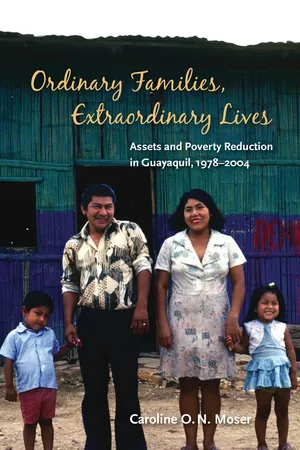
Fifty years after Oscar Lewis's famous depiction of five Mexican families caught in a ""culture of poverty,"" Caroline Moser tells a very different story of five neighborhood women and their families strategically accumulating assets to escape poverty in the Ecuadoran city of Guayaquil. In Ordinary Families, Extraordinary Lives, Moser shows how a more sophisticated understanding of the complexities of asset accumulation as well as poverty itself can help counter inaccurate stereotypes about global poverty. It provides invaluable insight into strategies that may help people in developing countries improve their wellbeing.
The similar socioeconomic characteristics and economic circumstances of the Guayaquil families in 1978, when Moser began her research, set the stage for a natural experiment. By 2004, these circumstances varied widely. Moser captures the causes and consequences of these developments through economic data, anthropological narrative, and personal photos. She then places this compelling story within the broader context of political, economic, and spatial changes in Guayaquil and Ecuador.
Moser describes how households in a Third World urban slum relentlessly and systematically fought to accumulate human, social, and financial capital assets. Her longitudinal account of their odyssey captures long-term trends and changes in perception that are missed in snapshot assessments. Chapters in this holistic story cover diverse issues such as housing and infrastructure, community mobilization and political negotiation, employment, family dynamics, violence, and emigration.
eBook - PDF
Ordinary Families, Extraordinary Lives
Assets and Poverty Reduction in Guayaquil, 1978-2004
- 401 pages
- English
- PDF
- Available on iOS & Android
eBook - PDF
Ordinary Families, Extraordinary Lives
Assets and Poverty Reduction in Guayaquil, 1978-2004
About this book
Information
Table of contents
- Front Cover
- Copyright Information
- Table of Contents
- Acknowledgments
- Prologue
- Introduction to Indio Guayas and the Study
- Grappling with Poverty: From Asset Vulnerability to Asset Accumulation
- A Home of One's Own: Squatter Housing as a Physical Asset
- Social Capital, Gender, and the Politics of Physical Infrastructure
- Leadership, Empowerment, and "Community Participation" in Negotiating for Social Services
- Earning a Living or Getting By: Labor as an Asset
- Families and Household Social Capital: Reducing Vulnerability and Accumulating Assets
- The Impact of Intrahousehold Dynamics on Asset Vulnerability and Accumulation
- Daughters and Sons: Intergenerational Asset Accumulation
- Migration to Barcelona and Transnational Asset Accumulation
- Youth Crime, Gangs, and Violent Death: Community Responses to Insecurity
- Research and Policy Lessons from Indio Guayas
- Appendix A: Research Methodology: Guayaquil Fieldwork
- Appendix B: Guayaquil's Political and Economic Context
- Appendix C: Econometric Methodology
- Notes
- References
- Index
- Back Cover
Trusted by 375,005 students
Access to over 1.5 million titles for a fair monthly price.
Study more efficiently using our study tools.
Frequently asked questions
Yes, you can cancel anytime from the Subscription tab in your account settings on the Perlego website. Your subscription will stay active until the end of your current billing period. Learn how to cancel your subscription
No, books cannot be downloaded as external files, such as PDFs, for use outside of Perlego. However, you can download books within the Perlego app for offline reading on mobile or tablet. Learn how to download books offline
Perlego offers two plans: Essential and Complete
- Essential is ideal for learners and professionals who enjoy exploring a wide range of subjects. Access the Essential Library with 800,000+ trusted titles and best-sellers across business, personal growth, and the humanities. Includes unlimited reading time and Standard Read Aloud voice.
- Complete: Perfect for advanced learners and researchers needing full, unrestricted access. Unlock 1.5M+ books across hundreds of subjects, including academic and specialized titles. The Complete Plan also includes advanced features like Premium Read Aloud and Research Assistant.
We are an online textbook subscription service, where you can get access to an entire online library for less than the price of a single book per month. With over 1.5 million books across 990+ topics, we’ve got you covered! Learn about our mission
Look out for the read-aloud symbol on your next book to see if you can listen to it. The read-aloud tool reads text aloud for you, highlighting the text as it is being read. You can pause it, speed it up and slow it down. Learn more about Read Aloud
Yes! You can use the Perlego app on both iOS and Android devices to read anytime, anywhere — even offline. Perfect for commutes or when you’re on the go.
Please note we cannot support devices running on iOS 13 and Android 7 or earlier. Learn more about using the app
Please note we cannot support devices running on iOS 13 and Android 7 or earlier. Learn more about using the app
Yes, you can access Ordinary Families, Extraordinary Lives by Caroline O.N. Moser in PDF and/or ePUB format, as well as other popular books in Economics & Development Economics. We have over 1.5 million books available in our catalogue for you to explore.