eBook - ePub
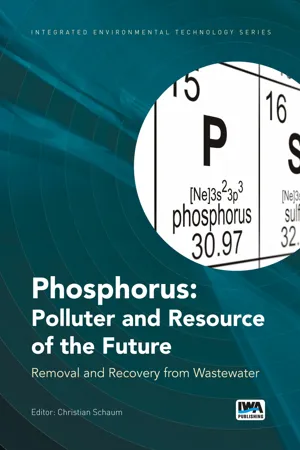
Phosphorus: Polluter and Resource of the Future
Removal and Recovery from Wastewater
- 590 pages
- English
- ePUB (mobile friendly)
- Available on iOS & Android
eBook - ePub
Phosphorus: Polluter and Resource of the Future
Removal and Recovery from Wastewater
About this book
Phosphorus has always been both a curse and a blessing. On the one hand, it is essential for all life forms and cannot be replaced by anything. On the other hand, wastewater treatment aims to minimize phosphorus concentrations in wastewater in order to minimize its discharge into rivers and lakes, where eutrophication caused by high phosphorus concentrations would lead to excessive plant growth. Phosphorus is extracted from rock phosphate deposits, which are finite and non-renewable. And as the issue of resource conservation is the focus of attention worldwide, phosphorus must be used sustainably. This includes recycling of secondary phosphates, efficient extraction and treatment of raw phosphate as well as its efficient use.
The book starts from the peculiarity of the element phosphorus in Part I Phosphorus a special element?, Part II shows the possibilities and limitations of the elimination of phosphorus during the wastewater treatment. Current developments in phosphorus recovery are presented in Part III Phosphorus Recovery - Technology, where also a large number of technology developments are presented in the context of case studies. Part IV "Assessment" shows impulses for future ways. The book concludes with an "Outlook" in Part V.
The book is partially based on the book Phosphorus in Environmental Technology – Principles and Application, edited by Eugina Valsami-Jones and published by IWA Publishing in 2004. Various new technologies have been developed since its release, particularly in the area of phosphorus recovery. Phosphorus: Polluter and Resource of the Future discusses all aspects of both Phosphorus elimination and recovery and summarizes the latest state of Phosphorus recovery technologies.
Information
Subtopic
Applied SciencesIndex
Biological Sciences© IWA Publishing 2018. Christian Schaum Phosphorus: Polluter and Resource of the Future – Removal and Recovery from Wastewater Christian Schaum DOI: 10.2166/9781780408361_001
Part I
Phosphorus – A Special Element
Chapter 1
Phosphorus the pollutant
Paul J. A. Withers1 and Michael J. Bowes2
1Lancaster Environment Centre, Lancaster University, Lancaster LA1 4YQ, UK ([email protected])
2Centre for Ecology and Hydrology, Wallingford, Oxon, OX10 8BB, UK
1.1 INTRODUCTION
Society is currently heavily dependent on an adequate supply of reactive phosphorus (P) for food and bioenergy production, as food additives and in a number of industrial uses ranging from detergents to car batteries. “Reactive P” here is defined as the product of the conversion of mined and relatively inactive phosphate rock into a range of more soluble and active P compounds that increase its bioavailability to crops, animals and humans and for use in industry. In this context, reactive P can be considered analogous to the concept of reactive nitrogen (N) defined by Galloway et al. (2003) as the conversion of atmospheric N2 into biologically, photochemically, and radioactively active N compounds in the Earth’s atmosphere and biosphere. Similarly, MacDonald et al. (2016) recently termed “anthropogenic P” to include any P released to the environment from human actions or management, including application of mineral P fertilisers derived from phosphate rock, and their subsequent redistribution via recycling of manures and human wastes and by soil erosion. Unlike reactive N, there is comparatively little cycling of reactive P in the atmosphere, although recent studies suggest that the amounts, and ecological importance for pristine ecosystems, of the P circulating in mineral dust and combustion aerosols has previously been underestimated (Wang et al., 2015; Stockdale et al., 2016). Most reactive P cycles within the biosphere, where it is a key component of the many biogeochemical processes required for growth and functioning of all organisms, whether it be on land or in water. This has been most amply demonstrated by the contribution that inorganic P fertilisers have made to world food production through the Green Revolution (Stewart et al., 2005), the many uses of reactive P within industry (Schipper, 2014), and the pivotal role that P plays in water, energy and food security (Jarvie et al., 2015). However, while human intervention has increased the availability of P for general societal well-being, this increased availability and reactivity has had a number of cascading and largely unintended adverse consequences for a wide range of ecosystem services valued by society (Withers et al., 2014b; MacDonald et al., 2016). The amount of reactive P being consumed by society has also led to longer-term concerns about the over-exploitation of an essentially finite and expensive resource (Cordell & White, 2014; Mew, 2016).
The vast majority of mined phosphate rock is converted into highly soluble inorganic fertilisers and feeds for use on crop and livestock farms or in aquaculture. These P inputs are inefficiently used and a large proportion of this added P remains as secondary P on the farm (e.g. stored in the soil or recycled in livestock manures and crop residues) where it is vulnerable to loss in storm run-off to adjacent waterbodies. The remainder is exported off the farm for redistribution as secondary P in food products to urban areas, with further additions of inorganic P for a range of food processing (food additives) and non-food uses (e.g. detergents), (León et al., 2013; Richards et al., 2015). Urban-concentrated P becomes channelled as solid waste to landfill and in municipal and industrial wastewater discharges and urban run-off to rivers, streams, lakes and coastal waters. This linear movement of P from mines to oceans is orders of magnitude greater than the sustainable closed-P-cycles typical of natural ecosystems that modern agriculture has replaced (Carpenter & Bennett, 2011). The widespread dissipation of reactive P throughout the biosphere, and the small amounts recycled (typically <20% of total P inputs, Chowdhury et al., 2014), has led to considerable P wastage and leakage to waterbodies at all stages of the food chain from production to post-consumption. Further dissipation of P to the aquatic environment can be expected under climate change (Michalak, 2016; Ockenden et al., 2016), and as global inputs of reactive P are forecast to increase to meet the growing food demands of an expanding population (Roy et al., 2016; Sattari et al., 2016).
In moderation, P enrichment of water can be beneficial for biodiversity (for example in preserving fish stocks (Anders & Ashley, 2007)), but in the majority of cases it leads to a chain of consequences that results in poor water quality, habitat degradation, reduced biodiversity, loss of amenity value and threats to human health, encompassed by the term eutrophication (Hilton et al., 2006; Smith & Schindler, 2009). Although not directly toxic, P has therefore become regarded as an endemic pollutant of watercourses because of its undesirable effects on the wide range of ecosystem services provided by aquatic ecosystems, and the resulting economic costs and damage of eutrophication. For example, Dodds et al. (2008) estimated that eutrophication is costing society over $2 × 10¹² annually in the USA, while in the UK the capital value of freshwaters (including wetlands and floodplains) to society has recently been estimated at £37 × 109 (Office for National Statistics [ONS] 2016). This P pollution is sourced from both rural and urban landscapes and is delivered over multiple spatial and temporal scales and in a multitude of different forms. Mitigating this pollution while preserving the benefits of reactive P for the food security, ecosystem services and for future generations is one of the major challenges of the 21st century (Elser & Bennett, 2011; Withers et al., 2015b). In this chapter we consider the role of P as a pollutant of water, review the sources, transport and control of P from rural and urban environments and highlight the need for more holistic strategies to improve the efficient and sustainable use of P in our society as a key step towards alleviating the pollution threat.
1.2 PERCEPTIONS OF PHOSPHORUS AS A POLLUTANT
Phosphorus is an essential element that is required by both aquatic flora and fauna to synthesise vital cellular components, such as phospholipid cell membranes, DNA and RNA, and adenosine triphosphate (ATP), which is used for intra-cellular energy transfer. The calcium phosphate mineral, apatite, is a major constituent of bones and teeth and the main ingested form, phytate, has a modulating role in the availability of ...
Table of contents
- Cover
- Half Title
- Title Page
- Copyright Page
- Contents
- About the Editor
- Preface – Phosphorus: Curse and Blessing?
- Part I: Phosphorus – A Special Element
- Part II: Elimination of Phosphorus from Wastewater
- Part IIIa: Phosphorus Recovery: Technology
- Part IIIb: Phosphorus Recovery: Technology
- Part IIIc: Phosphorus Recovery: Assessment
- Part IV: Outlook
- Index
Trusted by 375,005 students
Access to over 1.5 million titles for a fair monthly price.
Study more efficiently using our study tools.
Frequently asked questions
Yes, you can cancel anytime from the Subscription tab in your account settings on the Perlego website. Your subscription will stay active until the end of your current billing period. Learn how to cancel your subscription
No, books cannot be downloaded as external files, such as PDFs, for use outside of Perlego. However, you can download books within the Perlego app for offline reading on mobile or tablet. Learn how to download books offline
Perlego offers two plans: Essential and Complete
- Essential is ideal for learners and professionals who enjoy exploring a wide range of subjects. Access the Essential Library with 800,000+ trusted titles and best-sellers across business, personal growth, and the humanities. Includes unlimited reading time and Standard Read Aloud voice.
- Complete: Perfect for advanced learners and researchers needing full, unrestricted access. Unlock 1.5M+ books across hundreds of subjects, including academic and specialized titles. The Complete Plan also includes advanced features like Premium Read Aloud and Research Assistant.
We are an online textbook subscription service, where you can get access to an entire online library for less than the price of a single book per month. With over 1.5 million books across 990+ topics, we’ve got you covered! Learn about our mission
Look out for the read-aloud symbol on your next book to see if you can listen to it. The read-aloud tool reads text aloud for you, highlighting the text as it is being read. You can pause it, speed it up and slow it down. Learn more about Read Aloud
Yes! You can use the Perlego app on both iOS and Android devices to read anytime, anywhere — even offline. Perfect for commutes or when you’re on the go.
Please note we cannot support devices running on iOS 13 and Android 7 or earlier. Learn more about using the app
Please note we cannot support devices running on iOS 13 and Android 7 or earlier. Learn more about using the app
Yes, you can access Phosphorus: Polluter and Resource of the Future by Christian Schaum in PDF and/or ePUB format, as well as other popular books in Biological Sciences & Applied Sciences. We have over 1.5 million books available in our catalogue for you to explore.