eBook - ePub
Available until 23 Dec |Learn more
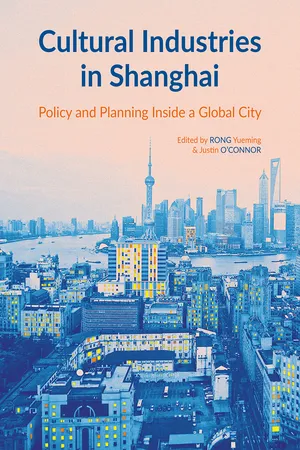
Cultural Industries in Shanghai
Policy and Planning inside a Global City
This book is available to read until 23rd December, 2025
- 500 pages
- English
- ePUB (mobile friendly)
- Available on iOS & Android
eBook - ePub
Available until 23 Dec |Learn more
Cultural Industries in Shanghai
Policy and Planning inside a Global City
About this book
This volume gathers articles by Chinese scholars dealing with developments in Shanghai's cultural industries over the past thirty years. Like many cities in China and elsewhere, Shanghai has explicitly stated that fostering the creative economy is its top economic and political priority over the next decade. This book examines, among other aspects of Shanghai's approach to culture, the effects of this policy focus on the city's creative growth in economic terms.
Frequently asked questions
Yes, you can cancel anytime from the Subscription tab in your account settings on the Perlego website. Your subscription will stay active until the end of your current billing period. Learn how to cancel your subscription.
No, books cannot be downloaded as external files, such as PDFs, for use outside of Perlego. However, you can download books within the Perlego app for offline reading on mobile or tablet. Learn more here.
Perlego offers two plans: Essential and Complete
- Essential is ideal for learners and professionals who enjoy exploring a wide range of subjects. Access the Essential Library with 800,000+ trusted titles and best-sellers across business, personal growth, and the humanities. Includes unlimited reading time and Standard Read Aloud voice.
- Complete: Perfect for advanced learners and researchers needing full, unrestricted access. Unlock 1.4M+ books across hundreds of subjects, including academic and specialized titles. The Complete Plan also includes advanced features like Premium Read Aloud and Research Assistant.
We are an online textbook subscription service, where you can get access to an entire online library for less than the price of a single book per month. With over 1 million books across 1000+ topics, we’ve got you covered! Learn more here.
Look out for the read-aloud symbol on your next book to see if you can listen to it. The read-aloud tool reads text aloud for you, highlighting the text as it is being read. You can pause it, speed it up and slow it down. Learn more here.
Yes! You can use the Perlego app on both iOS or Android devices to read anytime, anywhere — even offline. Perfect for commutes or when you’re on the go.
Please note we cannot support devices running on iOS 13 and Android 7 or earlier. Learn more about using the app.
Please note we cannot support devices running on iOS 13 and Android 7 or earlier. Learn more about using the app.
Yes, you can access Cultural Industries in Shanghai by Yueming Rong, Justin O'Connor, Yueming Rong,Justin O'Connor, YueMing Rong, Justin OConnor in PDF and/or ePUB format, as well as other popular books in Politics & International Relations & Entertainment Industry. We have over one million books available in our catalogue for you to explore.
Information
Edition
1Subtopic
Entertainment IndustryPart 1
Macro Perspectives
Chapter 1
The One Belt, One Road Initiative and the Masterplan of Shanghai’s Cultural Industry1
Hua, Jian
In the second century bc when the Han dynasty ruled over China, its imperial envoy Zhang Qian established a network of routes that paved the way for silk trading, which came to be known later as the ‘Silk Road’. It connected China to the western parts of the world and brought economic prosperity to the region for many centuries thereafter. Over time, this has cultivated the ‘Silk Road Spirit’ of peace and cooperation, openness and inclusiveness, mutual learning and mutual benefits among the countries along the Silk Road and has lasted for thousands of years across many generations.
When President Xi Jinping assumed office in 2013, he proposed a foreign and economic policy called the One Belt, One Road (OBOR) initiative – a modern version of the Silk Road that would further strengthen China’s links with other countries by adding new routes over land and sea. The land component (One Belt) is the Silk Road Economic Belt – the Eurasian Land Bridge that connects China to Europe via Central Asia and Russia, to the Middle East and the Mediterranean via Central and West Asia, and to Southeast Asia, South Asia and the Indian Ocean. The sea component (One Road) is the 21st Century Maritime Silk Road, which aims to develop China’s coastal ports and hubs to connect it to the South Pacific via the South China Sea on one route and to Europe via the South China Sea and Indian Ocean on the other. This initiative is part of China’s national strategy to reinvigorate its opening-up policy, increase its participation in global affairs, position itself better in the world economy, and foster a win-win cooperation from all partner countries (National Development and Reform Commission et al. 2015).
The OBOR Initiative also goes hand in hand with China’s current socio-economic development plan, which is drafted every five years by the Central Committee of the Communist Party of China. This practice is now on its thirteenth cycle and covers the period 2016–20. Its goal is to build a ‘moderately prosperous society’ by maintaining a ‘medium-high’ growth rate and focusing on an innovation-driven development strategy among others (Government of the People’s Republic of China 2016: 10), in time for the centennial celebration of the Communist Party of China (CPC) in 2021. Another key element in the OBOR Initiative is the development plan of the Yangtze River Economic Belt, which involves nine provinces and two municipalities, including Shanghai as a major player in propelling China’s economic transformation and sustaining its growth. As such, Shanghai is looking at how to keep its strategies aligned with the OBOR Initiative and the 13th Five-Year Plan for Economic and Social Development of the People’s Republic of China by boosting its cultural industry and exploring new avenues of cultural exchange. This article suggests three approaches towards the attainment of this vision.
Building a Cultural Innovation Hub
Since the OBOR Initiative revolves around cultural interaction and international relations and cooperation, and the 13th Five-Year Plan is anchored on innovation, Shanghai is set towards building itself as a cultural innovation hub where the world’s cultures meet and interact. There is a need for Shanghai to develop such a strategy to enhance the city’s cultural landscape and allow the city to radiate its influence nationally and globally.
In the past, the fifteenth century was regarded as the ‘Age of Discovery’ because Europeans sailed across the seas to explore a ‘New World’. The period was marked by long-distance voyages and the productivity of capitalism, which made it possible for goods to be put in one big market, as well as for the propagation of western culture, values, religions, market models and political structures. By the end of the Second World War, the West (led by the USA) continued to spread its ideas and belief systems across Asia and Africa, including other parts of the east. This eventually marked the beginning of westernization and the rise of globalization.
In the modern era, China represents the non-western mode of modernization, as its influence in the global community becomes greater. In a way, the OBOR Initiative can be considered as the second ‘Age of Discovery’ because it shares similar objectives with that of the ‘first’ such as exploring new grounds and expanding trade and commerce. The initiative involves 40 countries (and counting) of around four billion people and has an economic aggregate of over RMB 20 trillion. Also part of the initiative is the establishment of integrated infrastructure networks through the creation of economic corridors, which include the China-Mongolia-Russia Economic Corridor and the Bangladesh-China-India-Myanmar Economic Corridor among others. This allows China to highlight the scope of the initiative, the advantage of being a partner country and the benefits it brings to its citizens. The initiative is expected to diminish, if not eliminate, the negative effects of globalization such as the widening gap between the rich and the poor, the economic divide between the West and the East and the unequal regional development. Hence, if the initiative is implemented as planned, it can also end the geographical catastrophe arising from China’s previous economic weakness such as the land secession and estuary degradation in Northeast China. Through the OBOR Initiative, China is poised to become a global superpower by virtue of being connected to two oceans (Pacific Ocean and Indian Ocean) and two continents (Asia and Europe).
From a geo-economic and geo-cultural perspective, the OBOR Initiative and the Yangtze River Economic Belt come with a glorious past that integrates the elements of policy, economy, people’s wellbeing, safety and culture. For instance, the Silk Roads encompass the North Silk Road, South Silk Road, Maritime Silk Road and all the global trade corridors in ancient China, while the Yangtze River Economic Belt has attracted and nurtured many ethnic minority groups, which signifies China’s great civilization, its three major regional cultures (Wuyue, Xiangchu and Bashu provinces) and over ten secondary regional cultures. In September 2014, the State Council released the Guidelines for Promoting the Development of the Yangtze River Economic Belt by Relying on the Golden Waterway and stated that the Yangtze River Economic Belt should become an inland waterway economic belt with a global influence, an area of comprehensive opening-up strategy, and a pilot area for ecological civilization. As a whole, the OBOR Initiative is more than just dots and lines on the map; rather, it is a powerful net that includes the development axes of Chengdu-Xinjiang-Europe, Chongqing-Xinjiang-Europe and Yiwu-Xinjiang-Europe.
With its immense land area, large population, long history and fast development, China is considered as a world power. However, holding such power is not really just about having a number of big cities. If China wants to be a cultural superpower, it needs to develop the areas within the Yangtze River Economic Belt and the places that are part of the OBOR Initiative. It is only through this approach that the cultural industry can be well developed and the power of financial capital, social capital and cultural capital can be fully utilized. Hence, China needs to form a mega-regional joint strategy that is entirely different from the western mode of development. Currently, there is a huge gap between the western and eastern section of the Yangtze River Economic Belt in terms of its development stage and economic strength. For example, Shanghai is located towards the lower end of the Belt and has a per capita GDP of over USD 15,000. This is considered as a medium-developed region based on World Bank definition. Towards the mid-section of the Belt, Hu’nan, Hubei and Anhui provinces have a per capita GDP of USD 6000–7000, which is generally the average in China. And towards the upper part of the Belt, Guizhou and Yunnan provinces have a per capita GDP of USD 3000–5000. This disparity in per capita GDP represents a regional imbalance. However, China’s socialist system enables these regions to be connected as a whole, and thereby releasing substantial resource endowment and market development potentials through industrial transfer and interactive development among the provinces in the Yangtze River area.
In this sense, the combined forces of the OBOR Initiative and the Yangtze River Economic Belt create a dynamic space for cultural industries to flourish and become instrumental to expanding China’s cultural space and making itself a cultural powerhouse. It pertains to the eleven provinces and cities along the Circum-Bohai-Sea: Liaoning, Tianjing, Hebei; the Yellow Sea: Shandong, Jiangsu; the East China Sea: Shanghai, Zhejiang and the South China Sea: Fujian, Guangdong, Guangxi, Hainan. They are also known as the most developed coastal areas that have become an important part of the 21st Century Maritime Silk Road. The second axis is the Eurasian Land Bridge, which represents the left leg of the ‘π’. It traverses the vast lands of East, West and Central China, and connects West Asia, Central Asia and Europe. The bridge starts from Lianyungang city and extends to Jiangsu, Anhui, He’nan, Shanxi, Gansu, Qinghai provinces and the Xinjiang Uygur autonomous region. This axis also covers the Gwadar port and the Indian Ocean, which makes it vital to the construction of an inland economic belt on the 21st Century Maritime Silk Road. The third axis is the Yangtze River Economic Belt, which represents the right leg of the ‘π’. It also covers East, West and Central China, and links eleven coastal provinces and municipalities, namely, Shanghai, Jiangsu, Zhejiang, Anhui, Jiangxi, Hubei, Hu’nan, Sichuan, Chongqing, Guzhou and Yunnan. From Yunnan province, the axis then stretches out to Southeast Asia and the Indian Ocean via the Indo-China Peninsula railway network.
From a bigger perspective, the Yangtze River Delta is the pivot of the three development axes. It is capable of land and marine development, and Shanghai is at its centre. As such, this area should rely on the OBOR Initiative in building itself as an innovation powerhouse and a hub for cultural creativity and start-ups. This way, the development of cultural industry and creative economy will become more intensive and large-scale and will boost regional distribution. These two elements correspond and contribute to the effort of building Shanghai into a global innovation city. Therefore, in aligning Shanghai’s cultural industry with the OBOR Initiative and the Yangtze River Economic Belt, Shanghai needs to anchor its strategies on the three development axes to transform the city as a major contributor to domestic and foreign cultural trade, the driving force of greater cultural productivity and an innovation hub that integrates both local and global resources and markets. In the 1970s for instance, the reason that the ‘Four Asian Tigers’ (Hong Kong, Singapore, South Korea and Taiwan) and other less developed nations were able to rise above the challenge was because of their factor flow with more developed countries. By establishing export-oriented policies and strengthening their development policies, the Four Asian Tigers attracted the industrial transfer of developed economies, introduced foreign capital and technology, mobilized their human capital and took advantage of their strategic locations. The Yangtze River Delta can also adopt the same coordination and mobilization strategies, which will allow the cities and provinces along the Yangtze River Economic Belt to learn from and complement each other. This in turn will enable the region to become a dynamic economic zone and serve as China’s ‘golden waterway’ towards the balanced development of its cultural industry.
In 2008, the World Economic Forum launched the ‘Innovation Heat Map’ that shows where and how innovation clusters develop, the number of city-based patents, diversity of creative activities and their scale of creativity. This tool reveals that the cultural industry and creative economy of an innovation-driven city follows a typical growth pattern of starting small, growing big and then tailing off. For example, it can be seen that there is an agglomeration of innovative activities and creative industry in Silicon Alley in New York and Silicon Valley in California – both with a remarkable growth rate. As the paradise of digital gadgets, web service and audio-visual technology, Silicon Valley covers an area of only 4700 square kilometres and a population of only 3 million, and yet it has empowered the development of communications, computing and the film and television industry, and contributed USD 258 billion to the GDP of the US in 2013. Similarly, Shanghai is considered as an ideal location for introducing innovative activities and developing the creative industries because a large-scale agglomeration of over 20,000 cultural and creative enterprises is available. Moreover, the added value of the cultural and creative industry has an average annual growth rate of 12%, which can promote the development of the Yangtze River Delta city group.
The Delta is China’s main driver for international cultural trade, and Shanghai is the biggest player here. For five consecutive years, Shanghai has maintained a steady trade surplus in cultural goods. One key development in Shanghai’s engagement in international cultural trade was the creation of the Shanghai International Cultural Service and Trade Platform in September 2007. This was renamed later as the National Base for International Cultural Trade (NBICT) by the Ministry of Culture on 27 October 2011. The NBICT aims to support Chinese cultural enterprises in making their brands, products and services more visible in the international market. NBICT is the only entity that offers public services in international cultural trade that operates in the China (Shanghai) Pilot Free Trade Zone (CSPFTZ). Based on the government’s strategic direction, the CSPFTZ was established to revitalize China’s reform and opening-up policy, which includes the opening up of cultural markets in wholly foreign-owned performance brokerage firms, entertainment venues and companies engaged in the production and sale of game consoles and entertainment machines. Proof to this commitment was the establishment of the Shanghai International Artwork Trade Centre, China’s first ever bonded artwork warehouse, which started operations in the NBICT in 2013. Based on the data from NBICT’s investigation and survey in CSPFTZ, the CSPFTZ attracted over 300 companies of international cultural trade by the first half of 2015, with a total registered capital of RMB 8.7 billion and a trade scale of RMB 10 billion. The success of Shanghai’s endeavours has reached Chengdu City (located towards the upper reach of the Belt) in that it also put up the first bonded artwork warehouse in Central and Western China in 2014, carrying the theme ‘China’s artwork goes global, foreign artwork goes local’. This action certainly benefits the cultural industry, as it helps transform the cultural resources in central and western China into cultural products, which will eventually contribute to the region’s development.
Another successful example is the Shanghai Culture Assets and Equity Exchange (SHCAEE), which was established in June 2009. It is the first of its kind and boasts of two state-level platforms – one for cultural assets and equity, and another for investment and financing services. SHCAEE performs three functions: (1) exchange of assets and equity in state-owned cultural enterprises, exchange of intangible property like cultural brands, trademarks, copyright and naming rights, exchange of project financing and property rights in the cultural industry; (2) provision of financing services for cultural enterprises, which include equity transfer, capital increase and stock expansion, introduction by private placement, increasing the chances of being listed, pledge financing and asset leasing and; (3) comprehensive supporting services for the cultural industry, which include establishing and improving evaluation, registration, right confirmation, trusteeship, safekeeping, information disclosure, settlement, authentication, insurance, trust, property protection and credit rating. Later, SHCAEE set up an online platform called Wenfex, which expanded the scope of cultural and financial asset management, internet financial service, online-to-offline (O2O) joint trade and cultural asset management, and resulted in having more cultural goods traded via SHCAEE. It has built a Beijing headquarters with service windows for artwork, ceramic products, ‘stamp, coin, card’ (SCC), gem and jade and emissions trading. Now, it has over 30 centres in China, US, Europe and Hong Kong, eight of which are listed in Forbes top 500 companies and four of which have made it to the top 300 companies. In this sense, SHCAEE is a good case of innovation-centred development that has strengthened the cultural reform in Shanghai and throughout China, and served as a big step towards building Shanghai as a global cultural metropolis and financial centre. As such, there should be more platforms like SHCAEE in Shanghai to generate more influence in the area of cultural assets, equity exchange and financing services locally and internationally.
By keeping Shanghai’s strategies in line with the OBOR Initiative and the Yangtze River Economic Belt, Shanghai can build a cultural hub that bespeaks of China’s global cultural power – one that connects various cultures worldwide and drives cultural innovation forward. Hence, it is imperative that Shanghai makes pioneering, forward-looking and transcendental contributions in cultivating new market players, expanding new space and building an innovation-driven system. However, it is not only about putting in a large amount of innovation resources. It is also about taking command and control in delivering major innovative achievements that are capable of extensive connection with global resources of cultural innovation, resource integration. Specific examples include intensive investment in cultural and technological exploration, international cooperation for global cultural projects, multiple network correlation of cultural innovation, international exchange of key projects and personnel, establishment of more global research and development (R&D) institutes, trade and release of major cultural and technological data and the organization of major international symposia and forums. It will also be beneficial for Shanghai’s cultural industry to apply the learning experience of the West and other BRICS states (Brazil, Russia, India and South Africa) and come up with a better integrated innovation model of development.
Developing Transnational and Export-Oriented Cultural Enterprises
As indicated in the 13th Five-Year Plan, an innovation-driven development is necessary to activate new economic drivers, balance overseas investment and export expansion, establish new strategies for an export-oriented economy through advanced technology, high production standard, brand influence and efficient service that will boost China’s economy. Following the OBOR Initiative framework, Shanghai needs to spearhead the promotion of cultural productivity and the establishment of export-oriented, world-class and transnational cultural companies as the centrepiece of the cultural industry.
Unlike local companies, transnational...
Table of contents
- Cover Page
- Title Page
- Copyright
- Notes on Translation
- Preface by the Chinese Editor
- Preface by the English Editor
- Part 1: Macro Perspectives
- Part 2: Creative Industry Clusters
- Part 3: Development of Cultural Industries
- Notes on Editors, Contributors and Translators
- Notes on Intellect China Library Series