An account of China's transition into a global capitalist economy, as agrarian reform in the 1980s led Chinese peasants to industrial cities and into poverty
In the early 1980s, China undertook a massive reform that dismantled its socialist rural collectives and divided the land among millions of small peasant families. Known as the decollectivization campaign, it is one of the most significant reforms in China's transition to a market economy. From the beginning, the official Chinese accounts, and many academic writings, uncritically portray this campaign as a huge success, both for the peasants and the economy as a whole. This mainstream history argues that the rural communes, suffering from inefficiency, greatly improved agricultural productivity under the decollectivization reform. It also describes how the peasants, due to their dissatisfaction with the rural regime, spontaneously organized and collectively dismantled the collective system.
A closer examination suggests a much different and more nuanced story. By combining historical archives, field work, and critical statistical examinations, From Commune to Capitalism argues that the decollectivization campaign was neither a bottom-up, spontaneous peasant movement, nor necessarily efficiency-improving. On the contrary, the reform was mainly a top-down, coercive campaign, and most of the efficiency gains came from simply increasing the usage of inputs, such as land and labor, rather than institutional changes. The book also asks an important question: Why did most of the peasants peacefully accept this reform? Zhun Xu answers that the problems of the communes contributed to the passiveness of the peasantry; that decollectivization, by depoliticizing the peasantry and freeing massive rural labor to compete with the urban workers, served as both the political and economic basis for consequent Chinese neoliberal reforms and a massive increase in all forms of economic, political, and social inequality. Decollectivization was, indeed, a huge success, although far from the sort suggested by mainstream accounts.
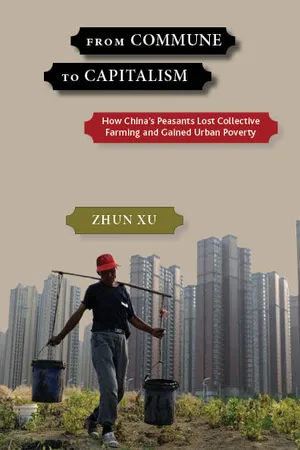
eBook - ePub
From Commune to Capitalism
How China’s Peasants Lost Collective Farming and Gained Urban Poverty
- 224 pages
- English
- ePUB (mobile friendly)
- Available on iOS & Android
eBook - ePub
From Commune to Capitalism
How China’s Peasants Lost Collective Farming and Gained Urban Poverty
About this book
Information
Topic
ÉconomieSubtopic
Politique économique
Socialism and Capitalism in the Chinese Countryside
The nearly seventy-year history of the People’s Republic of China can be roughly divided into two periods: during the first thirty years the PRC mainly followed the socialist path, but in the last four decades China has gradually become a champion of capitalism. As the Chinese maxim says, “Thirtyyears east and then thirty years west,” meaning there is no eternity of ideas, powers, and social relations. The differences between the two eras are more than clear to the Chinese people. In 1949, Mao Zedong, the founder of the republic, proudly announced,“The Chinese people have stood up!” But nowadays, folk wisdom laments,“Work hard for decades, go back to the time before liberation in one night!” Every single aspect of social relations in China is marked by the retrogression from state socialism to capitalism. Everything has seen a great reversal. Red becomes black, noble becomes vulgar—and revolutionary becomes reactionary.
This book investigates some of these changes as they have affected land use and agriculture. In the 1950s, the PRC implemented a program of massive land reform and redistribution. The resulting collectives and people’s communes worked for more than twenty years and made significant contributions to the country’s economic development and to the education and health care of hundreds of millions of people.
In the early 1980s, however, the Chinese Communist Party (CCP) undid much of the previous reform and dismantled the rural collectives, turning them into atomized peasant households while maintaining collective ownership of the land on paper. At the same time, academia and the mainstream media started condemning collective agriculture and praising the post-collective small-producer agriculture—formally called the house responsibility system, or HRS—as an alternative to collectives and capitalist farms. The actual performance of HRS, however, has been mediocre at best. Rural health care and education have clearly deteriorated as a consequence of decollectivization. Gains in agricultural production since the 1980s have been rather limited, and the gap between the urban and rural economies has become much larger than it was thirty years ago. Recent evidence also suggests that land consolidation and capitalist farms have developed rapidly in recent years, with the open endorsement of the CCP itself.1
Agrarian relations in China seem to have come full circle in just a few decades. The obvious question is, why? What historical forces led to a rapid decollectivization and a gradual path to capitalist agriculture after twenty years of collectives?
A simple but not uncommon explanationis the power struggles of the CCP leaders: the organization of agriculture in China is largely the result of the personal beliefs and triumphs of Mao Zedong and Deng Xiaoping and their respective allies.2 These studies correctly point to the close link between CCP politics and agrarian change. However, they tend to focus entirely on individual political figures and their pursuit of power, which often leads to no more than detailed descriptions of palace intrigues.
Most existing studies look at the systemic changes in Chinese agriculture only through the lens of Chinese history, implicitly assuming a kind of Chinese exceptionalism. Such a narrow focus weakens our understanding of the significance of these changes. This book provides an alternative approach: placing the power struggles of the leadership and the consequent agrarian changes in China within the context of systemic changes that were happening concurrently throughout the globe. Analyzing the historical context does not necessarily imply a causal relationship; rather it shows that when countries face the same agrarian questions and constraints, they choose solutions that suggest certain general patterns.
As chapter 2 argues, recent trends in China have been more or less the same as in the rest of the world. The first three quarters of the twentieth century were marked by revolutionary changes in social relations. The driving forces were twofold: the worldwide socialist movement, beginning with the Mexican Revolution of 1910 and the Russian Revolution of 1917, and the national independence movement that followed the Second World War. The last quarter, however, was characterized by worldwide waves of privatization and deregulation, which are sometimes referred to as neoliberalism. Agrarian relations reflected these changes globally: in the first phase they tended to be more peasant-oriented, but in the second phase the peasant-capitalist compromise that existed in many nations came to an end. All the countries that had previously adopted progressive agrarian reforms stepped back and undid small or large portions of those reforms.
During the twentieth century, several different solutions to the organization of agrarian social relations existed. The capitalist and socialist paths are the obvious ones, but the populist small-producer path was also important.
Many developing countries started to address the agrarian question by choosing noncapitalist paths in the first phase. Most of them at least tried to guarantee peasants’ access to the land, and many enacted redistributive land reforms or even encouraged collectivization to build socialism. However, these countries started to move to the capitalist path in the second phase.
How does this framework help us understand the Chinese situation? Actually, there were very different answers to the agrarian question within the CCP. Three major debates on the agrarian question took place during the 1950s and 1960s. The first debate was between the socialist solution and the capitalist one, while the second debate was between the socialist and the populist small-producer paths. In the end, and third, the factions in favor of the capitalist and populist paths joined forces against the socialist faction in the CCP. What we can observe is that the anti-socialist coalition always had significant political power, so Mao’s intervention and his personal charisma and authority played a crucial role in the pursuit of the socialist path in China. But after Mao’s death, the anti-socialist coalition faced no more political obstacles. They soon took power and abandoned the socialist agrarian policies. In recent decades, the political and academic mainstream in China and in many third-world countries has managed to take socialism off the agenda. Now the neoliberal capitalist program (the right) and an essentialist populist program (the left) occupy the political stage.
Gone is a class-based analysis. Instead, the mainstream has provided a sophisticated and highly influential theoretical framework for understanding the historical changes in the countryside, built around two key concepts: efficiency and spontaneity. First, the literature argues, the Chinese rural collectives suffered from inefficiency, and decollectivization greatly improved agricultural productivity.3 The 1959–1961 famine is sometimes cited as an important factor to explain the need for decollectivization.4 And second, because of their dissatisfaction with the rural regime, the peasants spontaneously organized and collectively dismantled the old system.5 This narrative fits nicely in the hegemonic neoliberal ideology, which emphasizes the holy connection between individual “free choice” and spontaneous order and economic efficiency. And it has become part of the cornerstone of mainstream ideology in China.
My own research, however, shows that these stories are often unreliable and misleading. On the efficiency question, let us take grain production as an example. The grain yield grew at 2.79 percent annually between 1956 and 1980, which was the collective period; but it only grew 1.09 percent between 1984 and 2008, in the post-collective period.6 There was indeed a famine in the late 1950s and early 1960s; however, this did not necessarily mean the collectives were inefficient. In fact, annual grain production grew at 3.44 percent per annum during the prefamine collectivization years of 1953 to 1958.7 After the famine, grain production regained pre-famine levels by 1965. The annual grain production growth rate between 1965 and 1978 was 3.51 percent.8 The famine, occurring twenty years before the period of decollectivation, hardly served as a cause for the end of a well-functioning system.
A more nuanced and often technical version of the efficiency story emphasizes that the transition from collective to household itself produced great efficiency gains. That is, there is a cause and effect relationship at work. One of the most widely cited sources for this version comes from Justin Lin, a leading proponent of market-oriented reform who later became chief economist at the World Bank. Lin’s research, employing long-term panel data at the province level, argued that almost half of the increase in output during the transition period was due to decollectivization. In chapter 3, I critically review the literature and in particular replicate Lin’s research model. After adjusting for some simple data errors, Lin’s main results totally disappear; the new results suggest that the impacts from decollectivization are negligible. I then argue that the legacy from socialist agriculture accounts for the most important part of the success of the transition period and has had a long-term positive impact on agricultural development even after decollectivization.9
On the spontaneity question, a widespread belief is that the collectives were inefficient, so the peasants themselves dissolved their own collectives. Even leaving the question of efficiency aside, this view is in immediate conflict with the very logic of decollectivization. As Bramall argued, if the peasants could organize their decollectivization in the way they are said to have done, then collective agriculture would have been a huge success and there would be no need for decollectivization.10 To be fair, this is not to deny that there were singular cases of decollectivization in small groups; nevertheless, it is simply ahistorical to explain the majority of cases in this way.
My research in chapter 4 shows that the CCP was enthusiastic rather than passive in promoting the household model. The cadres faced immense political pressure to follow the guidelines of the central leadership. The mainstream view holds that those people who opposed decollectivization were local cadres who were afraid of losing control. But my research suggests that the cadres and a small section of the peasantry implemented and benefited from decollectivization, while most of the peasants were not enthusiastic, and even opposed decollectivization in some cases.
Based on the evidence, I argue that decollectivization served as the political basis for the capitalist transition in China, in that it not only disempowered the peasantry but also broke the peasant-worker alliance and greatly reduced the potential resistance to the reform. The political significance of rural reform for the CCP cannot be overstated, and this was exactly why the mainstream interpreted decollectivization as spontaneous.
But if decollectivization was not driven by efficiency and spontaneity, why did it eventually succeed without major resistance? What were the internal contradictions of the rural collective regime that facilitated (if not “led to”) its demise?
My fieldwork in Songzi County, documented in chapter 5, offers insights on this question. I find that rural collectives had remarkable achievements. Many of them did experience shirking (work avoidance) and inefficiency, not because of egalitarianism but because of stratification—because of a cadre-peasant, manager-worker divide. The actual demise of rural collectives was mostly due to political pressure from the Communist Party. But the stratification contributed to peasants’ passiveness in resisting the institutional change.
Stratification was at the root of unsatisfactory performance and was the focus of peasants’ complaints during the collective era. Decollectivization, on the contrary, seemed to be able to destroy stratification by destroying the whole collective, which, in turn, sometimes generated better performance in what had been dysfunctional collectives. That was probably one of the most important reasons why most peasants accepted the new policy without serious opposition. The rising income due to the procurement price adjustment probably also contributed to peasants’ faith in the new policies. Certainly, other factors, like propaganda efforts from the cadres, should not be overlooked.
But was decollectivization a genuine solution to the stratification? Logically, stratification is not an integral aspect of collectives per se. In fact, the socialist element of the collectives put some constraint on stratification, at least on income distribution, but there were no such restrictions once it was dismantled: decollectivization disempowered the peasantry and allowed even greater and more explicit stratification and eventually class division.
Taking all these factors together, this book provides an alternative framework for analyzing the dramatic transition from communes to capitalism in the Chinese countryside. I hope this discussion will be useful to anyone who is willing to learn from the great history of socialism, humanity’s efforts to end what we might call our prehistory.
Chinese Agrarian Change in World-Historical Context
INTRODUCTION
The twentieth century was an age of both revolution and counterrevolution. The first three quarters of the century saw revolutionary changes in social relations, mainly driven by the worldwide socialist movement that spread after the founding of the Soviet Union in 1917 and by the national independence movement that erupted after the Second World War. The last quarter was characterized by worldwide waves of privatization and deregulation, sometimes referred to as neoliberalism. This dramatic cycle shaped many crucial aspects of social relations in the contemporary world, in particular the trajectories of agrarian change.
After the Second World War, many countries implemented agrarian reforms that sought to protect peasants to varying degrees from landlords and usurers. One key element of these policies was redistributive land reform. In some places—for example, South Korea and Taiwan—“land to the tiller” was implemented. Land redistribution was relatively well enforced, and most peasants became small commodity producers. In other countries, like Peru and Chile, agriculture was even partly collectivized. Countries like Egypt, with no significant land reform, at least tried to put a cap on land rent and place restrictions on the size of individual landholdings. In socialist states like China and Cuba, the agrarian reforms included collectivization—collective ownership of the land by the peasants—partly to prevent potential class differentiation in the new peasantry.
This period has been called “the Golden Age of land reform.”1 These agrarian reforms were unprecedented in human history, both in scale and in content. One of the crucial features of agrarian ref...
Table of contents
- Cover
- Title Page
- Copyright
- Contents
- Preface
- 1— Socialism and Capitalism in the Chinese Countryside
- 2— Chinese Agrarian Change in World-Historical Context
- 3— Agricultural Productivity and Decollectivization
- 4— The Political Economy of Decollectivization
- 5— The Achievement, Contradictions, and Demise of Rural Collectives
- Epilogue
- Appendix 1
- Appendix 2
- Bibliography
- Notes
- Index
Trusted by 375,005 students
Access to over 1.5 million titles for a fair monthly price.
Study more efficiently using our study tools.
Frequently asked questions
Yes, you can cancel anytime from the Subscription tab in your account settings on the Perlego website. Your subscription will stay active until the end of your current billing period. Learn how to cancel your subscription
No, books cannot be downloaded as external files, such as PDFs, for use outside of Perlego. However, you can download books within the Perlego app for offline reading on mobile or tablet. Learn how to download books offline
Perlego offers two plans: Essential and Complete
- Essential is ideal for learners and professionals who enjoy exploring a wide range of subjects. Access the Essential Library with 800,000+ trusted titles and best-sellers across business, personal growth, and the humanities. Includes unlimited reading time and Standard Read Aloud voice.
- Complete: Perfect for advanced learners and researchers needing full, unrestricted access. Unlock 1.5M+ books across hundreds of subjects, including academic and specialized titles. The Complete Plan also includes advanced features like Premium Read Aloud and Research Assistant.
We are an online textbook subscription service, where you can get access to an entire online library for less than the price of a single book per month. With over 1.5 million books across 990+ topics, we’ve got you covered! Learn about our mission
Look out for the read-aloud symbol on your next book to see if you can listen to it. The read-aloud tool reads text aloud for you, highlighting the text as it is being read. You can pause it, speed it up and slow it down. Learn more about Read Aloud
Yes! You can use the Perlego app on both iOS and Android devices to read anytime, anywhere — even offline. Perfect for commutes or when you’re on the go.
Please note we cannot support devices running on iOS 13 and Android 7 or earlier. Learn more about using the app
Please note we cannot support devices running on iOS 13 and Android 7 or earlier. Learn more about using the app
Yes, you can access From Commune to Capitalism by Zhun Xu in PDF and/or ePUB format, as well as other popular books in Économie & Politique économique. We have over 1.5 million books available in our catalogue for you to explore.