Moonlight, Magnolias, and Madness is a social history of the perceptions and treatment of the mentally ill in South Carolina over two centuries. Examining insanity in both an institutional and a community context, Peter McCandless shows how policies and attitudes changed dramatically from the colonial era to the early twentieth century. He also sheds new light on the ways sectionalism and race affected the plight of the insane in a state whose fortunes worsened markedly after the Civil War. Antebellum asylum reformers in the state were inspired by many of the same ideals as their northern counterparts, such as therapeutic optimism and moral treatment. But McCandless shows that treatment ideologies in South Carolina, which had a majority black population, were complicated by the issue of race, and that blacks received markedly inferior care. By re-creating the different experiences of the insane — black and white, inside the asylum and within the community — McCandless highlights the importance of regional variation in the treatment of mental illness.
eBook - ePub
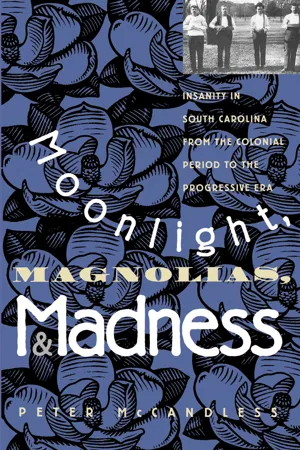
Moonlight, Magnolias, and Madness
Insanity in South Carolina from the Colonial Period to the Progressive Era
- 424 pages
- English
- ePUB (mobile friendly)
- Available on iOS & Android
eBook - ePub
Moonlight, Magnolias, and Madness
Insanity in South Carolina from the Colonial Period to the Progressive Era
About this book
Information

PART ONE
Before
the
Asylum
the
Asylum
1670 – 1828
One
OUT OF HER SENSES
INSANITY IN EARLY SOUTH CAROLINA
For months, Kate’s neighbors along the Santee River had considered her dangerously mad. Thus, they were probably not surprised to hear in June 1745 that this slave woman had murdered a black child. The Craven County authorities lodged her in jail, where her actions convinced the justices of the peace that she was indeed “out of her Senses.” Because they deemed her irresponsible, they did not bring her to trial. But they did not know what to do with her. They did not want to release her, because they considered her dangerous. But Kate’s owner, Robert Fullwood, was too poor to pay for her confinement, and the colony of South Carolina made no provision for the public maintenance of slaves. The justices remanded Kate to jail and petitioned the colonial assembly in Charleston for relief and advice. The assembly refused their request for remuneration. Instead it passed an act that made each parish in the colony responsible for the maintenance of lunatic slaves whose owners were unable to care for them.1
Kate’s story may seem a strange place to begin a history of insanity in South Carolina. English settlers had founded the colony seventy-five years earlier, and even discounting native Americans, hers was not South Carolina’s first case of insanity. Yet there are several reasons for beginning with Kate. Her predicament (or that of the Craven County justices) prompted the first law in the state’s history that dealt specifically with the care of the insane. That the act dealt only with insane slaves was significant and, in a sense, fitting.
By the early eighteenth century, blacks made up a majority of the colony’s population. Their numbers and skills went far to shape the nature of South Carolina’s culture. Yet the colonial government had never made any provision for their care when attacked by insanity. Until Kate’s case, the colony’s laws assumed that masters were responsible for the control and care of their slaves; a law of 1717 provided for a fine of twenty pounds for any master who turned out a sick or disabled servant.2 The act of 1745 remedied, on paper at least, a flaw in that assumption: some masters, like Fullwood, might be unable to control or care for an unproductive slave.
The act was also significant in what it did not do: it did not lead to any general reassessment of public policy toward the mentally disordered. The assembly did not perceive insanity as a widespread problem. The colony’s population was low, and its inhabitants were scattered about the countryside on plantations and farms. Charleston was the only town of consequence well into the nineteenth century.3 Only rarely, as in a case like Kate’s, did the insane intrude upon the public consciousness. The insane were few, and the authorities were satisfied with the existing mechanisms for dealing with them.
Governmental interference in the care of the insane before the nineteenth century was minimal. But it does not follow that they were generally abandoned to brutality and neglect, as many historians would have it. In the 1930s Albert Deutsch characterized colonial provision for the mentally disordered as a mixture of “punishment, repression, and indifference.”4 Evidence regarding the insane of early South Carolina is ambiguous and sketchy; but much of it points to a more complex reality, closer to Roy Porter’s remark about the fate of the insane in Georgian England: it depended “on who you were, and where you were and who was treating you.”5
A variety of social, racial, geographical, and medical circumstances influenced the care and treatment lunatics received. Perhaps none was more important than their domestic situation, for nearly everyone viewed the insane as primarily a private, familial responsibility. If a family had the means to do so, they were expected to care for their insane themselves. For such families, the main options were home care or boarding out with another family. Planter families sometimes assigned a slave to care for an insane relative. Ann Richardson awarded her slave Sam his freedom in 1810 as a reward for several years’ devoted care of her deranged son Manley.6 If an insane person had no family, or his family was unable or unwilling to care for him, sympathetic private citizens sometimes accepted the familial role. When a ship’s captain named Bernard became “disorder’d in his head” in 1744, Charleston merchant Robert Pringle provided him with a lodging in town and medical care. Reverend Francis Guichard took the deranged shopkeeper Peter Calvett into his own home in 1751.7
An insane person for whom no one took responsibility might be left alone as long as he or she did not appear to threaten public safety or tranquility. Documented cases of wandering lunatics, however, are surprisingly few in the early records of South Carolina. Whether this was because they were rare or because they did not arouse much public concern is not clear. Samuel Farrow was allegedly moved to campaign for a lunatic asylum in the early nineteenth century by the sight of a deranged woman who for years had wandered about the upper parts of the state.8
The Carolina backcountry probably had its share of characters like Mason Lee, whom some considered insane but who nevertheless lived his life without interference. Lee, who lived in Marlboro County in the late eighteenth and early nineteenth centuries, amassed a considerable fortune in slaves and land. At the age of thirty he was struck by lightning and soon afterward began to exhibit bizarre ideas and behavior. He moved to Georgia, where he murdered one of his slaves. After returning to South Carolina in a successful attempt to avoid prosecution for the crime, he became convinced that his relations, the Wigginses, wanted him dead to get his property. He allegedly accused them of using supernatural powers, including bewitchment, to accomplish their goal. Despite his great wealth, he lived in a shack “worse than any of his negro houses” and possessed no tables, chairs, or dishes. He slept in a hollow log, surrounded by an arsenal of swords, guns, and razors. Convinced that all women were witches, he refused to sleep in a bed made by a woman. He extracted fourteen sound teeth because he was convinced that the Wigginses were inside them. To prevent witches from grabbing his hair during fights, he shaved his head. During the day he slept, so that he could stay awake at night to struggle against witches and the devil.
These oddities and more came out when his relations contested his will, itself decidedly peculiar. Determined to prevent his relatives from gaining by his death, he left his property to the states of South Carolina and Tennessee. After his death in 1820, the Wigginses contested the will on the grounds that Lee was insane when he made it. Witnesses at the trial differed as to Lee’s mental condition; some thought him insane, others thought him merely eccentric. But the jury ruled that Lee was mentally competent when he made the will.9
The Lee case indicates that early South Carolinians, at least in the backcountry, tolerated a high degree of odd ideas and behavior. Yet Lee’s neighbors may have left him alone more out of fear than tolerance. In the early 1820s John Adamson, a man many considered insane, terrorized the area around Camden. Members of the community tried to get Adamson declared a lunatic on several occasions. But he threatened to shoot anyone who claimed he was insane, and potential witnesses refused to testify. Adamson was eventually killed in a fight with a man whose life he had threatened.10
The insane who had committed a crime were sometimes sent to jail, as Kate was. Charleston tailor William Linnen was sent to the city’s jail twice as a criminal lunatic, the second time after he shot and killed Dr. David Ramsay in 1815. Several patients admitted to the South Carolina Lunatic Asylum shortly after it opened in 1828 had been in local jails for long periods of time, one for fifteen years. But references to incarceration of lunatics are rare in early South Carolina. This may be partly due to gaps in the records, but few jails existed and those that did exist were notoriously insecure.11
Early South Carolina had two formal mechanisms, adopted from England, which could be used to deal with the insane whom no one was able or willing to care for: the commission of lunacy and the poor law. The commission of lunacy was a chancery or equity procedure adopted from English law. The ostensible purpose of the commission of lunacy was to protect the property and persons of lunatics, idiots, and other persons of “unsound mind.” Family members normally initiated lunacy commissions through a petition to the court. If the court ruled favorably on the petition, it would issue a writ de lunatico inquirendo appointing a commission to inquire into the alleged lunacy. If the commission’s members found the person to be incompetent, the court would appoint a committee (a guardian or guardians) to handle his or her affairs. In some cases, the judge would also give directions about the care or control of the alleged lunatic. The number of lunacy commissions increased greatly in the early 1800s, when the equity court began to hold sessions in the counties and the power of holding commissions of lunacy and appointing guardians for the insane was given to judges of the court of common pleas.12
The court records of early South Carolina include a few lunacy cases. In 1726, for example, a lunacy commission found David Guerard to be “of very unsound Memory and understanding,” and the chancery court appointed Rev. Alexander Garden and Benjamin Godin as guardians. Guerard was still under the protection of the court more than twenty years later.13 Thomas Drayton’s relatives sought to bring him under the protection of the chancery court in 1785, when his behavior began to alarm his neighbors and embarrass his prominent planting family. Drayton was declared a lunatic, but his period under the court’s protection was brief. In December 1787, a friend presented a petition from his physician and several other persons stating that Drayton “had recovered his perfect senses.” The court superseded the commission and restored Drayton’s liberty and control over his property.14 In 1801, a lunacy commission declared Catherine Wigfall insane for, among other reasons, “speaking of smoaking her body until it be as black as a Negroes and living with them.”15
The commission of lunacy was normally a private procedure, an arrangement between the lunatic’s family and the court to safeguard property. But public authorities or concerned citizens might also use the procedure if an alleged lunatic with property had no family or his family failed to control him. In 1749, the vestry of St. Philip’s Parish in Charleston petitioned the governor and council to hold a commission of lunacy on shopkeeper Peter Calvett. The vestry had two reasons for wanting to bring Calvett under the guardianship of the court. One was to prevent him from harming others. For some time, the petition alleged, he had been acting in a bizarre, irresponsible, and dangerous manner. Among other things, he had a habit of firing pistols out of his windows at night, terrorizing and endangering the lives of his neighbors. The second reason the vestry wanted to place Calvett under legal control was to prevent him from squandering his property and becoming “burthensome to this Parish.”16
The vestry’s petition succeeded. The lunacy commission declared Calvett a lunatic and appointed two citizens as guardians. But the committee apparently did not perform its duty properly. Two years later, Rev. Francis Guichard petitioned the chancery court, asking that a new committee be appointed to take care of Calvett’s property and person. Guichard claimed that the original guardians had failed in their responsibility to Calvett, who was now living at the clergyman’s house. Guichard was not anxious to keep him. Caring for Calvett, he stated, “would greatly Embarrass and obstruct him in the Discharge of his ministerial Function.” The court appointed a new committee and ordered that Calvett’s personal property be inventoried and sold and his home rented out. His subsequent fate is unclear.17
The lunacy commission was of little use to those without property to protect. Its use was also probably restricted by ignorance of the law — by the courts as well as by ordinary citizens. In 1793, George Gill petitioned the state assembly on behalf of his insane relative Jacob Castor. According to Gill, Castor owned a large amount of land, but because of his condition, he was unable to support himself. Gill first applied to the Chester County Court to seek some provision for Castor’s support. But, Gill claimed, the court did nothing: they knew “of no law authorizing them to lay their hands on the property of persons of his description and have therefore refused to do any thing.” Gill then tried to secure poor relief for Castor, but the Chester court ruled that Castor was ineligible for public assistance because of the property he owned. As a result, Gill declared, Castor was “totally unprovided for.”18
The poor law was the second, and far more common, method by which government became involved in the care of the insane. Along with the other British North American colonies, South Carolina adopted the English poor law, which made each parish responsible for the maintenance of its paupers.19 Had Kate, the insane slave, been a free white without anyone able to care for her, the justices would not have needed to petition the assembly in her case. They could have charged the costs of her maintenance to the parish poor tax.
South Carolina enacted its first formal poor law in 1695, but the initial unit of administration was the colony as a whole rather than the individual parish. In 1712, the assembly adopted the English system, by which the vestry of each parish was responsible for administering poor relief. The vestry elected overseers of the poor to collect the poor tax and distribute aid to the poor. South Carolina’s poor law made no specific provision for the insane, but insanity, like other diseases, inevitably pauperized some of its victims and made them eligible for relief. The colony’s poo...
Table of contents
- Cover Page
- Title Page
- Copyright Page
- Dedication
- Contents
- Preface
- Introduction
- PART ONE: BEFORE THE ASYLUM, 1670–1828
- PART TWO: THE ANTEBELLUM ASYLUM, 1828–1860
- PART THREE: BEYOND THE ASYLUM, 1828–1915
- PART FOUR: THE POSTBELLUM ASYLUM, 1861–1920
- Epilogue
- Notes
- Index
Trusted by 375,005 students
Access to over 1.5 million titles for a fair monthly price.
Study more efficiently using our study tools.
Frequently asked questions
Yes, you can cancel anytime from the Subscription tab in your account settings on the Perlego website. Your subscription will stay active until the end of your current billing period. Learn how to cancel your subscription
No, books cannot be downloaded as external files, such as PDFs, for use outside of Perlego. However, you can download books within the Perlego app for offline reading on mobile or tablet. Learn how to download books offline
Perlego offers two plans: Essential and Complete
- Essential is ideal for learners and professionals who enjoy exploring a wide range of subjects. Access the Essential Library with 800,000+ trusted titles and best-sellers across business, personal growth, and the humanities. Includes unlimited reading time and Standard Read Aloud voice.
- Complete: Perfect for advanced learners and researchers needing full, unrestricted access. Unlock 1.5M+ books across hundreds of subjects, including academic and specialized titles. The Complete Plan also includes advanced features like Premium Read Aloud and Research Assistant.
We are an online textbook subscription service, where you can get access to an entire online library for less than the price of a single book per month. With over 1.5 million books across 990+ topics, we’ve got you covered! Learn about our mission
Look out for the read-aloud symbol on your next book to see if you can listen to it. The read-aloud tool reads text aloud for you, highlighting the text as it is being read. You can pause it, speed it up and slow it down. Learn more about Read Aloud
Yes! You can use the Perlego app on both iOS and Android devices to read anytime, anywhere — even offline. Perfect for commutes or when you’re on the go.
Please note we cannot support devices running on iOS 13 and Android 7 or earlier. Learn more about using the app
Please note we cannot support devices running on iOS 13 and Android 7 or earlier. Learn more about using the app
Yes, you can access Moonlight, Magnolias, and Madness by Peter McCandless in PDF and/or ePUB format, as well as other popular books in History & North American History. We have over 1.5 million books available in our catalogue for you to explore.