The Conservatives won control of the Virginia state government in 1869 and goverened for ten years on a program of integrating their homeland into the structure of the contemporary United States by adopting Yankee“ institutions and ideas: industrial capitalism, American nationalsim, Gilded-Age political practices, and a system of race relations that made the Afro-American a free man and officially a citizen but not an equal.”
Originally published in 1970.
A UNC Press Enduring Edition — UNC Press Enduring Editions use the latest in digital technology to make available again books from our distinguished backlist that were previously out of print. These editions are published unaltered from the original, and are presented in affordable paperback formats, bringing readers both historical and cultural value.
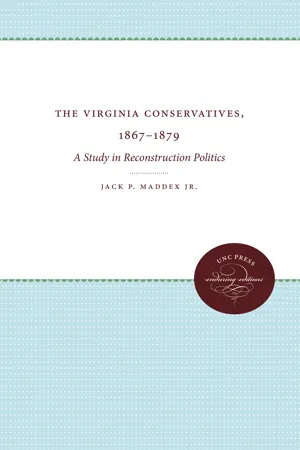
eBook - ePub
The Virginia Conservatives, 1867-1879
A Study in Reconstruction Politics
- 348 pages
- English
- ePUB (mobile friendly)
- Available on iOS & Android
eBook - ePub
About this book
1. A Long Time Dead
It was with a “painful intensity” of emotion, in 1873, that Henry A. Wise considered a letter from his old friend James Lawson Kemper, asking him to support Kemper as the Conservative candidate for governor of Virginia.
In former days, Wise himself had been one of the giants of Virginia politics—successively congressman, governor, and brigadier general in the Army of Northern Virginia. The Southern Confederacy’s collapse had decisively terminated his political career. Refusing to apply for recovery of his political rights, he had held no public position since 1865 except as a member of the commission to determine the boundary between Maryland and Virginia. His fellow citizens, puzzled and amused by his occasional pronouncements on current events, regarded him as a relic of a departed era. Kemper, like Wise, had been a Democratic politician and a Confederate general—but eight years of bitter experience had taught the elder statesman that a great gulf separated most of his former associates from himself in outlook.
His lesson began at the time of Lee’s surrender. Since the Freed-men’s Bureau was occupying his plantation, Wise wandered about Virginia, isolated, for months. Coming to rest in Richmond, he was startled to discover that many of his Confederate comrades-in-arms, including General Robert E. Lee, had applied to President Andrew Johnson for amnesty for their Confederate service. Old Governor Wise could not understand their eagerness to confess, implicitly, that in defending the constitutional right of secession they had committed treason.1
Wise’s hopes rallied in 1867, when conservative Virginians united to resist the congressional Reconstruction policy as an assault on their traditions. The year 1869, however, brought the most crushing disappointment of all. Nine Conservatives journeyed to Washington to offer federal authorities a settlement in which the Conservatives would accept enfranchisement of Negroes, the most hated Northern imposition. At first, it appeared that the “Committee of Nine” represented only itself; but in the ensuing months, the Conservative party dramatically reversed its policy. Withdrawing its candidates for state office, it endorsed instead a Republican faction’s ticket, headed by a “carpetbagger” intruder. The Conservative organization also endorsed the Radical-dictated proposed state constitution, opposing only the separate clauses to deprive erstwhile Confederates of political rights. Accepting Negro suffrage, it held biracial election gatherings and appealed to Negroes for their votes. After winning its election, the Conservative legislature promptly ratified the Fourteenth and Fifteenth Amendments to the federal Constitution and subserviently petitioned Congress to restore the state to the status to which, Wise insisted, it was unconditionally entitled.2
After the surrender of 1869, Wise could not credit the Conservatives’ credentials as redeemers from Radicalism and guardians of white supremacy. Their subsequent support of the antislavery reformer Horace Greeley, “that Harlequin of wickedness and folly,” for president of the United States redoubled his disgust. The Conservatives seemed to him unprincipled opportunists, “out-carpetbagging the Carpet Baggers & out-scallawagging the Scallawaggers.” Although he might vote for Kemper for governor, the old man made up his mind, he could not “touch, taste, handle or sort with the Conservative party or its ticket.”3
In Henry A. Wise’s eyes, the Virginia of the 1870’s was in fact and law a different realm from the Old Dominion that had honored him before the war, and the Conservative party was related to no important political force in that other, antebellum, Virginia. Like many another disaffected traditionalist, the old governor could say with Benét’s Clay Wingate, “The world I knew is a long time dead.”4
Note
1. James A. Bear, Jr., ed., “Henry A. Wise and the Campaign of 1873: Some Letters from the Papers of James Lawson Kemper,” Virginia Magazine of History and Biography, LXII (July, 1945), PP. 326–28 (hereafter cited as “Wise and 1873 Campaign”); all citations from this source refer to Wise’s letter of August 18, 1873, to Kemper.
2. Ibid., pp. 328-31.
3. Ibid., pp. 331-33, 336-37.
4. Stephen Vincent Benét, John Brown’s Body (New York: Rinehart and Company, 1928), p.318.
2. Old Virginia
The Virginia Conservatives’ education began in the period before 1861. Nearly all reared in a society characterized by slave labor, they later spent many years adjusting to one organized on a different basis. Insofar as the need to adjust resulted from external— not internal—events, men used to the Old South found it difficult to adjust to the New. Antebellum Virginia was not, however, a world to itself. In some respect distinctively “Southern,” in others it participated in the common life of the American Union. With vestiges of precapitalist traditional societies—slavery and its social concomitants—it combined elements of nineteenth-century liberal capitalism. Although it was external force that overthrew slavery in the 1860’s, the factors tending to its extinction were present in muted form within Virginia as well. Before the free-soil Republicans won control of the federal government, those factors were already educating some Virginians for the world in which they would live after 1865.
SOCIETY
During the 1850’s, the Commonwealth of Virginia occupied a topographically symmetrical area centering in the Shenandoah Valley. The Blue Ridge bounded the Valley on the east and the Appalachian plateau, on the west. Eastward from the Blue Ridge, rivers made their way past Piedmont hills and Tidewater plain to the Chesapeake Bay. Westward from the Appalachians other streams wended through more rugged country toward the Ohio and Tennessee Rivers. In general, eastern Virginia was a land of slave-labor plantations and farms, dotted with a few small cities; western Virginia was a smallholder’s free-labor frontier.
Of the 1,596,318 inhabitants of Virginia in 1860, 1,219,630 lived in the counties that would compose Virginia after 1865.1 Five-twelfths of the latter number were Negro slaves, and only the 140,000 white adult males were able to qualify as voters. About 50,000 voters were slaveowning agriculturists, about half of whom owned more than five slaves each. About 13,000 voters were merchants or professional men, most of them small-scale slaveowners. The remainder of the electorate consisted of three groups about equal in numbers: farmers who owned land but no slaves, “mechanics,” and propertyless “poor whites.” These groups exercised very slight political power.2
In every part of the state, agriculture was the principal economic activity. Land was concentrated in large estates or in parcels belonging to the powerful families who also, ordinarily, owned the largest numbers of slaves and provided most of the political leadership.3 “Previous to 1860,” a southwest Virginia school superintendent later recalled with some exaggeration, “five great families held nearly the entire fertile portion of our county. They divided society into two classes, Virginia gentlemen and slaves, the poor dependent whites occupying a position like the grain between two millstones.”4
Of the 490,865 slaves within Virginia’s 1860 boundaries, 428,351 lived east of the Blue Ridge. In that politically dominant region, they were a majority of the population; in the remainder of the state, a small minority. In fifty-six of the sixty-four eastern counties, more than two-fifths of the free families owned slaves; in only one western county, a county later included in West Virginia, did the proportion of slaveowners reach that figure. In thirteen eastern counties, more than three-fifths of the inhabitants were slaves; in sixteen, more than three-fifths of the free families owned slaves.5
The geographic distribution of slaves corresponded strikingly to that of the tobacco crop. Both, by 1860, concentrated most heavily in the southern Piedmont, extending with decreasing incidence eastward and northward.6 That region most completely realized the ideal of the plantation system. Working slaves in gangs with close supervision, planters devoted as much land as possible to tobacco— or, if their land has ceased to support tobacco, to another “money crop” such as wheat. Many planters, in addition to managing their estates, practiced law or medicine and participated in county courts and political gatherings. Long-established planters lived by a well-defined code of proper behavior, respectful to social equals and paternalistic to inferiors. Leisurely and aristocratic, they did not understand the Yankee cult of money-grubbing efficiency and did not like its social manifestations. They prized above all a proud independence that expressed itself at best in self-discipline, at worst in eccentric irascibility.7
The traditional specialization in tobacco, by the 1820’s, had ruinously exhausted the soil of the old tobacco lands of the Tidewater. The tobacco belt, consequently, moved westward across the southern Piedmont, and eastern planters turned to wheat and corn as alternative staple crops that they could send to Northern cities in the form of flour.8 Many planters talked about improved methods of cultivation, but few practiced them before Edmund Ruffin’s experiments with marl in the 1830’s. Thereafter, especially in the tobacco-gutted Tidewater, real improvement occurred. Fertilization, superior implements, and crop diversification and rotation began to appear.9
Simultaneously, slave labor began to disappear. As plantation agriculture expanded in the Deep South, some planters migrated with slaves and others sold economically redundant slaves southward and westward. In Virginia, the export of slaves increased efficiency, simplified the managerial task, and provided capital for agricultural experimentation. Between 1830 and 1860, slaves declined from 39.2 per cent of Virginia’s population to 30.1 per cent. Counties in which farming practices progressed often reduced their proportions of slaves greatly, while the southern Piedmont greatly increased its proportion.10 These facts posed a dilemma for planters: by selling slaves they could stabilize their agriculture, but by depleting Virginia’s slave population they might undermine the system of slavery there.11
Agricultural reform also eroded faith in the economic benefits of slavery. Alert Virginians began to reflect on their slaves’ inefficiency, and a few slaveowners converted to free-labor farming as more productive. In 1852, the Virginia State Agricultural Society adopted a statement calling attention to Virginia’s agricultural backwardness in comparison with several Northern states; the members later rescinded the document for fear that it would supply ammunition for antislavery writers.12 In some areas, principally Fairfax County, diversification attracted Northern settlers who pioneered in scientific farming.13 The immigrants were another channel by which economic modernization might introduce social subversion. In 1860, Fairfax and adjoining counties distinguished by Northern immigration accounted for almost all of...
Table of contents
- Cover Page
- Title Page
- Copyright Page
- Dedication
- Contents
- By Way of Introduction
- Acknowledgments
- Voices
- 1. A Long Time Dead
- 2. Old Virginia
- 3. Confederate Crucible
- 4. The Pierpont Government, 1865–1867
- 5. Conservatives during Military Reconstruction, 1867–1868
- 6. 1869: The Conservatives Come to Power
- 7. The Walker Administration, 1869–1873
- 8. A “Kemper Redemption,” 1873–1877?
- 9. Virginia Conservatives and the New America
- 10. The Politics of Transportation
- 11. The Commonwealth and the Countryside
- 12. White Supremacy in Theory and Practice
- 13. The Educational Revolution
- 14. Making Ends Meet
- 15. Emergence of the State Debt Issue, 1871–1877
- 16. Disintegration of the Conservative Party, 1877–1879
- 17. The Source of the Conservative Impulse
- Bibliography of Sources Cited
- Index
Trusted by 375,005 students
Access to over 1.5 million titles for a fair monthly price.
Study more efficiently using our study tools.
Information
Year
2018Topic
HistoryPrint ISBN
9780807897188
9780807811405
Subtopic
North American HistoryeBook ISBN
9781469648101
Index
HistoryFrequently asked questions
Yes, you can cancel anytime from the Subscription tab in your account settings on the Perlego website. Your subscription will stay active until the end of your current billing period. Learn how to cancel your subscription
No, books cannot be downloaded as external files, such as PDFs, for use outside of Perlego. However, you can download books within the Perlego app for offline reading on mobile or tablet. Learn how to download books offline
Perlego offers two plans: Essential and Complete
- Essential is ideal for learners and professionals who enjoy exploring a wide range of subjects. Access the Essential Library with 800,000+ trusted titles and best-sellers across business, personal growth, and the humanities. Includes unlimited reading time and Standard Read Aloud voice.
- Complete: Perfect for advanced learners and researchers needing full, unrestricted access. Unlock 1.5M+ books across hundreds of subjects, including academic and specialized titles. The Complete Plan also includes advanced features like Premium Read Aloud and Research Assistant.
We are an online textbook subscription service, where you can get access to an entire online library for less than the price of a single book per month. With over 1.5 million books across 990+ topics, we’ve got you covered! Learn about our mission
Look out for the read-aloud symbol on your next book to see if you can listen to it. The read-aloud tool reads text aloud for you, highlighting the text as it is being read. You can pause it, speed it up and slow it down. Learn more about Read Aloud
Yes! You can use the Perlego app on both iOS and Android devices to read anytime, anywhere — even offline. Perfect for commutes or when you’re on the go.
Please note we cannot support devices running on iOS 13 and Android 7 or earlier. Learn more about using the app
Please note we cannot support devices running on iOS 13 and Android 7 or earlier. Learn more about using the app
Yes, you can access The Virginia Conservatives, 1867-1879 by Jack P. Maddex Jr. in PDF and/or ePUB format, as well as other popular books in History & North American History. We have over 1.5 million books available in our catalogue for you to explore.