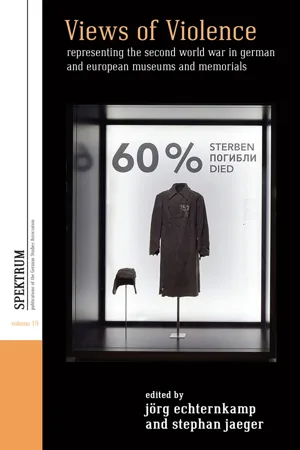
Twenty-first-century views of historical violence have been immeasurably influenced by cultural representations of the Second World War. Within Europe, one of the key sites for such representation has been the vast array of museums and memorials that reflect contemporary ideas of war, the roles of soldiers and civilians, and the self-perception of those who remember. This volume takes a historical perspective on museums covering the Second World War and explores how these institutions came to define political contexts and cultures of public memory in Germany, across Europe, and throughout the world.
eBook - ePub
Views of Violence
Representing the Second World War in German and European Museums and Memorials
- 310 pages
- English
- ePUB (mobile friendly)
- Available on iOS & Android
eBook - ePub
Views of Violence
Representing the Second World War in German and European Museums and Memorials
About this book
Trusted by 375,005 students
Access to over 1.5 million titles for a fair monthly price.
Study more efficiently using our study tools.
Information
PART I

Museums
CHAPTER 1
Multi-Voiced and Personal
Second World War Remembrance in German Museums
THOMAS THIEMEYER
Translated by Erin Johnston-Weiss
Translated by Erin Johnston-Weiss
The end of the Second World War in 1945 is relatively poorly canonized in German memory culture. The memories of German suffering and guilt were too intertwined to be able to build a cultural consensus concerning the end of the war. Consequently, the memorability of “1945” and of the war’s end is seemingly dynamic in today’s remembrance of the events of the Second World War.1 The memory of the war’s end has been newly contoured in recent years in a process that began with Richard von Weizsäcker’s 1985 speech characterizing the end of the war in Germany as liberation from the Nazi regime instead of as a German defeat. This was followed by debates surrounding violent crimes in the Soviet occupation zone2 and questions of the expulsion3 and reintegration of Germans living in the conquered territories after 1945.4
It is therefore interesting to note how German museums thematized the seventieth anniversary of the war’s end in 2015. A brief discussion of three special exhibitions can clarify the ways in which the curators approached the commemoration of the war’s anniversary. The Deutsches Historisches Museum (German Historical Museum) in Berlin presented the exhibition 1945: Niederlage, Befreiung, Neuanfang—Zwölf Länder Europas nach dem Zweiten Weltkrieg (1945: Defeat, liberation, new beginning—Twelve European countries after the Second World War), which focused specifically on the immediate postwar period and examined the comparative postwar hardships of twelve countries “without qualifying or weighing the experiences or the suffering of the different individuals against one another.”5 It explored the reality of war-torn Europe and narrated the history of ordinary people through thirty-six biographies in order to represent the complexity of individual experiences. The central goal of the exhibition was “to demonstrate the different war experiences of each country. Naturally, there were parallels, for example regarding how to deal with collaboration and crimes. However, the exhibition and its panorama of postwar stories highlight the specific developments in each individual country.”6
In the same year, the Militärhistorisches Museum der Bundeswehr (Bundeswehr Military History Museum, MHM) in Dresden held an exhibition entitled Schlachthof 5: Dresdens Zerstörung in literarischen Zeugnissen (Slaughterhouse 5: Dresden’s destruction in literary works). This exhibition analyzed the ways in which authors with a variety of perspectives worked through the bombing of Dresden. The exhibition’s focal point was the concept of the author as historical witness and chronicler, exemplified through the work of Kurt Vonnegut, particularly in his 1969 novel Slaughterhouse-Five. The story of an American prisoner of war who survived the bombing by taking shelter near a slaughterhouse, Vonnegut’s literary work had a lasting effect in shaping the English-speaking world’s view of Dresden. Rather than representing the Dresden bombing as a narrative of German suffering, the exhibition began with a “tunnel” of photography, which intertwined the history of bombing campaigns in Dresden with those in other European cities. Therefore, the exhibition reminded visitors that, before the bombs fell on Dresden, the Luftwaffe themselves bombed cities such as Coventry and Rotterdam.7
Finally, the Berlin documentation center Topographie des Terrors (Topography of Terror) ran the special temporary exhibition Deutschland 1945: Die letzten Kriegsmonate (Germany 1945: The last months of war). This exhibition represented themes of individual people occupying the permanent space between destruction and terror, as well as loss of orientation and fears about the future. It also equally focalized German perpetrators and victims, as soldiers, children, and expellees, through the direct contrast of large, cropped photographs of a German youth in the destroyed remains of Berlin and an old man in the ruins of Paris.8
Although these three examples provide only a rough sketch of German exhibitions centered on the war’s end, they nevertheless point to a new trend that is typical of the contemporary emphasis on German memory culture: all three exhibitions narrated the last months of the war through the fate of individuals. All three addressed either the war’s end or a distinctive event during the war’s final phase, and none focused particularly on the representation of the Nazi dictatorship or on the war as a whole. Consequently, in 2015, the war’s end and the immediate postwar period could become the dominant narrative in German Second World War representation. Speaking about one coherent narrative is disingenuous, however, since contemporary Second World War narrative has become differentiated, whereas one core narrative previously shaped each anniversary year: in 1985, questions of guilt and liberation dominated the discussion; in 1995, the crimes of the Wehrmacht,9 as well as questions about the perpetration of “ordinary men,”10 came into focus; and in 2005, the experience of German suffering during bombardments and the flight and expulsion of Germans in the East became an increasingly popular representational subject. In 2015, the temporal distance between the present and the events of the war was finally large enough for exhibitions to begin to simultaneously represent different experiences of war.
Based on these contemporary observations and the history of German Second World War exhibitions, which I will develop and explain later, I would like to formulate two theses that will build the thread of this chapter. First, I suggest that we are experiencing a contemporary phase of anthropologizing the Second World War, similar to the representation of the First World War in the 1990s.11 Contemporary narratives of the Second World War revolve around the war experience of individuals of the wartime generation.12 This focus on the individual explores how people interpret war, which differentiates itself from an events-based history. The wider the distance between the visitor and the events of the war become, the more museums’ desire to focalize individual wartime actions and experiences is strengthened.
Second, the narratives of the Second World War have become diversified. Historically, museal narratives have raised the issue of the National Socialist industrialization of mass murder, and questions of guilt and responsibility. Debates surrounding German guilt framed museal narratives, which were demonstrated, for example, by the Historikerstreit, the intellectual and political controversy of the late 1980s in West Germany about how best to remember Nazi Germany; the question of historicizing National Socialism; and the controversy surrounding the so-called Wehrmacht exhibition.13 In contrast, Germans’ self-perception can now play a larger role in the public eye. The “nation of perpetrators” is no longer necessarily the only acceptable perspective. Rather, the wartime generation has the right to narrate its own experiences of the war. This narrative is multifaceted and differs from the former historic canon. SS members can exist next to displaced persons; soldiers in the war of extermination can exist next to raped German women. Perpetrator and victim are no longer categories with which to distinguish different nations; one can find examples of both within the same country.
Both developments are new, especially concerning German war exhibitions.14 I will pursue these developments and, in doing so, differentiate between four separate stages, starting with the first phase from 1945 to 1960, in which the Nazi crimes and the war faded out of museum exhibitions. The second phase occurred from 1960 to the 1990s, in which the contents and aesthetics of Nazi memorial sites and war exhibitions primarily steered the German perception of the war toward the war of extermination in the East and the criminal Nazi regime. The third phase (from the mid-1990s to the mid-2000s) used—through the writings and critiques of the historiographers Christopher Browning and Daniel Goldhagen—the journals of Victor Klemperer and the Wehrmacht exhibition to begin the so-called critical investigation of perpetrators. Finally, the fourth phase, from the mid-2000s to the present, marks—alongside the dominant narrative of perpetration—the rediscovery of Germans as victims of the war and the events following it.
Phase 1: 1945–1960
The heavy losses during the last months of the war, the subsequent flight and expulsion of Germans, and the violence of the occupying forces in the war’s immediate aftermath deeply traumatized the German people, pushing aside memories of blitzkrieg and the atrocities perpetrated in the East. The German war of extermination in the East, and the Wehrmacht’s participation in these crimes, split German war memory between the individual remembrance of war experiences and silence about these crimes. Members of the perpetrator nation saw themselves as victims of a criminal regime. The reeducation policy of the Allied forces did not allow German citizens to ignore German atrocities. The corpses in the concentration camps made the extent of the mass murders clear to everyone, and extinguished every trace of National Socialist ethos within Germany. However, the war itself was barely touched on in the Allied “propaganda of truth,” and the 1950s saw the powerful return of entertainment media (film, literature, and Landser books) into West Germany society. The Landser was the immaculate German hero, whereas the stories kept silent about the culpability of ordinary German citizens for the crimes of the Einsatzgruppen. Not coincidentally, the post-1945 German war memorials were dedicated to German soldiers, and to the civilians of the German Volk killed in the war. The victims of Germany’s violent crimes only gradually saw justice, and when they did, the perpetrators of the Holocaust were demonized as outsiders on the fringe of German society. Their many followers and “ordinary citizen” perpetrators were only scarcely prosecuted.15
For German museums (as for most European museums), the period after 1945 was onerous. The air war had wrought destruction on various nations, and destroyed many museum buildings and exhibitions.16 The victorious parties had also looted the holdings of the military history museums. By the 1960s, many museums were engaged in securing their holdings, collecting new artifacts, repairing their buildings, and—with the little money they had—continuing the smooth running of their operations. There was no future for the German military history museums directly after 1945 because the Allies decreed that all museums and exhibitions of a military nature throughout Germany be closed by 1 January 1947.17 Only after the Westernization and rearmament of the Federal Republic of Germany (FRG), as well as the entrance of the German Democratic Republic (GDR) to the Soviet-led Warsaw Pact, could military history once again begin to be represented in German museums.18 Even then, this change took place gingerly: the Bayerisches Armeemuseum (Bavarian Army Museum) in Ingolstadt remained closed, and its collections were temporarily given to the Bayerisches Nationalmuseum (Bavarian National Museum). After reopening in 1949, the Badisches Armeemuseum (Baden Army Museum) removed “Army” from its name and, in the following years, devoted itself to national—as opposed to mi...
Table of contents
- Cover
- Title Page
- Copyright Page
- Contents
- List of Illustrations
- Preface
- List of Abbreviations
- Introduction. Representing the Second World War in German and European Museums and Memorials
- Part I. Museums
- Part II. Memorials and Memorial Landscapes
- Afterword. The Memory Boom and the Commemoration of the Second World War
- Index
Frequently asked questions
Yes, you can cancel anytime from the Subscription tab in your account settings on the Perlego website. Your subscription will stay active until the end of your current billing period. Learn how to cancel your subscription
No, books cannot be downloaded as external files, such as PDFs, for use outside of Perlego. However, you can download books within the Perlego app for offline reading on mobile or tablet. Learn how to download books offline
We are an online textbook subscription service, where you can get access to an entire online library for less than the price of a single book per month. With over 1.5 million books across 990+ topics, we’ve got you covered! Learn about our mission
Look out for the read-aloud symbol on your next book to see if you can listen to it. The read-aloud tool reads text aloud for you, highlighting the text as it is being read. You can pause it, speed it up and slow it down. Learn more about Read Aloud
Yes! You can use the Perlego app on both iOS and Android devices to read anytime, anywhere — even offline. Perfect for commutes or when you’re on the go.
Please note we cannot support devices running on iOS 13 and Android 7 or earlier. Learn more about using the app
Please note we cannot support devices running on iOS 13 and Android 7 or earlier. Learn more about using the app
Yes, you can access Views of Violence by Jörg Echternkamp, Stephan Jaeger, Jörg Echternkamp,Stephan Jaeger in PDF and/or ePUB format, as well as other popular books in Art & Museum Studies. We have over 1.5 million books available in our catalogue for you to explore.