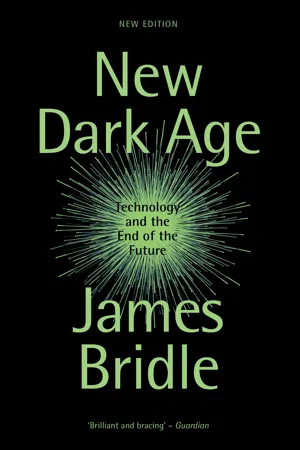
From the highly acclaimed author of WAYS OF BEING. We live in times of increasing inscrutability. Our news feeds are filled with unverified, unverifiable speculation, much of it automatically generated by anonymous software. As a result, we no longer understand what is happening around us. Underlying all of these trends is a single idea: the belief that quantitative data can provide a coherent model of the world, and the efficacy of computable information to provide us with ways of acting within it. Yet the sheer volume of information available to us today reveals less than we hope. Rather, it heralds a new Dark Age: a world of ever-increasing incomprehension.
In his brilliant new work, leading artist and writer James Bridle offers us a warning against the future in which the contemporary promise of a new technologically assisted Enlightenment may just deliver its opposite: an age of complex uncertainty, predictive algorithms, surveillance, and the hollowing out of empathy. Surveying the history of art, technology and information systems he reveals the dark clouds that gather over discussions of the digital sublime.
- 304 pages
- English
- ePUB (mobile friendly)
- Available on iOS & Android
eBook - ePub
About this book
Information
1
Chasm
‘If only technology could invent some way of getting in touch with you in an emergency,’ said my computer, repeatedly.
Following the 2016 US election result, along with several other people I know and perhaps prompted by the hive mind of social media, I started re-watching The West Wing: an exercise in hopeless nostalgia. It didn’t help, but I got into the habit, when alone, of watching an episode or two in the evenings, after work, or on planes. After reading the latest apocalyptic research papers on climate change, total surveillance, and the uncertainties of the global political situation, a little neoliberal chamber play from the noughties wasn’t the worst thing to sink into. One night I am halfway through an episode from the third series, and President Bartlett’s chief of staff, Leo McGarry, is regretting attending an AA meeting and as a result missing the early stages of an emergency.
‘What would you have done a half hour ago that hasn’t already been done?’ asks the president.
‘I’d have known a half hour ago what I know now,’ replies McGarry. ‘This is exactly why I’m not going to my meeting anymore – it’s a luxury.’
Bartlett circles McGarry, teasing him: ‘I know. If only technology could invent some way to get in touch with you in an emergency! Some sort of telephonic device with a personalised number we could call to let you know that we needed you’ – he reaches into Leo’s pocket and pulls out his phone – ‘Perhaps it would look something like this, Mr Moto!’
Except the episode didn’t get that far. The image on the screen continued to change, but my laptop had crashed, and one sentence of the audio looped over and over: ‘If only technology could invent some way to get in touch with you in an emergency! If only technology could invent some way to get in touch with you in an emergency! If only technology could invent some way to get in touch with you in an emergency!’
This is a book about what technology is trying to tell us in an emergency. It is also a book about what we know, how we know, and what we cannot know.
Over the last century, technological acceleration has transformed our planet, our societies, and ourselves, but it has failed to transform our understanding of these things. The reasons for this are complex, and the answers are complex too, not least because we ourselves are utterly enmeshed in technological systems, which shape in turn how we act and how we think. We cannot stand outside them; we cannot think without them.
Our technologies are complicit in the greatest challenges we face today: an out-of-control economic system that immiserates many and continues to widen the gap between rich and poor; the collapse of political and societal consensus across the globe resulting in increasing nationalisms, social divisions, ethnic conflicts and shadow wars; and a warming climate, which existentially threatens us all.
Across the sciences and society, in politics and education, in warfare and commerce, new technologies do not merely augment our abilities, but actively shape and direct them, for better and for worse. It is increasingly necessary to be able to think new technologies in different ways, and to be critical of them, in order to meaningfully participate in that shaping and directing. If we do not understand how complex technologies function, how systems of technologies interconnect, and how systems of systems interact, then we are powerless within them, and their potential is more easily captured by selfish elites and inhuman corporations. Precisely because these technologies interact with one another in unexpected and often-strange ways, and because we are completely entangled with them, this understanding cannot be limited to the practicalities of how things work: it must be extended to how things came to be, and how they continue to function in the world in ways that are often invisible and interwoven. What is required is not understanding, but literacy.
True literacy in systems consists of much more than simple understanding, and might be understood and practised in multiple ways. It goes beyond a system’s functional use to comprehend its context and consequences. It refuses to see the application of any one system as a cure-all, insisting upon the interrelationships of systems and the inherent limitations of any single solution. It is fluent not only in the language of a system, but in its metalanguage – the language it uses to talk about itself and to interact with other systems – and is sensitive to the limitations and the potential uses and abuses of that metalanguage. It is, crucially, capable of both performing and responding to critique.
One of the arguments often made in response to weak public understanding of technology is a call to increase technological education – in its simplest formulation, to learn to code. Such a call is made frequently by politicians, technologists, pundits and business leaders, and it is often advanced in nakedly functional and pro-market terms: the information economy needs more programmers, and young people need jobs in the future. This is a good start, but learning to code is not enough, just as learning to plumb a sink is not enough to understand the complex interactions between water tables, political geography, ageing infrastructure, and social policy that define, shape and produce actual life support systems in society. A simply functional understanding of systems is insufficient; one needs to be able to think about histories and consequences too. Where did these systems come from, who designed them and what for, and which of these intentions still lurk within them today?
The second danger of a purely functional understanding of technology is what I call computational thinking. Computational thinking is an extension of what others have called solutionism: the belief that any given problem can be solved by the application of computation. Whatever the practical or social problem we face, there is an app for it. But solutionism is insufficient too; this is one of the things that our technology is trying to tell us. Beyond this error, computational thinking supposes – often at an unconscious level – that the world really is like the solutionists propose. It internalises solutionism to the degree that it is impossible to think or articulate the world in terms that are not computable. Computational thinking is predominant in the world today, driving the worst trends in our societies and interactions, and must be opposed by a real systemic literacy. If philosophy is that fraction of human thought dealing with that which cannot be explained by the sciences, then systemic literacy is the thinking that deals with a world that is not computable, while acknowledging that it is irrevocably shaped and informed by computation.
The weakness of ‘learning to code’ alone might be argued in the opposite direction too: you should be able to understand technological systems without having to learn to code at all, just as one should not need to be a plumber to take a shit, nor to live without fear that your plumbing system might be trying to kill you. The possibility that your plumbing system is indeed trying to kill you should not be discounted either: complex computational systems provide much of the infrastructure of contemporary society, and if they are not safe for people to use, no amount of education in just how bad they are will save us in the long run.
In this book, we are going to do some plumbing, but we must bear in mind the needs of the non-plumbers at every stage: the need to understand, and the need to live even when we don’t always understand. We often struggle to conceive of and describe the scope and scale of new technologies, meaning that we have trouble even thinking them. What is needed is not new technology, but new metaphors: a metalanguage for describing the world that complex systems have wrought. A new shorthand is required, one that simultaneously acknowledges and addresses the reality of a world in which people, politics, culture and technology are utterly enmeshed. We have always been connected – unequally, illogically, and some more than others – but entirely and inevitably. What changes in the network is that this connection is visible and undeniable. We are confronted at all times by the radical interconnectedness of things and our selves, and we must reckon with this realisation in new ways. It is insufficient to speak of the internet or amorphous technologies, alone and unaccountable, as causing or accelerating the chasm in our understanding and agency. For want of a better term, I use the word ‘network’ to include us and our technologies in one vast system – to include human and nonhuman agency and understanding, knowing and unknowing, within the same agential soup. The chasm is not between us and our technologies, but within the network itself, and it is through the network that we come to know it.
Finally, systemic literacy permits, performs, and responds to critique. The systems we will be discussing are too critical to be thought, understood, designed and enacted by the few, especially when those few all too easily align themselves with, or are subsumed by, older elites and power structures. There is a concrete and causal relationship between the complexity of the systems we encounter every day; the opacity with which most of those systems are constructed or described; and fundamental, global issues of inequality, violence, populism and fundamentalism. All too often, new technologies are presented as inherently emancipatory. But this is itself an example of computational thinking, of which we are all guilty. Those of us who have been early adopters and cheerleaders of new technologies, who have experienced their manifold pleasures and benefited from their opportunities, and who have consequently argued, often naively, for their wider implementation, are in no less danger from their uncritical deployment. But the argument for critique cannot be made from individual threats, nor from identification with the less fortunate or less knowledgeable. Individualism and empathy are both insufficient in the network. Survival and solidarity must be possible without understanding.
We don’t and cannot understand everything, but we are capable of thinking it. The ability to think without claiming, or even seeking, to fully understand is key to survival in a new dark age because, as we shall see, it is often impossible to understand. Technology is and can be a guide and helpmate in this thinking, providing we do not privilege its output: computers are not here to give us answers, but are tools for asking questions. As we will see recur throughout this book, understanding a technology deeply and systemically often allows us to remake its metaphors in the service of other ways of thinking.
Beginning in the 1950s, a new symbol began to creep into the diagrams drawn by electrical engineers to describe the systems that they built. The symbol was a fuzzy circle, or a puffball, or a thought bubble. Eventually, its form settled into the shape of a cloud. Whatever the engineer was working on, it could connect to this cloud, and that’s all you needed to know. The other cloud could be a power system, or a data exchange, or another network of computers, or whatever. It didn’t matter. The cloud was a way of reducing complexity: it allowed one to focus on the near at hand, and not worry about what was happening over there. Over time, as networks grew larger and more interconnected, the cloud became more and more important. Smaller systems were defined by their relation to the cloud, by how fast they could exchange information with it, by what they could draw down from it. The cloud was becoming weightier, becoming a resource: the cloud could do this, it could do that. The cloud could be powerful and intelligent. It became a business buzzword and a selling point. It became more than engineering shorthand; it became a metaphor.
Today the cloud is the central metaphor of the internet: a global system of great power and energy that nevertheless retains the aura of something noumenal and numinous, something almost impossible to grasp. We connect to the cloud; we work in it; we store and retrieve stuff from it; we think through it. We pay for it and only notice it when it breaks. It is something we experience all the time without really understanding what it is or how it works. It is something we are training ourselves to rely upon with only the haziest of notions about what is being entrusted, and what it is being entrusted to.
Downtime aside, the first criticism of this cloud is that it is a very bad metaphor. The cloud is not weightless; it is not amorphous, or even invisible, if you know where to look for it. The cloud is not some magical faraway place, made of water vapour and radio waves, where everything just works. It is a physical infrastructure consisting of phone lines, fibre optics, satellites, cables on the ocean floor, and vast warehouses filled with computers, which consume huge amounts of water and energy and reside within national and legal jurisdictions. The cloud is a new kind of industry, and a hungry one. The cloud doesn’t just have a shadow; it has a footprint. Absorbed into the cloud are many of the previously weighty edifices of the civic sphere: the places where we shop, bank, socialise, borrow books, and vote. Thus obscured, they are rendered less visible and less amenable to critique, investigation, preservation and regulation.
Another criticism is that this lack of understanding is deliberate. There are good reasons, from national security to corporate secrecy to many kinds of malfeasance, for obscuring what’s inside the cloud. What evaporates is agency and ownership: most of your emails, photos, status updates, business documents, library and voting data, health records, credit ratings, likes, memories, experiences, personal preferences and unspoken desires are in the cloud, on somebody else’s infrastructure. There’s a reason Google and Facebook like to build data centres in Ireland (low taxes) and Scandinavia (cheap energy and cooling). There’s a reason global, supposedly post-colonial empires hold onto bits of disputed territory like Diego Garcia and Cyprus, and it’s because the cloud touches down in these places, and their ambiguous status can be exploited. The cloud shapes itself to geographies of power and influence, and it serves to reinforce them. The cloud is a power relationship, and most people are not on top of it.
These are valid criticisms, and one way of interrogating the cloud is to look where its shadow falls: to investigate the sites of data centres and undersea cables and see what they tell us about the real disposition of power at work today. We can seed the cloud, condense it, and force it to give up some of its stories. As it fades, certain secrets may be revealed. By understanding the way the figure of the cloud is used to obscure the real operation of technology, we can start to understand the many ways in which technology itself hides its own agency – through opaque machines and inscrutable code, as well as physical distance and legal constructs. And in turn, we may learn something about the operation of power itself, which was doing this sort of thing long before it had clouds and black boxes in which to hide itself.
But beyond this once-again functional vision of the cloud, beyond its re-earthing, can we turn the figure of the cloud over once more in order to produce a new metaphor? Can the cloud absorb not only our failure to understand, but our understanding of that lack of understanding? Can we supplant base computational thinking with cloudy thinking, which acknowledges an unknowing and makes of it productive rain? In the fourteenth century, an unknown author of Christian mysticism wrote of ‘The Cloud of Unknowing’ that hangs between mankind and the Godhead: the embodiment of goodness, justice, and right action. This cloud cannot be pierced by thought, but by the letting-go of thought, and through the insistence upon the here and now – not the predicted, computed future – as the domain of agency. ‘Go after experience rather than knowledge,’ the author urges us. ‘On account of pride, knowledge may often deceive you, but this gentle, loving affection will not deceive you. Knowledge tends to breed conceit, but love builds. Knowledge is full of labor, but love, full of rest.’1 It is this cloud that we have sought to conquer with computation, but that is continually undone by the reality of what we are attempting. Cloudy thinking, the embrace of unknowing, might allow us to revert from computational thinking, and it is what the network itself urges upon us.
The greatest signifying quality of the network is its lack of single, solid intent. Nobody set out to create the network, or its greatest built exemplar, the internet. Over time, system upon system, culture upon culture, were linked together, through public programmes and private investments; through personal relationships and technological protocols; in steel, glass and electrons; through physical space; and in the space of the mind. In turn, the network gave expression to the basest and highest ideals, contained and exulted the most mundane and the most radical desires, almost none of it foreseen by its progenitors – who are all of us. There was and is no problem to solve, only collective enterprise: the emergent, unconscious generation of a tool for unconscious generation. Thinking the network reveals the inadequacy of computational thinking and the interconnectedness of all things, as well as their endlessness; it insists upon the constant need to rethink and reflect upon its weights and balances, its collective intent and failings, its roles, responsibilities, prejudices and possibilities. This is what the network teaches: nothing short of everything will really do.2
Our great failing in thinking the network up to now was to presume that its actions were inherent and inevitable. By inherent, I mean the notion that they emerged, ex nihilo, from the things we created rather than involving our own actions as part of that co-creation. By inevitable, I mean a belief in a direct line of technological and historical progress that we are powerless to resist. Such a belief has been repeatedly attacked by thinkers in the social sciences and philosophy for decades, yet it has not been defeated. Rather, it has been reified into technology itself: into machines that are supposed to carry out their own embedded desires. Thus we have abdicated our objections to linear progress, falling into the chasm of computational thinking.
The greatest carrier wave of progress for the last few centuries has been the central idea of the Enlightenment itself: that more knowledge – more information – leads to better decisions. For which one can, of course, substitute any concept of ‘better’ that one chooses. Despite the assaults of modernity and postmodernity, this core tenet has come to define not merely what is implemented, but what is even considered possible from new technologies. The internet, in its youth, was often referred to as an ‘information superhighway’, a conduit of knowledge that, in the flickering light of fibre-optic cables, enlightens the world. Any fact, any quantum of information, is available at the tap of a keyboard – or so we have led ourselves to believe.
And so we find ourselves today connected to vast repositories of knowledge, and yet we have not learned to think. In fact, the opposite is true: that which was intended to enlighten the world in practice darkens it. The abundance of information and the plurality of worldviews now accessible to us through the internet are not producing a coherent consensus reality, but one riven by fundamentalist insistence on simplistic narratives, conspiracy the...
Table of contents
- Cover Page
- Halftitle Page
- Title Page
- Copyright Page
- Dedication
- Contents
- 1. Chasm
- 2. Computation
- 3. Climate
- 4. Calculation
- 5. Complexity
- 6. Cognition
- 7. Complicity
- 8. Conspiracy
- 9. Concurrency
- 10. Cloud
- Acknowledgements
- Notes
- Index
Trusted by 375,005 students
Access to over 1.5 million titles for a fair monthly price.
Study more efficiently using our study tools.
Frequently asked questions
Yes, you can cancel anytime from the Subscription tab in your account settings on the Perlego website. Your subscription will stay active until the end of your current billing period. Learn how to cancel your subscription
No, books cannot be downloaded as external files, such as PDFs, for use outside of Perlego. However, you can download books within the Perlego app for offline reading on mobile or tablet. Learn how to download books offline
Perlego offers two plans: Essential and Complete
- Essential is ideal for learners and professionals who enjoy exploring a wide range of subjects. Access the Essential Library with 800,000+ trusted titles and best-sellers across business, personal growth, and the humanities. Includes unlimited reading time and Standard Read Aloud voice.
- Complete: Perfect for advanced learners and researchers needing full, unrestricted access. Unlock 1.5M+ books across hundreds of subjects, including academic and specialized titles. The Complete Plan also includes advanced features like Premium Read Aloud and Research Assistant.
We are an online textbook subscription service, where you can get access to an entire online library for less than the price of a single book per month. With over 1.5 million books across 990+ topics, we’ve got you covered! Learn about our mission
Look out for the read-aloud symbol on your next book to see if you can listen to it. The read-aloud tool reads text aloud for you, highlighting the text as it is being read. You can pause it, speed it up and slow it down. Learn more about Read Aloud
Yes! You can use the Perlego app on both iOS and Android devices to read anytime, anywhere — even offline. Perfect for commutes or when you’re on the go.
Please note we cannot support devices running on iOS 13 and Android 7 or earlier. Learn more about using the app
Please note we cannot support devices running on iOS 13 and Android 7 or earlier. Learn more about using the app
Yes, you can access New Dark Age by James Bridle in PDF and/or ePUB format, as well as other popular books in Computer Science & Science & Technology Public Policy. We have over 1.5 million books available in our catalogue for you to explore.