eBook - ePub
Precision Recruitment Skills
How to Find the Right Person For the Right Job, the First Time
- 125 pages
- English
- ePUB (mobile friendly)
- Available on iOS & Android
eBook - ePub
Precision Recruitment Skills
How to Find the Right Person For the Right Job, the First Time
About this book
This book is great for anyone in management who has ever experienced the stress, frustration, and costs associated with poor recruitment decisions. Presented in an easy-to-read, engaging, step-by-step format, Rod Matthews has detailed practical ways to reduce the time and money spent on recruitment, while increasing the likelihood of recruiting the right person the first time. Complete with practical exercises, it contains insightful steps for improving skills around recruitment advertising, interview preparation, interviewing candidates, and what happens after the interview. In this humorous and engaging book, the author offers key insights from his extensive experience in dealing with people at all levels of organizations. It is highly recommended as a must-read manual for anyone whose job involves recruitment.
Trusted by 375,005 students
Access to over 1 million titles for a fair monthly price.
Study more efficiently using our study tools.
Information
CHAPTER 1
The Cost of Getting Recruitment Wrong
The Right Person in the Right Job, First Time
I can understand that, at the beginning of a book such as this, you might be thinking a number of different things to yourself. For example, you might be thinking:
Thanks very much but I don’t have the time. If you could see the thickness of my in-tray, if you could count the number of emails that are stacking up at this very moment, if you knew the number of people who are looking for me. I don’t have the time to read this book and I certainly don’t have the time to recruit.
Or you might be thinking . . .
Recruitment is not rocket science. Either they can do the job or they can’t. If they can, then great, they get the job. If they can’t, then fine, we find someone with a pulse who can! And you have written a whole book on this?
Or you might be thinking . . .
Listen, I’ve been around a bit. I’ve worked for a number of different organizations in a number of different capacities and recruited more than my fair share of people in my time. So I know what it takes to find the right person. What could this book possibly hold for me that I don’t already know?
No matter what you are thinking or feeling at this point, this book that you hold in your hands and have chosen to read this far, is an excellent opportunity to do a number of things.
Look at what you can do to reduce the amount of time that recruitment and interviewing take:
1.You can streamline the process so that you increase the quality of people you attract and select while minimizing the time and effort to do so.
2.This book provides you with an excellent opportunity to add to your bottom line. Recruiting with increased precision will
•increase your profitability
•reduce your costs
•improve the productivity of your team.
In some cases you will be able to multiply the effect by gaining all of these benefits.
3.The skills and ideas in this book, when implemented, will reduce the stress and frustration that can be associated with having to deal with underperforming team members. How much of your time in the past has been spent trying to improve the performance of people who seem to be square pegs in round holes?
4.You also have an excellent opportunity to look at what makes the difference between a good recruiter and an excellent recruiter.
A good recruiter might stand a better than 50-percent chance of finding a satisfactory operator who, with a little coaching and the occasional counseling, will perform to expectations.
An exceptional recruiter, a precision recruiter, will:
•not only find the right person, someone who is highly competent and highly committed
•also ensure that they have identified the right job, not just the one that has been vacated
•be able to do this with an error rate of almost nil.
Think for a moment about all the interviews and recruitment processes that you have been part of. It could have been that you were going for a job as a candidate. Or you may have been running the process. It could have been that you were one of a number of interviewers. Which of these would you rate as being good or better. Chances are there wouldn’t be too many.
Now if you take away the ones that just made good, leaving you with the very good or better. Now you would be culling the list.
Now if I asked you to take out the ones that were very good, so that you are left with only the exceptional, chances are that there are very few examples you can think of. And those that do come to mind stand out clearly. You probably even thought of them first.
So this book is an excellent opportunity to identify what the precision recruiter does that the good one doesn’t. And to find out how to do more precision recruitment and less of the average.
But first try this quick quiz . . .
Interviewer’s Self-assessment
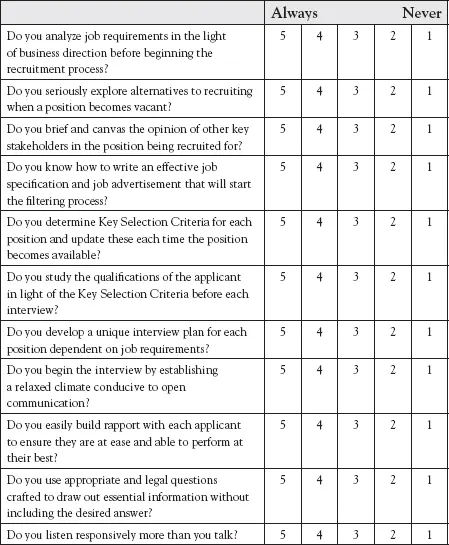
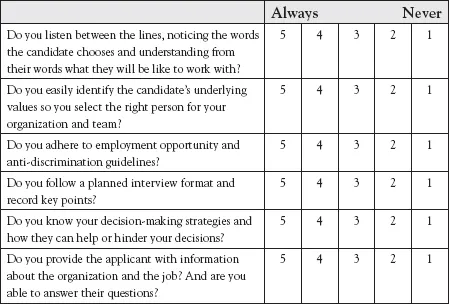
How Did You Score?
17-35: Ouch! You Are a Liability . . .
You are causing your team, your organization, your candidates, and yourself some serious problems. The good news is that you are best positioned to learn most from this book and when you take action on what you have learnt, you are most likely to clearly see the multiplier effect on your bottom line of improving your recruitment practices.
35-51: You Need Help . . .
You are taking a “bums on seats” approach to recruitment. It may result in quick replacements but as we shall see later in this chapter, you are probably costing yourself more than the speedy replacements are making for you. The good news for you is that if you implement the ideas and skills covered in this book, you will enjoy a dramatic improvement in your profitability.
52-68 Not Bad . . .!
You know what you should be doing. You just don’t do it all the time. There are a number of ideas and skills in this book that can streamline your process and improve the quality of the people you get to work with.
69-85 Awesome. You Rule . . .
Please consider becoming a recruitment consultant. Not only would you clean up financially, but you would also improve the recruitment industry’s standing in the corporate world from parasite to provider.
No Matter What You Scored . . .
. . . if you read this book looking for what you don’t know, tracking for what is new and different, then you will undoubtedly learn something that could save you time, effort, money, and credibility as a manager.
Some Important Recruitment Lessons
But first, allow me to introduce myself. I left school, I guess as many people do, with no clear understanding as to what I wanted to do after school. Fortunately, in some respects, I just got enough marks to go to university. So I went for a whole year and failed abysmally. Why? Because I found it very hard to fit any study into the hectic social calendar you have to keep when living on campus.
Two days before an exam or assignment due date, I would think to myself, OK Rod, If you’re going to cram an entire term’s worth of work, now is the time to start! So I would set myself up: books at reachable distance, pot of coffee on the boil, and a couple of No-Doze pills had been ingested. (No-Doze pills are 100 mg of caffeine. They are evil things! I’m sure truckies take them! You can feel the hairs on the back of your neck growing after a couple of these.) Take a couple of these and you are going to stay awake for a good few hours yet!
Just as I was about to put pen to paper when there would be a knock at the door.
“Rod we’re going to the pub. What are you doing?”
“Give me two minutes. I’ll be with you.”
There were people at university who were able to do both—kill brain cells on a nightly basis and pass with honors. I was not one of them. So I deferred after first year with the grand plan of getting a job for a year to earn enough to put myself through the rest of the degree.
I remember telling this to one of my tutors before I left. She responded with, “Well Rod, it was nice knowing you!”
I asked, “What do you mean?”
She replied, “Ninety percent of people who defer studies after their first year do not come back. So . . . it was nice knowing you, Rod!”
Obviously she had a little more experience with that than I did. And she turned out to be right. I didn’t go back. Instead I found a job in a bank, and enjoyed an entry-level position that allowed me to continue with the party lifestyle and still have some money in the wallet at the end of it.
First Lesson in Recruitment
This is where I first came into contact with the concept of recruitment. Each branch of the bank had a branch manager. In those days this was a respected position held by someone with greying hair and substantial standing in the community. The branch manager would be responsible for all aspects of running the branch, including recruitment and selection.
Let’s say that Jennifer is the manager of Centreville branch and her team includes a wide variety of performers. Some are great performers who have a lot of experience, love their job and take their work but not themselves seriously. Then there are the good, the average and, unfortunately, the bad. One of whom is named Graham.
Graham will never be a highflyer. The rest of the team will always need to carry him. Silly errors, short fuse, does the bare minimum. Jennifer has not dealt with Graham’s performance in a constructive manner. She has been asking her good operators to fix his errors, look after poorly treated customers, and stay behind when necessary to make sure the team meets targets. Jennifer is a weak manager, it’s j ust that she has had difficulty putting Graham’s poor performance into words that won’t start an hour-long debate.
You are the manager from nearby Surfside branch and you have just recently lost one of your top performers. You phone Centreville to see if they have anyone who can fill the position. Jennifer spots the opportunity and recommends Graham.
Jennifer says, “I’ve got a guy called Graham who is ready for that position but I’m a little reluctant to let him go as he is showing a lot of promise at the moment.”
Excitedly you reply, “He sounds perfect. Now, Jennifer, you know it is bank policy that you send his file over to me to look at. That’s the least you can do.”
“All right,” says ...
Table of contents
- Cover
- Title
- Copyright
- Dedication
- Abstract
- Contents
- How to Get the Most Out of This Book
- Acknowledgments
- Chapter 1 The Cost of Getting Recruitment Wrong
- Chapter 2 Precision Recruitment Process
- Chapter 3 Advertising and Dealing with the Response
- Chapter 4 Interview Preparation
- Chapter 5 Interviews
- Chapter 6 Advanced Questioning Skills
- Chapter 7 Advanced Listening Skills
- Chapter 8 After the Interview
- Chapter 9 How to Speed Up the Return on Your Investment
- Appendix
- About the Author
- Index
- OTHER TITLES
- Back
Frequently asked questions
Yes, you can cancel anytime from the Subscription tab in your account settings on the Perlego website. Your subscription will stay active until the end of your current billing period. Learn how to cancel your subscription
No, books cannot be downloaded as external files, such as PDFs, for use outside of Perlego. However, you can download books within the Perlego app for offline reading on mobile or tablet. Learn how to download books offline
Perlego offers two plans: Essential and Complete
- Essential is ideal for learners and professionals who enjoy exploring a wide range of subjects. Access the Essential Library with 800,000+ trusted titles and best-sellers across business, personal growth, and the humanities. Includes unlimited reading time and Standard Read Aloud voice.
- Complete: Perfect for advanced learners and researchers needing full, unrestricted access. Unlock 1.4M+ books across hundreds of subjects, including academic and specialized titles. The Complete Plan also includes advanced features like Premium Read Aloud and Research Assistant.
We are an online textbook subscription service, where you can get access to an entire online library for less than the price of a single book per month. With over 1 million books across 990+ topics, we’ve got you covered! Learn about our mission
Look out for the read-aloud symbol on your next book to see if you can listen to it. The read-aloud tool reads text aloud for you, highlighting the text as it is being read. You can pause it, speed it up and slow it down. Learn more about Read Aloud
Yes! You can use the Perlego app on both iOS and Android devices to read anytime, anywhere — even offline. Perfect for commutes or when you’re on the go.
Please note we cannot support devices running on iOS 13 and Android 7 or earlier. Learn more about using the app
Please note we cannot support devices running on iOS 13 and Android 7 or earlier. Learn more about using the app
Yes, you can access Precision Recruitment Skills by Rod Matthews in PDF and/or ePUB format, as well as other popular books in Business & Human Resource Management. We have over one million books available in our catalogue for you to explore.