eBook - ePub
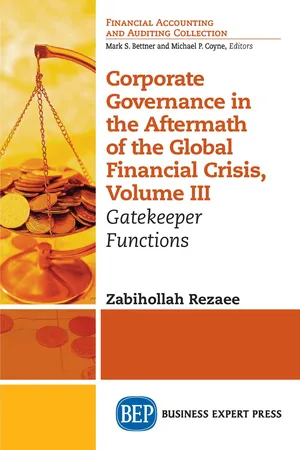
Corporate Governance in the Aftermath of the Global Financial Crisis, Volume III
Gatekeeper Functions
- 157 pages
- English
- ePUB (mobile friendly)
- Available on iOS & Android
eBook - ePub
Corporate Governance in the Aftermath of the Global Financial Crisis, Volume III
Gatekeeper Functions
About this book
Corporate governance has evolved as a central issue for public companies in the aftermath of the 2007–2009 global financial crisis. Corporate governance is a process (journey) of managing corporate affairs to create shareholder value and protect interests of other stakeholders. This book presents a road map for various functions and measures of corporate governance. The participants in the corporate governance process are the board of directors, executives, stakeholders, internal and external auditors, financial analysts, legal counsel, and regulators. This book is organized into four separate volumes; each volume can be utilized separately or in an integrated form. The first volume consists of five chapters that address the relevance and importance of corporate governance as well as the framework and structure of corporate governance. The second volume consists of four chapters that present the three prevailing corporate governance functions of oversight, management, and monitoring. The third volume consists of four chapters that address corporate governance functions performed by corporate gatekeepers, including policy makers, regulators, standard-setters, internal auditors, external auditors, legal counsel, and financial advisors. The fourth volume consists of five chapters that address the emerging issues in corporate governance, including governance for private companies and nonprofit organizations and convergence in global corporate governance.
Trusted by 375,005 students
Access to over 1.5 million titles for a fair monthly price.
Study more efficiently using our study tools.
Information
Topic
Negocios y empresaSubtopic
Negocios en general1
Compliance Function
Introduction
The wave of financial scandals at the turn of the twenty-first century and their persistence in recent years, coupled with the perceived inadequacy of market correction mechanisms, significantly eroded investor confidence and corporate governance effectiveness. The Sarbanes-Oxley Act of 2002 (SOX) and the Dodd-Frank Act of 2010 (DOF) were enacted in efforts to rebuild investor confidence and improve corporate governance, and the safety, integrity, and efficiency of the capital markets. More than 15 years after the passage of the SOX and 7 years after the enactment of the DOF, the efficacy and sustainability of both acts and their impacts on corporate governance effectiveness have been challenged. This chapter discusses the regulatory reforms enacted in the United States in the past decade; examines provisions of the regulatory reforms and related implementation rules; addresses the global reach of the regulatory reforms and related rules; and discusses the efficacy of the regulatory reforms in terms of their expected benefits, compliance costs, and sustainability.
Regulatory Reforms in the United States
Reported corporate and accounting scandals of the late 1990s and the early 2000s suggest that market-based correction mechanisms have failed to prevent those scandals and properly penalize corporate wrongdoers. Therefore, regulations, rules, standards, and best practices established by governing bodies, standard setters, and professional organizations are important external mechanisms in creating an environment that promotes, monitors, and enforces responsible corporate governance, reliable financial reporting, and credible audit functions. Academic studies argue that the legal system is an important mechanism of corporate governance that protects investor rights, which leads to a lower cost of capital.1 Lawmakers, regulators, standard setters, professional organizations, and investor activists are key participants in corporate governance, and each plays an important role in the compliance function, discussed in this chapter, to protect investors and to ensure that shareholders and other stakeholders receive accurate, complete, reliable, and transparent financial information. The compliance function eventually determines what information public companies must disclose to their shareholders for making sound investment and voting decisions and to other stakeholders for protecting their interests.
The history of regulation in the United States appears to follow the pattern of lax regulation (early twentieth century) followed by corporate and accounting scandals (the stock market crash of 1929), responded to with more regulation (Securities Acts of 1933, 1934), relaxed or compromised regulation (the end of the twentieth century), and yet another wave of financial scandals (the late 1990s and the early 2000s), and then the resulting additional regulation (the SOX, Securities and Exchange Commission, SEC rules, listing standards of the early 2000s). The intent of regulation has been to restore public trust and investor confidence in corporate America, its financial reports, and capital markets pursuant to the occurrences of massive financial scandals. It is expected that this endless cycle of financial scandals and government regulation will continue, as regulation is often compromised, leading to another wave of scandals.
The regulatory reforms in the United States including the SOX2 and the DOF3 passed by Congress and the related federal securities laws established by regulators to implement their provisions are intended to protect investors of public companies from receiving misleading financial reports and to improve investor confidence in the integrity and efficiency of the capital markets. The federal securities laws are primary, disclosure-based statutes that require public companies to file a periodic report with the SEC and to disclose certain information to shareholders to inform their investment and voting decisions. Congress responded to the financial scandals of the late 1990s and the early 2000s by passing the SOX, which expanded the role of federal statutes in corporate governance by providing measures to improve corporate governance, financial reporting, and audit activities. The aftermath of the global 2007–2009 financial crisis prompted Congress to pass the DOF to minimize the risk of future financial crisis and systemic distress by empowering regulators to require higher capital requirements and establish new regulatory regimes and corporate governance measures for large financial services firms. These regulatory reforms and their impacts on corporate governance, financial reporting, and audit activities are discussed in the next section.
Primary sources of the compliance function of corporate governance are lawmakers, regulators, courts, standard setters, and enforcement agents. The fair and effective enforcement of compliance with applicable laws, regulations, rules, and standards governing public companies is the fabric of our financial markets. The enforcement should be aggressive and uncompromising enough to promote compliance yet not so rigid that it adversely affects the foundation of our free enterprise system. The SEC, in its new enforcement guidelines, is attempting to create a fair balance between effective compliance and severity of penalties. In the aftermath of the 2007–2009 financial crisis, the SEC has attempted to bring criminal charges against several Wall Street Firms, including Goldman Sachs, for their involvement in improper securitization of mortgages.4 These and other emerging developments in the compliance function of corporate governance are discussed in this chapter.
Anecdotal evidence and empirical research indicate that investors benefit when public companies are better governed. Regulations that create an environment of better governance and are cost-efficient in the long term can result in more sustainable performance. Regulations that require more effective governance (e.g., majority board independence, executive certifications of financial statements, and related internal controls) enable companies to make changes that create sustainable shareholder value. Laws affecting corporate governance can be established at both the state and/or federal level as discussed in next sections.
State Regulation
Corporations are created under state corporation statutes, which define the fiduciary duty of their boards of directors, describe rights of shareholders, and set other provisions, including sales of major assets and mergers and acquisitions. State courts and judges often interpret state corporate laws. State legislatures began regulating the securities markets in the early 1900s, before there were any regulations of securities markets.
The first comprehensive state securities law was enacted by Kansas in 1911 and known as the blue-sky law, some form was subsequently enacted in 23 states.5 The blue-sky legislation was intended to mandate registration of securities and require companies to provide fair trading of securities and prevent fraud in the sale of securities. State corporate laws vary by state and in general define directors’ obligations, as almost all corporations (except for some banks and federally regulated entities) are incorporated by states. By 1960, every state, except for New Jersey and Wyoming, had required dealers and brokers to file statements about their operations with the secretary of state. If the requirement is violated, state officials had the right to suspend, revoke, or deny licenses.6 The state of Delaware has dominated with the issuance of corporate laws, regulations, and standards where more than 50 percent of U.S. public companies are incorporated.
The Committee on Capital Markets Regulation recommends limiting how and when state law can pursue enforcement actions against auditing firms and financial institutions by suggesting that the Department of Justice (DOJ) has the ability to sign off on all state indictments only in cases where the SEC chose not to take action, and that the SEC has a final say on any settlement cases of national importance.7 The committee proposes that state attorneys general coordinate prosecutions of companies with federal agencies (the SEC, DOJ). The DOJ should only pursue corporate criminal indictments as a last resort, with the rare possibility that companies waive their attorney-client privilege. The committee basically suggests that lawmakers and regulators should not be tough on the gatekeepers (management, directors, legal counsel, and auditors) who violate securities laws by relaxing some of the measures designed to protect investors from corporate malfeasance and wrongdoers and by promoting less-aggressive civil and criminal investigations. Investor protection measures provided through state law are vital to the effectiveness of corporate governance.
Federal Securities Regulation
Prior to the stock market crash in 1929, financial markets were primarily unregulated, and there was no support for federal regulations of the securities market as investors were not concerned about the threats of investing in an unregulated market.8 From 1870 to 1900, federal statutes aimed to mitigate the abuses growing out of corporate securities transactions. However, the regulations were not self-enforcing.9 The 1929 stock market crash and resulting Great Depression generated needed support and interest in federal securities legislation. Congress responded by passing the Securities Act of 1933. The primary purpose of the act was to protect the initial purchaser of securities by requiring companies that offer securities for public sale to provide registration statements presenting adequate financial and other significant information about the securities.10 Congress also enacted the Securities Exchange Act of 1934 to provide protection to all investors who trade securities (both buyers and purchasers) and created the Securities and Exchange Commission to register, regulate, and oversee the securities industry.11
In the United States, federal regulations of corporations started with the passage of the 1933 Securities Act and the Exchange Act of 1934. These acts apply to SEC registrants (public companies) and their financial reporting in providing accurate financial information to the capital markets for fair pricing purposes. Federal securities laws passed by Congress are intended to protect investors of public companies from receiving misleading financial reports and improve investor confidence in the integrity and efficiency of the capital markets. The Federal Securities laws are primary disclosure-based statutes that require public companies to file a periodic report with the SEC and disclose certain information to their shareholders to make investment and voting decisions. Congress responded to the wave of financial scandals during the late 1990s and the early 2000s by passing the SOX, which expanded the role of federal statutes in corporate governance by providing measures to improve corporate governance, financial reports, and audit activities. Federal securities laws play an important role in corporate governance through disclosure requirements and the creation and approval of accounting and auditing standards, the latter through the formation of the Public Company Accounting Oversight Board (PCAOB) by the SOX as explained in the following sections.
Sarbanes-Oxley Act of 2002
The economic downturn of the early 2000s, coupled with several years of steady decline in the capital markets and numerous high-profile financial scandals, paved the road for regulatory actions. After several unsuccessful attempts by Congress to protect investors from receiving inaccurate financial information pursuant to the enactments of the securities laws, and the wave of financial scandals and corporate malfeasance of the early 2000s, which caused the erosion of investor confidence, provided needed support for Congress to pass the SOX. The act was intended to rebuild investor confidence and protect investors by improving the reliability, completeness, accuracy, and transparency of corporate disclosures, including financial reports.12 President George W. Bush, in signing the SOX into law, praised it as “the most far-reaching reforms of American Business Practices since the time of Franklin Delano Roosevelt.”13 The SOX creates new and unprecedented requirements for public companies, measures that impact all corporate governance functions discussed in this book. The proper implementation of its far-reaching provisions is intended to address and influence the conduct of boards of directors, audit committees, executive, internal and external auditors, financial analyst...
Table of contents
- Cover
- Half Title Page
- Title Page
- Copyright Page
- Contents
- Preface
- Acknowledgments
- Chapter 1 Compliance Function
- Chapter 2 Internal Audit Function
- Chapter 3 Legal and Advisory Function
- Chapter 4 External Audit Function
- Index
Frequently asked questions
Yes, you can cancel anytime from the Subscription tab in your account settings on the Perlego website. Your subscription will stay active until the end of your current billing period. Learn how to cancel your subscription
No, books cannot be downloaded as external files, such as PDFs, for use outside of Perlego. However, you can download books within the Perlego app for offline reading on mobile or tablet. Learn how to download books offline
Perlego offers two plans: Essential and Complete
- Essential is ideal for learners and professionals who enjoy exploring a wide range of subjects. Access the Essential Library with 800,000+ trusted titles and best-sellers across business, personal growth, and the humanities. Includes unlimited reading time and Standard Read Aloud voice.
- Complete: Perfect for advanced learners and researchers needing full, unrestricted access. Unlock 1.5M+ books across hundreds of subjects, including academic and specialized titles. The Complete Plan also includes advanced features like Premium Read Aloud and Research Assistant.
We are an online textbook subscription service, where you can get access to an entire online library for less than the price of a single book per month. With over 1.5 million books across 990+ topics, we’ve got you covered! Learn about our mission
Look out for the read-aloud symbol on your next book to see if you can listen to it. The read-aloud tool reads text aloud for you, highlighting the text as it is being read. You can pause it, speed it up and slow it down. Learn more about Read Aloud
Yes! You can use the Perlego app on both iOS and Android devices to read anytime, anywhere — even offline. Perfect for commutes or when you’re on the go.
Please note we cannot support devices running on iOS 13 and Android 7 or earlier. Learn more about using the app
Please note we cannot support devices running on iOS 13 and Android 7 or earlier. Learn more about using the app
Yes, you can access Corporate Governance in the Aftermath of the Global Financial Crisis, Volume III by Zabihollah Rezaee in PDF and/or ePUB format, as well as other popular books in Negocios y empresa & Negocios en general. We have over 1.5 million books available in our catalogue for you to explore.