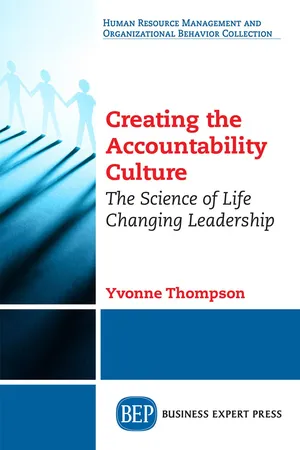
Creating The Accountability Culture: The Science of Life Changing Leadership takes a close look at the challenges facing business today which demand higher productivity, improved efficiency, and increased employee engagement. The author proposes an entirely new way of building corporate culture to address these issues. Tools and techniques designed to shift our present culture to one of full accountability and responsibility are at the heart of this work...Utilization of new sciences help to inform and provide a platform for the unique tools and techniques that, when practiced, consistently create an accountability culture that is life-changing for leaders, their teams and their organizations as a whole.This work introduces, for the first time, the Accountability Model, which outlines a simple yet highly effective roadmap for culture shift, which, in turn transforms lives and facilitates achievement of corporate goals. Creating capacity, improved productivity and profits in our organizations are grounded in a full understanding of what it is to be human and our ability to access all of the gifts and talents that this encompasses. This approach is not for the faint of heart and requires courage and commitment however the results are astounding when the tools are consistently practiced.
- 192 pages
- English
- ePUB (mobile friendly)
- Available on iOS & Android
eBook - ePub
Creating the Accountability Culture
About this book
Trusted by 375,005 students
Access to over 1 million titles for a fair monthly price.
Study more efficiently using our study tools.
Information
CHAPTER 1
Let the Journey Begin
This is the most exciting time to be working in the corporate world and specifically in the field of leadership. Never before have we seen so much change, upheaval, new science, and shaky ground relating to the new direction of leadership in the business community. Nothing makes my heart sing like seeing a leader have that ah-ha light bulb moment where he or she connects the dots for the first time and realizes that he or she can turn ownership for results, accountability, and responsibility over to his or her team member who is actually doing the work. In fact, that is simply where the ownership belongs. The leader has made the necessary and important connections to both their logical brain and heart-centered emotions. There is meaningful alignment and balance between heart and head. They have the new and important skills to create the necessary environment where individual contributors simply want to be responsible and accountable for their outcomes and overall results. This is the sweet spot.
Creating the Accountability Culture: The Science of Life-changing Leadership is a compilation of many years of research and experience from the school of hard knocks. It details a formula and model that we have seen work over and over again. As the journey unfolds, leaders slowly become aware of how to create the right environment where amazing performance and true accountability can reside. I find nothing more rewarding than working with clients who openly admit that the old way no longer works. These clients have a genuine desire to make positive changes within their corporate culture. They recognize the significant stress people are under and they want to provide an environment where relief can occur. This relief creates an openness and curiosity, which results in increased exploration. We see capacity improve along with a renewed sense of sustainability, and then joy and happiness quickly follow. The journey is fabulous, tough at times but worth every moment, as we observe leaders transform from the old dense energy of command and control to a lighter more fluid energy of expression, commitment, accountability, and unparalleled focus on results. This occurs out of respect for the company and what it stands for, and not from a place of compliance.
The Accountability Model has evolved over the past 15 years of working with clients large and small. We have watched it unfold into a smooth process and unique journey for each and every leader. The process is fluid and flexible and becomes a road map that assists leaders in appreciating the human experience. Instead of resisting what it is to be human by demonstrating to employees how to ignore the natural human needs we all have, these leaders embrace it and allow others to do the same. The organization expects a lot from contributors, it is not about making friends and playing politics, it is about tapping into what it means to truly access all of the gifts and strengths of humanity within a corporate setting. We have been playing small, accessing only a portion of our brains and almost nothing from our hearts, thinking that if we are tough and work harder and harder we will win the race. Nothing could be farther from the truth.
The leader of the future plays only one key role. The leader creates the environment where others can and will take full responsibility and accountability for actions, behaviors, outcomes, and final results. This work is meaningful, engaging, and highly purpose driven. This is where true sustainable results exist and it is incredibly fun to play in this arena. Nothing could be more important in the coming years than to create an amazing culture where individual contributors love coming to work, feel connected to something meaningful, and go above and beyond for their work family and organization. Whoever said work shouldn’t be fun, I suspect, was buried in density and heaviness. I hope you will come on this journey with me as we explore the many aspects of the new sciences combined with my version of spirituality that has become the foundation of the Accountability Model.
The Flow
Creating the Accountability Culture: The Science of Life-Changing Leadership is divided into two parts. These parts are very different and yet are so important to the building of an Accountability Culture. Part I is all about the foundation, the science, and the spiritual connections. Part II explores the tools and techniques of the Accountability Model and includes daily and weekly practices that assist leaders in their growth and evolution.
Without a really strong foundation, nothing will last. Many organizations think and sometimes say that they want the quick 10 steps to great leadership. A great example is when we are teaching our seven-month Coaching as a Leader program. Participants will often ask in Module III or Module IV, when are we going to get to the competencies and capabilities of great coaching? They have been programmed to get a checklist with the ‘how to’s. Why all the preparation? There is a very clear reason for this and a method to our madness.
If we want transformation, we must build a very strong foundation that includes understanding, clarity, and lots of opportunity for reflection before we venture into the core coaching capabilities. Many leaders have long-standing programming relating to what they believe a manager needs to do in order to get results. This programming must be rewritten. It is not for the faint of heart or for those that simply like command and control. The philosophy and process we use works best in companies who want unparalleled shift, results, and accountability and who are willing to dabble in the unknown from a corporate perspective. We explore purpose, compassion, truth, alignment, neuroscience, neurochemistry, and magnetic energy fields, and create a new framework for examining the human as leader. It takes courage, commitment, and a lot of love to make the shift but once you do it, it will be like opening yourself up to the most incredible fresh air where abundance, resources, and well-being in all of its forms can exist. Joy and passion can emerge organically and easily within all contributors. I encourage you to stay with Part I even when you think, wow this is a lot of information and citations, are we ever going to get to the process and Accountability Model? The foundation is important.
Part II of the book is the practical application. It completes the circle including real examples and the process that we have seen work over and over again. When reading about some of the concepts in Part II you may simply say, “No way, that is ridiculous we could never do that.” However, it is essential to creating sustainable corporations of the future, corporations where people want to join your team and work their butts off to help make the company successful. They do this from a true place of alignment and commitment, not from a place of compliance. You will be able to attract the best talent that is intellectual, innovative, focused, and truly committed from a place of honesty, love, and passion.
When I made the decision to write this book, I was nervous about how I could take something that is so internal, soul felt, and so personally experienced and put it into words where others could feel the intent and process. Our clients have been telling us for years that the process and results are life changing for themselves, their team, and their organization. This book is as much about feeling the material as intellectualizing it, so I encourage you to stay open, be curious, and be willing to dive deep into the concepts. Be willing to consider that what we are doing today is not sustainable and that a completely new approach is needed if we are going to create amazing companies where people truly want to be, where work doesn’t feel like work but feels like an honor, a commitment, and a soul-felt journey of contribution.
Definitions
The following section provides some basic background and definitions that will assist you in working through the material. Some of the words I have chosen as key descriptors might not resonate with you in the way I have intended them. I felt it was important to provide some context. For example, the word spirituality invokes all kinds of emotions and thoughts. My use of the word is very intentional as it represents what it is to be human. If I was to say that we are logical beings with an intellect, a left and right brain hemisphere, no one is likely to dispute that. But when I say we are spiritual beings and that our humanness is about recognizing our emotions, connecting to the heart center, and understanding some basic innate needs, we might have some debate. Spirituality for the purposes of this book is about recognizing that we are complex beings that are mostly emotional and partially logical. These two parts within all of us work closely together and if we don’t take a holistic approach to the overall complexities of being human, we miss valuable information that informs our leadership role and corporate world. Here are the definitions that I think will assist in navigating the material.
The Accountability Model
This is the name given to the model created by Change Innovators Inc which is shared with their permission. The model provides the reader with a visual of the tools, process, and techniques used in order to create a culture where each and every contributor can take 100 percent responsibility for their actions and the outcomes they get. It is important to acknowledge that this is not about the leader holding people accountable. This model is about creating a context and an environment where every contributor wants to personally hold themselves accountable to the outcomes they get.
Compelling Purpose
The term compelling purpose is used in the context of organizational life, to describe why a business is in business. An organization’s compelling purpose is different from the traditional mission and vision statement. It is intrinsic, internal, and felt, instead of something that is intellectualized. I dedicate a full section to this topic.
Emotional Intelligence
Emotional intelligence is the regulation of emotions and the healthy, positive use of emotions in order to increase personal and professional effectiveness. It is also defined as the ability to use the information provided by emotions to act appropriately in the face of challenges.
Energy
I use the word energy a lot within these pages. A formal and traditional definition of energy is shared in a subsequent chapter; however, for now my use of this word is intended to mean those things we can feel but not necessarily see. It is the transference of feelings amongst individuals that is not spoken but felt and that has impact, either intended...
Table of contents
- Cover
- halftitle
- title
- Copyright
- frontmatter01
- contents
- frontmatter02
- frontmatter03
- part1
- Chapter 1
- Chapter 2
- Chapter 3
- Chapter 4
- Chapter 5
- part2
- Chapter 6
- Chapter 7
- Chapter 8
- Chapter 9
- Chapter 10
- Chapter 11
- Chapter 12
- Chapter 13
- References
- Index
Frequently asked questions
Yes, you can cancel anytime from the Subscription tab in your account settings on the Perlego website. Your subscription will stay active until the end of your current billing period. Learn how to cancel your subscription
No, books cannot be downloaded as external files, such as PDFs, for use outside of Perlego. However, you can download books within the Perlego app for offline reading on mobile or tablet. Learn how to download books offline
Perlego offers two plans: Essential and Complete
- Essential is ideal for learners and professionals who enjoy exploring a wide range of subjects. Access the Essential Library with 800,000+ trusted titles and best-sellers across business, personal growth, and the humanities. Includes unlimited reading time and Standard Read Aloud voice.
- Complete: Perfect for advanced learners and researchers needing full, unrestricted access. Unlock 1.4M+ books across hundreds of subjects, including academic and specialized titles. The Complete Plan also includes advanced features like Premium Read Aloud and Research Assistant.
We are an online textbook subscription service, where you can get access to an entire online library for less than the price of a single book per month. With over 1 million books across 990+ topics, we’ve got you covered! Learn about our mission
Look out for the read-aloud symbol on your next book to see if you can listen to it. The read-aloud tool reads text aloud for you, highlighting the text as it is being read. You can pause it, speed it up and slow it down. Learn more about Read Aloud
Yes! You can use the Perlego app on both iOS and Android devices to read anytime, anywhere — even offline. Perfect for commutes or when you’re on the go.
Please note we cannot support devices running on iOS 13 and Android 7 or earlier. Learn more about using the app
Please note we cannot support devices running on iOS 13 and Android 7 or earlier. Learn more about using the app
Yes, you can access Creating the Accountability Culture by Yvonne Thompson in PDF and/or ePUB format, as well as other popular books in Business & Human Resource Management. We have over one million books available in our catalogue for you to explore.