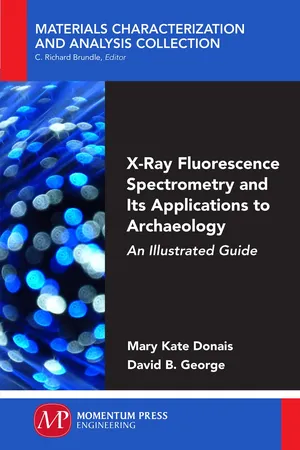
This book serves as a practical guide for applications of X-ray fluorescence spectrometry, a nondestructive elemental analysis technique, to the study and understanding of archaeology. Descriptions of XRF theory and instrumentation and an introduction to field applications and practical aspects of archaeology provide new users to XRF and/or new to archaeology with a solid foundation on which to base further study. Considering recent trends within field archaeology, information specific to portable instrumentation also is provided. Discussions of qualitative and quantitative approaches and applications of statistical methods relate back to types of archaeological questions answerable through XRF analysis. Numerous examples, figures, and spectra from the authors' field work are provided including chapters specific to pigments, ceramics, glass, construction materials, and metallurgical materials.
eBook - ePub
X-Ray Fluorescence Spectrometry and Its Applications to Archaeology
- 176 pages
- English
- ePUB (mobile friendly)
- Available on iOS & Android
eBook - ePub
X-Ray Fluorescence Spectrometry and Its Applications to Archaeology
About this book
Information
CHAPTER 6

Pigments
6.1 Background
Pigments are used on or in many archaeological artifacts and materials including fresco, ceramics, wood, stone, glass, and architectural terracotta. The chemical characterization of pigments is quite common within cultural heritage research, and it can be applied across historic periods and into modern times. There is also a considerable overlap between the pigments discussed in this chapter and the characterization of ceramics (Chapter 7) and glass (Chapter 8). The focus of this chapter is on pigments found on fresco and architectural terracotta.
XRF, as noted in the first chapter, is not an effective tool in detection of organic compounds because it does not detect the lighter elements, including carbon, of which organic compounds predominantly consist. Organic pigments therefore produce little to no detectable XRF signal. Mineral-based pigments, on the other hand, often contain metals easily detected via XRF analysis. In addition, a number of pigments have both natural and synthetic forms or only exist in a synthetic form. Synthetic pigments were often developed later in history to provide a more reliable pigment source and/or a higher purity product. The date of development of synthetic pigments is often documented, so the presence of one of these pigments on a cultural heritage object can make confident determination of that object’s age possible.
A table summarizing information for pigments used within archaeology is provided in Table 6.1 (Burgio and Clark 2001; Rapp 2009; Douma 2008; Berke 2002; Feller 1986; Roy 1993; Fitzhugh 1997; Berrie 2007). Many of the pigments presented in the table, such as the ochres and green earth, are commonly found on archaeological artifacts, while others such as lapis lazuli are considered valuable and rare.
The four volume Artists’ Pigments: A Handbook of Their History and Characteristics is a tremendous resource for anyone wanting both the historic and chemical information specific to each pigment in a highly organized and referenced format (Feller 1986; Roy 1993; Fitzhugh 1997; Berrie 2007). The chemical formula, name(s), and origin for each pigment in Table 6.1 are listed by color. Where possible, the date or time period of origin and use is provided for synthetic pigments.
| Table 6.1. Summary of pigments | ||||
| Color | Pigment | Chemical Formula | Name(s) | Origin |
| White | Titanium white Chalk Gypsum Huntite Lead white | TiO2 CaCO3 CaSO4·2H2O Mg3Ca(CO3)4 2PbCO3·Pb(OH)2 | Titanium dioxide, rutile, anatase Calcium carbonate, calcite Calcium sulfate dihydrate Magnesium calcium carbonate Basic lead(II) carbonate, hydrocerussite | Mineral/Synthetic (1923) Mineral Mineral Mineral Mineral/Synthetic (pre-500 BCE) |
| Blue | Azurite Egyptian blue Han blue Indigo Lazurite Verdigris (basic)1 Verdigris (neutral)1 | 2CuCO3·Cu(OH)2 CaCuSi4O10 BaCuSi4O1... | ||
Table of contents
- cover
- halftitle
- title
- copyright
- Dedication
- abstract
- contents
- List of Figure
- List of tables
- Preface
- Ack
- 01_Chapter 01
- 02_Chapter 02
- 03_Chapter 03
- 04_Chapter 04
- 05_Chapter 05
- 06_Chapter 06
- 07_Chapter 07
- 08_Chapter 08
- 09_Chapter 09
- 10_Chapter 10
- 11_Summary
- 12_About the author
- 13_Index
Trusted by 375,005 students
Access to over 1.5 million titles for a fair monthly price.
Study more efficiently using our study tools.
Frequently asked questions
Yes, you can cancel anytime from the Subscription tab in your account settings on the Perlego website. Your subscription will stay active until the end of your current billing period. Learn how to cancel your subscription
No, books cannot be downloaded as external files, such as PDFs, for use outside of Perlego. However, you can download books within the Perlego app for offline reading on mobile or tablet. Learn how to download books offline
Perlego offers two plans: Essential and Complete
- Essential is ideal for learners and professionals who enjoy exploring a wide range of subjects. Access the Essential Library with 800,000+ trusted titles and best-sellers across business, personal growth, and the humanities. Includes unlimited reading time and Standard Read Aloud voice.
- Complete: Perfect for advanced learners and researchers needing full, unrestricted access. Unlock 1.5M+ books across hundreds of subjects, including academic and specialized titles. The Complete Plan also includes advanced features like Premium Read Aloud and Research Assistant.
We are an online textbook subscription service, where you can get access to an entire online library for less than the price of a single book per month. With over 1.5 million books across 990+ topics, we’ve got you covered! Learn about our mission
Look out for the read-aloud symbol on your next book to see if you can listen to it. The read-aloud tool reads text aloud for you, highlighting the text as it is being read. You can pause it, speed it up and slow it down. Learn more about Read Aloud
Yes! You can use the Perlego app on both iOS and Android devices to read anytime, anywhere — even offline. Perfect for commutes or when you’re on the go.
Please note we cannot support devices running on iOS 13 and Android 7 or earlier. Learn more about using the app
Please note we cannot support devices running on iOS 13 and Android 7 or earlier. Learn more about using the app
Yes, you can access X-Ray Fluorescence Spectrometry and Its Applications to Archaeology by Mary Kate Donais, David B. George in PDF and/or ePUB format, as well as other popular books in Technology & Engineering & Materials Science. We have over 1.5 million books available in our catalogue for you to explore.