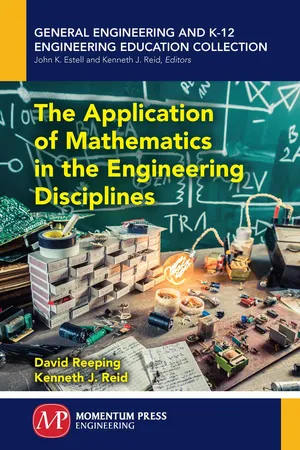
This text serves as the companion text to Introductory Engineering Mathematics, which introduces common mathematical concepts we see in engineering, including trigonometry, calculus, and functions. This text assumes a level of mathematics of a high school senior, plus some elements from the introductory text. Additional concepts we see in engineering are also introduced: specifically, matrices, differential equations, and some introduction to series. The concepts are introduced by examples rather than strict mathematical derivation. As a result, this text likely will not be an effective substitute for a differential equations course, but by illustrating the implementation of differential equations, it can be a companion to such a course. We primarily use historical events as examples (including failures) to illustrate the use of mathematics in engineering and the intersection of the disciplines. We hope you develop an appreciation for how to apply these concepts, and find a new lens through which to view engineering successes (and failures).
eBook - ePub
The Application of Mathematics in the Engineering Disciplines
- 150 pages
- English
- ePUB (mobile friendly)
- Available on iOS & Android
eBook - ePub
The Application of Mathematics in the Engineering Disciplines
About this book
Information
CHAPTER 1
MODELING SYSTEMS IN ENGINEERING
If art can capture the human experience with a few brushstrokes, mathematical models capture the raw details of the same experience using equations and formulas. Anything that we would quantify (make measurable) or explain using numbers is a candidate for modeling. Something that is purely qualitative, meaning something that is not measured using numbers, can also be mathematically modeled, strangely enough.
What is a model? A model is a representation of an item, a process, an event, a person, etc. It may be a three-dimensional representation of a physical structure, or it may be a simplified process meant to represent a more complex one. Models are extraordinary helpful tools for cutting costs and increasing the efficiency and effectiveness of our products and processes. NASA certainly does not operate on a trial and error basis by launching multimillion dollar space shuttles and hoping the journey is successful. When the government is prepared to introduce a new program, we may hear that the program is expected to save (or cost) so many billions of dollars. To find this number, we can: either implement the program and let it run for a few years and see what happens, or develop a model and predict what we expect will happen. This is an example of a mathematical model.
Why else would we want to make a model? Many fields of research and businesses require a mathematical model to make decisions. These can take the form of statistical models, an offshoot of mathematical models that involve statistics, where the main goal is to produce something that can make accurate predictions. It is essentially the company genie that can only grant one big wish and possibly do a few tricks.
More complex models are based off experimental data. After a certain number of trials, we may be pretty confident that you could come up with a model to predict what will happen. That way, we can make an accurate prediction of the results without having to collect more data. This is particularly attractive once you start talking about outrageously expensive, time-intensive massive experiments that may or may not be feasible to run in real life. In the cases of real-world data, no perfect model exists, we can only aim to create and improve the models to a degree they are useful.
1.1 A NOTE ON CREATING MATHEMATICAL MODELING
We’ll start nice and easy by creating and interpreting a common mathematical model to make approximations of functions; however, the process of generating a mathematical model generalizes to just about any modeling challenge. Much like learning a second language, there is a learning curve in translating English to Math. Luckily, there are some tricks that we can use to ease into these translations.
1. Read and understand the problem. This step should be obvious, but we should always read a problem until we completely understand what is asked. Not interpreting the problem correctly is where most mistakes begin.
2. Once you understand the problem, pick out important information. While this may be a more acquired skill, identifying given information and necessary assumptions is crucial. Sometimes, extraneous information—data or descriptions that are not relevant or not helpful—may be included in the problem description. In the real world, extraneous information is abundant and can take many for...
Table of contents
- Cover
- Half Title Page
- Title Page
- Copyright Page
- Contents
- List of Figures
- List of Tables
- Acknowledgments
- Chapter 1 Modeling Systems in Engineering
- Chapter 2 Differential Equations in Engineering
- Chapter 3 Describing Systems Using Mathematics
- Chapter 4 Analyzing Failure in Systems
- About the Authors
- Index
Trusted by 375,005 students
Access to over 1.5 million titles for a fair monthly price.
Study more efficiently using our study tools.
Frequently asked questions
Yes, you can cancel anytime from the Subscription tab in your account settings on the Perlego website. Your subscription will stay active until the end of your current billing period. Learn how to cancel your subscription
No, books cannot be downloaded as external files, such as PDFs, for use outside of Perlego. However, you can download books within the Perlego app for offline reading on mobile or tablet. Learn how to download books offline
Perlego offers two plans: Essential and Complete
- Essential is ideal for learners and professionals who enjoy exploring a wide range of subjects. Access the Essential Library with 800,000+ trusted titles and best-sellers across business, personal growth, and the humanities. Includes unlimited reading time and Standard Read Aloud voice.
- Complete: Perfect for advanced learners and researchers needing full, unrestricted access. Unlock 1.5M+ books across hundreds of subjects, including academic and specialized titles. The Complete Plan also includes advanced features like Premium Read Aloud and Research Assistant.
We are an online textbook subscription service, where you can get access to an entire online library for less than the price of a single book per month. With over 1.5 million books across 990+ topics, we’ve got you covered! Learn about our mission
Look out for the read-aloud symbol on your next book to see if you can listen to it. The read-aloud tool reads text aloud for you, highlighting the text as it is being read. You can pause it, speed it up and slow it down. Learn more about Read Aloud
Yes! You can use the Perlego app on both iOS and Android devices to read anytime, anywhere — even offline. Perfect for commutes or when you’re on the go.
Please note we cannot support devices running on iOS 13 and Android 7 or earlier. Learn more about using the app
Please note we cannot support devices running on iOS 13 and Android 7 or earlier. Learn more about using the app
Yes, you can access The Application of Mathematics in the Engineering Disciplines by David Reeping, Kenneth J. Reid in PDF and/or ePUB format, as well as other popular books in Technology & Engineering & Engineering General. We have over 1.5 million books available in our catalogue for you to explore.