This book is available to read until 23rd December, 2025
- 216 pages
- English
- ePUB (mobile friendly)
- Available on iOS & Android
eBook - ePub
Available until 23 Dec |Learn more
The HOW of Leadership
About this book
The HOW of Leadership: Inspire People to Achieve Extraordinary Results provides a road map of how great leaders inspire people to achieve extraordinary results. It takes the confusion out of the concept of leadership and introduces quick, easily applicable, and proven leadership concepts that today's leaders can employ. In this extraordinary, easy-to-read, and practical book, you will: Learn the leadership attitude that guarantees greatness; Make better decisions to secure the future of your organization; Improve the engagement levels of your constituents; Inspire and influence people to achieve extraordinary results; Unleash the spirit of performance throughout your organization.
Frequently asked questions
Yes, you can cancel anytime from the Subscription tab in your account settings on the Perlego website. Your subscription will stay active until the end of your current billing period. Learn how to cancel your subscription.
No, books cannot be downloaded as external files, such as PDFs, for use outside of Perlego. However, you can download books within the Perlego app for offline reading on mobile or tablet. Learn more here.
Perlego offers two plans: Essential and Complete
- Essential is ideal for learners and professionals who enjoy exploring a wide range of subjects. Access the Essential Library with 800,000+ trusted titles and best-sellers across business, personal growth, and the humanities. Includes unlimited reading time and Standard Read Aloud voice.
- Complete: Perfect for advanced learners and researchers needing full, unrestricted access. Unlock 1.4M+ books across hundreds of subjects, including academic and specialized titles. The Complete Plan also includes advanced features like Premium Read Aloud and Research Assistant.
We are an online textbook subscription service, where you can get access to an entire online library for less than the price of a single book per month. With over 1 million books across 1000+ topics, we’ve got you covered! Learn more here.
Look out for the read-aloud symbol on your next book to see if you can listen to it. The read-aloud tool reads text aloud for you, highlighting the text as it is being read. You can pause it, speed it up and slow it down. Learn more here.
Yes! You can use the Perlego app on both iOS or Android devices to read anytime, anywhere — even offline. Perfect for commutes or when you’re on the go.
Please note we cannot support devices running on iOS 13 and Android 7 or earlier. Learn more about using the app.
Please note we cannot support devices running on iOS 13 and Android 7 or earlier. Learn more about using the app.
Yes, you can access The HOW of Leadership by Maxwell Ubah in PDF and/or ePUB format, as well as other popular books in Business & Leadership. We have over one million books available in our catalogue for you to explore.
Information
SECTION 1
Now that You Are the Leader
Leadership happens only when there are purposeful and positive interactions between the leader and the led that inspire the latter to achieve extraordinary results or high performance. Great leaders know that every interaction with their followers is an opportunity to inspire them to achieve extraordinary results whether the interaction is face-to-face, through e-mail, or by phone. The goal is the same: to inspire their followers to achieve breakthrough results. Purposeful and positive interactions between the leader and the led are the means of leadership; high performance is its end or goal.
This concept of leadership, in my view, is encapsulated in the following equation:
Leadership = relationships × results
Every definition of leadership can be summarized by this equation. It is my working definition of leadership. So simple yet so powerful. Leaders build people (teams) and achieve results. Nothing can be simpler than that!
Using the relationships-and-results dimensions of leadership, we can easily identify three false leadership states—boss, friend, and stranger—as captured in the matrix that follows:
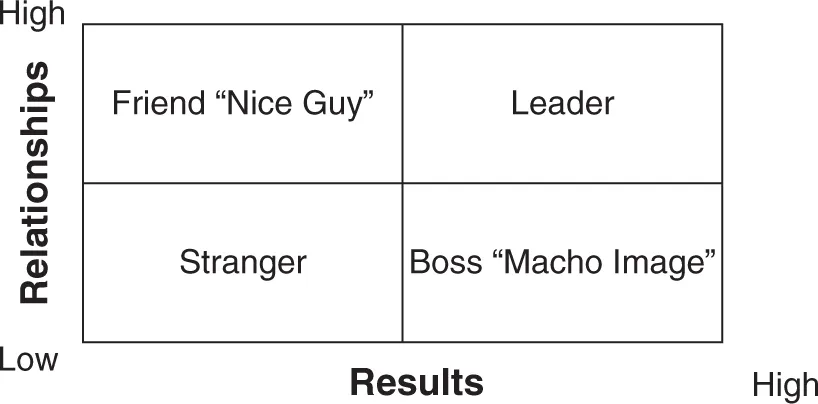
A boss focuses more on performance at the expense of the relational dimension of leadership. He is more concerned with the work output than the welfare of his people. He can be counted upon to deliver business results but will leave people burned out in the process. Most companies run the boss-like model of leadership—working conditions are horrible, performance targets are unrealistic, and threats of sack are used to motivate people to keep delivering on those unrealistic targets.
A friend focuses more on the relational dimension at the expense of results. A friend is more concerned about your welfare than your work output. You enjoy the company of a friend but won’t trust him with critical and sensitive organizational issues. The challenge with a friend is that the means (people) become the end. As long as the people are happy even though performance is suffering, a friendly leader is satisfied. This type of leader will not make the tough calls for the organization to succeed if they will somehow affect those relationships.
A stranger is the worst of both worlds—at least you know what you are getting from a friend or boss. A stranger does not build relationships or accomplish results. He is cold, aloof, emotionally volatile, incompetent, and lacks the follow through to achieve business results.
A leader, on the other hand, achieves results and drives performance through people. He harnesses the power of relationships to deliver outstanding results. He combines the attitude of a boss, relentlessly focusing on performance, with that of a friend, creating healthy, collaborative relationships with his team. Consequently, a leader is more than a friend and more than a boss. He is also more than an individual contributor—one who achieves results by the force of his personality and the strength of his skills. He achieves results only through people, people who become better and more productive and more satisfied under his watch, people who will eventually call him their leader!
This section covers six topics:
- Leadership: It’s not about you!
- You are your first follower!
- Decisiveness
- Love what you do, whom you do it with, and whom you do it for
- Service-oriented leadership
- How will you be remembered?
CHAPTER 1
Leadership: It’s Not about You!
Leadership begins with attitude. No title or position can make a true leader out of a man with a negative attitude.
It’s Not about You!
Michael is aggressive and very competitive by nature. He likes the spotlight and is not afraid of confronting problems or people headlong. Due to his aggressive nature, he can be counted upon to achieve business results. The challenge, however, is that Michael doesn’t care about people’s feelings in the process. He is impatient with people he considers slow learners or who do not see things from his perspective, and usually, it is either his way or the highway. He is a classic workplace bully. He has been promoted to the position of a branch manager. Will Michael make a good leader?
While ambition can guarantee personal success, ambition alone cannot guarantee effective leadership. Without ambition—the personal drive or desire for success—individuals cannot succeed, but without the right attitude, they cannot become effective leaders. We have established that leadership is relationships × results. Leaders who fail to maintain the right balance between ambition for results and the right attitude of developing positive relationships with their constituents will eventually lose their leadership effectiveness. So, while Michael may possibly achieve results in the short to medium term, he will not achieve sustainable results in the long term unless he changes his attitude. The lesson is obvious: Unrestrained ambition or oversized ego destroys!
All leaders are ambitious, but the focus of their ambitions is what differentiates great leaders from ordinary leaders. Great leaders are incredibly ambitious, but so are mediocre leaders. The difference is that great leaders are ambitious about their organizations. They have subsumed their personal ambitions for the greater good of their organizations and nations. Their ambitions—build a world-class company, lead the market, and achieve breakthrough results—can be witnessed through their organization’s success. To these leaders, leadership is about building enduring institutions that will consistently outperform their competitors. They take a long-term view of leadership and leading.
Both Andrew Grove of Intel and Steve Jobs of Apple Inc. commented that their greatest achievements were in building a strong company. Grove, in an interview with Nightly Business Report coanchor Susie Gharib said, “My proudest accomplishment has been to contribute to the creation of a company that has helped put a billion PCs into people’s hands.”1 Was he ambitious? Of course! But his ambition was channeled into building a great company—attitude. For ordinary leaders, however, their ambitions are for their own personal gain—their personal benefits at the expense of their institutions and the people they are meant to serve. To these second group of leaders, life and leadership are all about them, just like it is with Michael.
In his best-selling book Good to Great: Why Some Companies Make the Leap and Others Don’t, Jim Collins wrote about this same concept. Writing about what he termed “Level 5” leadership, the first ingredient necessary to transform a good company into a great company, he noted,
Level 5 leaders channel their ego needs away from themselves and into the larger goal of building a great company. It’s not that Level 5 leaders have no ego or self-interest. Indeed, they are incredibly ambitious—but their ambition is first and foremost for the institution, not themselves.
It’s Time to Grow Up
I have seen this negative, overambitious attitude play out at the personal, organizational, and national levels. And every time I see it, I can always predict that such individuals and the organizations that they run or the nations they preside over are doomed to mediocrity and failure as there is usually no hope for people who think that life and leadership are all about them. When we think that we are the center of the universe, we show how small our world is and how immature and childish our understanding of leadership and life is because a child simply thinks only about herself.
A country is doomed if its leader is immature and its high officials throw parties in the morning.
—Ancient Wisdom
In a child’s world, only one person exists—her. Every other person is secondary. It’s all about her, her desires, and her wants, just like Michael. But as the child begins to grow, a transition happens: She begins to see life from others’ perspectives. She learns that the family is not just about her, that others do not exist just to make her happy. The growth in perspective happens when the child now learns that life ultimately is not just about her.
Just as a child’s growth always comes with a change in perspectives, leadership development and maturity happen when our perspectives on leadership change—when we understand that it is not just all about us. In life and in leadership, we all start out as children, emotionally immature and selfish, thinking only about our own wants, desires, and goals. We listen to only one station, WII-FM, an acronym that stands for “What’s in it for me?” But as we grow, we come to see the needs, dreams, and aspirations of other members of the team.
There are two characteristics of leadership growth and maturity. The first is consideration. We begin to think about others—their feelings, fears, and views. Today, this concept is called diversity. The second is inclusion. When we consider others, we include them in our plans, and include their views before arriving at a decision. The result of consideration and inclusion is the ability to subordinate one’s desires for the greater good of the team. Consideration and inclusion help us pursue a course that will be beneficial to everybody in the team and not only ourselves. You know that someone is growing and will likely make a good leader when his language changes from “I” to “We,” from “What I want” to “What we—the team—wants.” So sorry, Michael, you won’t make a good leader!
The leaders who work most effectively, it seems to me, never say “I.” And that’s not because they have trained themselves not to say “I.” They don’t think “I.” They think “we”; they think “team.” They understand their job to be is to make the team function. They accept responsibility and don’t sidestep it, but “we” gets the credit. This is what creates trust, what enables you to get the task done.
—Peter F. Drucker
Individuals with skills but without the right attitude will not realize their potentials, and individuals with ambition but without the self-restraint of a positive attitude will self-destruct. Michael’s career will be derailed if he doesn’t learn this lesson and make the necessary adjustments on time.
Lasting success is impossible without the right attitude. While attitude alone doesn’t guarantee success, true and lasting success is impossible without it. I see attitude as the trim tab that determines whether potential will be harnessed and realized. Most leaders fail not because they do not have the potential for success but simply because their attitude of and understanding about leadership undermined their ability to succeed.
success = potential × attitude
What exactly is attitude? It is a mindset, a way of thinking that manifests in behaviors. It is your understanding (or lack thereof) about an issue that shapes your views and governs your pursuits. It is your disposition about life, people, and circumstances in general. It is your biases, assumptions, and prejudices that color your understanding of and response to situations. In aeronautics, it is “the position of the aircraft orspacecraft relative to a frame of reference (the horizon or direction of motion)”.2 That is, the attitude of the airplane reflects the direction of movement of the plane. Consequently, the direction of your life followsyour personal attitude. If I know your attitude about an issue, I can almost always predict your behaviors in that context.
Wrong Attitudes toward Leadership
Since this is a book about leadership and not about attitude in general, the focus will be on the wrong attitudes toward leadership. I see two major wrong attitudes toward leadership.
Leadership Is about Positions and Titles
A great misunderstanding about leadership today is the impression that leadership is all about positions and titles. We call people who have titles “leaders.” Nothing can be further from the truth. Although titles confer some measure of positional authority on individuals, they don’t confer leadership. This is due to the fact that positional authority is usually formal, it resides in the position and not in the person, consequently, followership is forced not voluntary. True leaders may sometimes have positions and titles, but it wasn’t their positions and titles that made them leaders. They are leaders because of who they are and what they did for others.
Look at it this way—a male is different from a man. Being a male is determined by your sex chr...
Table of contents
- Cover
- Half Title Page
- Title Page
- Copyright
- Dedication
- Contents
- Acknowledgments
- Introduction
- Section 1 Now that You Are the Leader
- Section 2 Inspire and Influence Your Team
- Section 3 Achieve Extraordinary Results
- Notes
- About the Author
- Index