- 186 pages
- English
- ePUB (mobile friendly)
- Available on iOS & Android
eBook - ePub
About this book
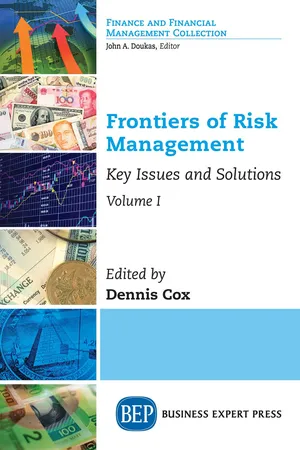
Frontiers of Risk Management was developed as a text to look at how risk management would develop in the light of Basel II. With an objective of being 10 years ahead of its time, the contributors have actually had even greater foresight. What is clear is that risk management still faces the same challenges as it did ten years ago. With a series of experts considering financial services risk management in each of its key areas, this book enables the reader to appreciate a practitioners view of the challenges that are faced in practice identifying where appropriate suitable opportunities.
Trusted by 375,005 students
Access to over 1.5 million titles for a fair monthly price.
Study more efficiently using our study tools.
Information
Topic
Negocios y empresaSubtopic
FinanzasPART I
Total Risk Management
CHAPTER 1
The Cultural Frontiers of Total Risk Management
Dennis Cox
Risk Reward Ltd
Introduction
Peter Bernstein’s Against the Gods1 illustrates how the remarkable story of risk has been an ever-evolving one, where the frontiers of risk have continually been pushed back with new breakthroughs in our understanding of risk and consequently in our improved ability to identify, measure, and manage risk. Best practices in risk management continue to be designed, defined, and refined by industry participants and their stakeholders. Indeed, there are libraries of books, reams of research papers, and years of discussion dedicated to the continual improvements that are being made in risk identification, measurement, and management. This will remain a perpetual frontier of risk management. However, rather than revisiting these best practices, I would like to focus on some of the other challenges faced by risk managers today. For many, one of the key frontiers is not to design or define new best practices—it is to embed established best practices in the management of their firms. In facing this frontier, the challenge is neither conceptual nor computational, it is in fact cultural.
Risk managers face many challenges today in supporting their businesses. These include the increasing demands on our industry by regulators, investors, and legislators. Regulators have redefined the minimum capital adequacy standards for the industry via Basel II and its successors. Rating agencies and investors are increasingly demanding about the standards of risk disclosures by firms. Legislators, via the Sarbanes-Oxley Act and similar papers, are increasingly holding management boards personally responsible for the corporate governance of their firms. Management boards, in turn, are consequently becoming more demanding of their own risk functions. This is a very heavy change agenda for risk managers and one which often meets with significant cultural challenges in many firms—particularly in more traditional firms. We will now review some of the cultural challenges faced by risk managers.
Beyond Minimum Compliance
Of the multifarious challenges faced by risk managers today, the increasing regulation of our industry has understandably attracted much focus. Despite the heavy regulatory burden, we need to remain mindful not to focus solely on minimum regulatory compliance. In an era of increasing regulatory demands, where compliance fatigue is a common industry ailment, it is easy to forget our primary purpose; that of more effective and efficient business management for our shareholders. The danger is that firms develop a culture of minimum compliance. Of course, regulatory compliance can often be compatible with better enterprise risk management. For example, the development of internal rating models is not just a means to achieving regulatory compliance. Rating models are merely decision tools that must be utilized better to manage risk and extract business benefits. For example, the development of Basel-compliant models, which are externally validated by regulators, will open up new opportunities to mitigate risk in portfolios, which previously could not easily be traded due to difficulties of consistently measuring different risks in different firms. The emphasis on model use is a common and necessary theme throughout the Basel II use test requirements.
Improved Risk Communication
As a result of the increasing regulation and complexity of our business, there are growing requirements for better risk communication with all stakeholders. Internal stakeholders need to understand the more complex regulatory capital impacts on their businesses and how their firms need to respond strategically. Risk managers must proactively engage the business generators in their firms by communicating the strategic context of the change agenda and facilitating their firms in responding strategically to those changes. Business generators, who have their own market-driven priorities, also need to engage with and support risk managers. Without such a partnership approach, neither will achieve their strategic objectives from the heavy change agenda.
Risk management itself is ever evolving. In the same way that risk managers utilize the tools of modern portfolio management theory and value-at-risk methodologies, they must also utilize the communication skills within their toolboxes. In doing so, they must move away from the boilerplate language, with its often specialist jargon, and engage stakeholders on their terms. This is both a cultural challenge and an opportunity for risk managers to be more centrally involved in the management of their firms.
Enterprise Risk Management
With management board members now personally responsible for the corporate governance of their firms, they are rightly more demanding of their risk functions in terms of risk comprehension and risk assurance. Management boards are responsible for the economic health of the entire business and are consequently more interested in an integrated view of all risks and how these risks might change and interact in response to various scenarios. This is often termed an enterprise risk management (ERM) approach which encompasses credit, market, operational, and other material risks2 for the enterprise as a whole. An ERM approach is very different to the traditional “silo-based” approach to risk management where different risk components are managed in separate silos (e.g., credit risk vs. market risk) with little interaction between silos. An ERM approach to risk management seeks to create the ability to integrate risks and report them at consolidated levels while recognizing potential diversification benefits both within and across risks. The Risk Management Association (RMA) defines ERM as:
a holistic approach to measuring and managing major risk types based on their simultaneous consideration (and inter-relationships where appropriate), thus allowing an institution to understand and adjust its risk exposures in an overall risk-reward framework.3
There is already much literature available on what an ERM approach entails. Suffice to say, management boards need to refocus on an integrated view of risks across their enterprises and accordingly will seek risk assurances in a similar vein. However, introducing an ERM approach is a major undertaking for any firm and poses significant cultural challenges.
Integration of Risk Silos
These cultural challenges arise as many firms still manage their risks quite strictly within risk silos. This silo-based approach often pervades the entire risk infrastructure of a firm, including its systems, processes, and people. Risk information systems are often designed specifically for one risk type and can impede integration or aggregation with other risk types. In addition to the difficulties in integrating risk information across risk silos, risk information can sometimes be difficult to integrate with other related information (such as earnings), thereby making it more difficult to evaluate risk—reward trade-offs either within or across risk types. Decision-making processes also tend to have different risk committees and risk personnel who evaluate different risks based on different evaluation criteria.
For example, while a VaR4 approach to market risk is well accepted in many firms, there is no reason why a credit VaR approach could not equally be employed in the same firms. Aside from the obvious but surmountable data constraints, why is it acceptable for a quantitative portfolio management approach to be adopted for one risk type (i.e., market risk) and not for another (i.e., credit risk) within the same firm? Even where different risks are not easily aggregated, we need to begin to speak the same language—for example, economic capital—and develop nomenclature across risk categories if we are to have an integrated view of enterprise risks.
However, while changing the systems and processes in a firm is one thing, changing the embedded staff culture of a firm is another entirely. Herein lies the real cultural challenge for any enterprise in seeking to adopt a more integrated approach to risk management. In many firms, risk professionals tend to operate in one silo (e.g., credit risk) with little interaction with other silos (e.g., market risk) and consequently tend to have little understanding of, or perhaps interest in, other risks. Moreover, professional progression and reward is often based on technical expertise within one silo and consequently those who succeed in becoming senior risk officers tend to have the majority of their experience in only one risk silo. Where this happens, risk managers do not receive the best preparation for understanding or managing enterprise-wide risks.
Staff Development
The divisions between risk silos are in many ways cultural divisions. To break down these cultural divisions, firms must invest in extensive training and development of their staff so that they can take a more integrated view of enterprise risks. They must encourage and promote job rotation across risk types in order to break down the artificial barriers between different risk silos. Job rotation between risk functions and the business also need to be encouraged so that the symbiotic nature of their relationship is recognized by all. Equally, staff must be willing, and incentivized if necessary, to become more risk-literate and consequently more quantitatively literate. Unless this is done, an ERM approach will remain an aspirational objective in many firms.
In addition to the training and development of staff, many firms may also need to look to the skills balance of staff across risk functions. In many traditional firms today, the majority of risk professionals remain focused on credit risks such that the cost of credit risk management is often a multiple of the actual expected loss for a portfolio. This is despite increasing evidence that the major killer risks faced by firms are increasingly of a nontraditional...
Table of contents
- Cover
- halftitle
- title
- copyright
- abstract
- contents
- Foreword
- Introduction
- part 1
- 01_Chapter 1
- 02_Chapter 2
- 03_Chapter 3
- 04_Chapter 4
- 05_Chapter 5
- part2
- 06_Chapter 6
- 07_Chapter 7
- 08_Chapter 8
- 09_Chapter 9
- 10_Chapter 10
- part 3
- 11_Chapter 11
- 12_Chapter 12
- 13_Chapter 13
- 14_Bios
- 15_Index
- 16_Adpage
Frequently asked questions
Yes, you can cancel anytime from the Subscription tab in your account settings on the Perlego website. Your subscription will stay active until the end of your current billing period. Learn how to cancel your subscription
No, books cannot be downloaded as external files, such as PDFs, for use outside of Perlego. However, you can download books within the Perlego app for offline reading on mobile or tablet. Learn how to download books offline
Perlego offers two plans: Essential and Complete
- Essential is ideal for learners and professionals who enjoy exploring a wide range of subjects. Access the Essential Library with 800,000+ trusted titles and best-sellers across business, personal growth, and the humanities. Includes unlimited reading time and Standard Read Aloud voice.
- Complete: Perfect for advanced learners and researchers needing full, unrestricted access. Unlock 1.5M+ books across hundreds of subjects, including academic and specialized titles. The Complete Plan also includes advanced features like Premium Read Aloud and Research Assistant.
We are an online textbook subscription service, where you can get access to an entire online library for less than the price of a single book per month. With over 1.5 million books across 990+ topics, we’ve got you covered! Learn about our mission
Look out for the read-aloud symbol on your next book to see if you can listen to it. The read-aloud tool reads text aloud for you, highlighting the text as it is being read. You can pause it, speed it up and slow it down. Learn more about Read Aloud
Yes! You can use the Perlego app on both iOS and Android devices to read anytime, anywhere — even offline. Perfect for commutes or when you’re on the go.
Please note we cannot support devices running on iOS 13 and Android 7 or earlier. Learn more about using the app
Please note we cannot support devices running on iOS 13 and Android 7 or earlier. Learn more about using the app
Yes, you can access Frontiers of Risk Management, Volume I by Dennis Cox in PDF and/or ePUB format, as well as other popular books in Negocios y empresa & Finanzas. We have over 1.5 million books available in our catalogue for you to explore.