A groundbreaking exploration of biocitizenship
Citizenship has a long, complex relationship with the body. In recent years, developments in biomedicine and biotechnology, as well as a number of political initiatives, grassroots efforts, and public policies have given rise to new ways in which bodies shape the idea and practices of citizenship, or what has been called "biocitizenship." This book, the first collection of essays on the topic of biocitizenship, aims to examine biocitizenship as a mode of political action and expand readers' understanding of biopolitics.
Organized into four distinct sections covering topics including AIDS, drug testing on the mentally ill, and force-feeding prisoners, Biocitizenship delves deep into the relationship between private and public identity, politics, and power. Composed of pieces by leading scholars from a wide variety of disciplines, Biocitizenship offers a clear and comprehensive discussion on biocitizenship, biopolitics, and groups that may be affected by this ever-growing dialogue. Authors address issues familiar to biopolitics scholarship such as gender, sexuality, class, race, and immigration, but also consider unique objects of study, such as incubators, dead bodies, and corporations.
Biocitizenship seeks to question who may count as a biological citizen and for what reasons, an essential topic in an age in which the body and its health provide the conditions necessary for political recognition and agency.
eBook - ePub
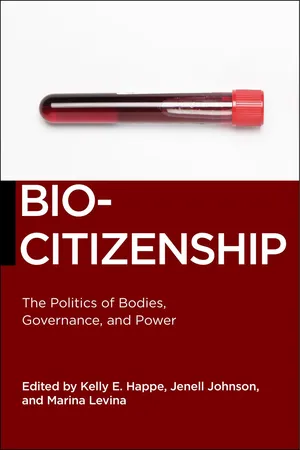
Biocitizenship
The Politics of Bodies, Governance, and Power
- 340 pages
- English
- ePUB (mobile friendly)
- Available on iOS & Android
eBook - ePub
Biocitizenship
The Politics of Bodies, Governance, and Power
About this book
Information
Part I
Categorical Understandings
1
Governing Sexual Health
Bridging Biocitizenship and Sexual Citizenship
Steven Epstein
For two days in April 2010, staff employees at the U.S. Centers for Disease Control and Prevention (CDC) sat down with sixty-seven invited experts and stakeholders to hash out an agenda for the nation’s sexual health. Dr. Kevin Fenton, the director of the CDC’s National Center for HIV/AIDS, Viral Hepatitis, STD, and TB Prevention, told those assembled: “Sexual health is a state of physical, emotional, mental, and social well-being in relation to sexuality and is not merely the absence of disease, dysfunction, or infirmity.”1 Noting that the U.S. Department of Health and Human Services (HHS) had recently designated sexual health and responsible sexual behavior as one of ten leading health indicators, Fenton called for a “radically inclusive” public health approach to promoting sexual health, one that would “bring new partners to the table.”2 The group of attendees was, in fact, diverse and included leaders from the National Coalition of STD Directors, the National Coalition for LGBT Health, and the National Alliance of State and Territorial AIDS Directors, along with representatives of the Ford Foundation’s Sexuality, Reproductive Health and Rights Program, the Navy and Marine Corps’ Sexual Health and Responsibility Program, and the Metropolitan Interdenominational Church.
While this meeting was distinctive, it was neither the first nor the last occasion on which something specifically called sexual health has been made the object of governmental scrutiny and policy making in the United States, or deemed a key linkage point between individual conduct and social membership. Nine year earlier, at the dawn of the new millennium, Surgeon General David Satcher issued the landmark “Call to Action to Promote Sexual Health and Responsible Sexual Behavior.” Sexual health has also been featured as a chief goal in important federal planning documents, including HHS’s National Prevention Strategy and HHS’s most recent decennial health promotion agenda for the nation, “Healthy People 2020.”3
These efforts have sought to make sexual health an object of governance—and to link governing efforts with the self-governance of individuals.4 Such developments raise questions that are both practical and theoretical. What is the place of the sexual in a well-developed conception of biocitizenship? What is the place of the biomedical in our understandings of sexual citizenship? In this chapter I seek to show how a focus on the social management of the sexual health of citizens prompts a dual expansion of view: on one hand, an enlargement of biocitizenship to encompass the embodied nature of sexual pleasure and risk, and on the other hand, an enhanced understanding of sexual citizenship to highlight the roles of public health officials, in engagement with ordinary citizens, in defining sexual meanings, practices, rights, responsibilities, and identities. I begin by locating my project in relation to the literature on citizenship, biocitizenship, and sexual citizenship, building an intersectional concept that Aaron Norton has termed “biosexual citizenship.”5 Then, I describe two historical moments in which state regulation of sexual conduct has emphasized health and medical concerns: the “social hygiene” era in the turn-of-the-twentieth-century United States, and the “sexual health” era, which dates to the mid-1970s but became a formal feature of governance with the surgeon general’s “Call to Action” in 2001.6
Examining these two moments helps me to call attention to important continuities in how notions of “sexual responsibility” have been made central to conceptions of the good citizen. Yet the juxtaposition of these historical episodes also points to certain relatively distinct characteristics of biocitizenship and governance in the recent era of sexual health. I emphasize several points of divergence that I suggest are loosely linked, including the knitting together of ideas of rights and responsibilities in relation to sexuality, the kinds of science and forms of evidence that undergird sexual health governance, the political openings afforded by a policy emphasis on reducing health disparities, and the salience of a practical emphasis on consensus formation and inclusiveness. I conclude by suggesting that these characteristics of modern sexual health governance provide openings for, but also impose constraints on, the active exercise of biosexual citizenship “from below.” Individuals and groups confronting sexual health challenges such as the HIV/AIDS epidemic must negotiate their way around these terms of citizenship—or else find themselves positioned as standing “against health.” The case therefore highlights the tensions between the top-down and bottom-up dimensions of biosexual citizenship.
Fleshing out “Biosexual Citizenship”
By “citizenship,” I refer to differentiated modes of incorporation of individuals or groups fully or partially into a polity through the articulation of notions of rights and responsibilities.7 Citizenship is not an “either/or”: in place of a static notion of citizenship as something one either fully possesses or fully lacks, it makes sense to understand the boundaries of citizenship as the outcome of ongoing struggles that reflect “constantly shifting relationships of power.”8 According to Lauren Berlant, citizenship “is continually being produced out of a political, rhetorical, and economic struggle over who will count as ‘the people’ and how social membership will be measured and valued.”9 Hence, as many scholars have described, the history of citizenship as a category of universal membership is simultaneously a history of exclusion, and citizenship has been defined in practice by means of the creation or dismantling of a wide range of social divisions and hierarchies.10
As Christian Joppke has observed, citizenship should be thought of simultaneously as a status (membership governed by rules of access), as rights that attach to that status, and as an identity articulated in relation to a political collectivity.11 While some discussions of citizenship—for example, some writings on cultural citizenship12—veer in the direction of including within its ambit nearly any form of belonging or affinity, I prefer to reserve the term for cases where the reference point includes some sort of political community (though in the broadest sense of “political”) associated with a state, government, or polity (whether national, transnational, local, or translocal).
Biocitizenship
As the essays in this volume attest, biocitizenship (and its various cousins, including biological citizenship, biopolitical citizenship, genetic citizenship, therapeutic citizenship, etc.) is an evocative label that has been used in many ways.13 Just as I believe that not every form of belonging should be called citizenship, I would similarly distinguish between “biosociality” and biocitizenship. As described by Paul Rabinow in an influential formulation, biosociality refers to the bases for affiliation provided by various sorts of classifications created, or given a transformed meaning, by the life sciences—for example, all those who share a disease, a treatment, a genetic risk factor, an exposure, or even a sex or a race.14 As suggested earlier, I would prefer to reserve “biocitizenship” for those moments when biosociality references a political community. However, it is important to say that this can happen in many different ways.
In an early usage, Adriana Petryna described how, in the Ukraine after the nuclear accident at Chernobyl, “the damaged body of a population [became] the grounds for social memberships and the basis for staking citizenship claims.”15 Others have pointed to patient activism or other political organizing around disease states or genetic risk factors as quintessential examples of biocitizenship.16 In a somewhat different register, in my own earlier work I used the term “biopolitical citizenship” to describe how biomedical classification of social groups (according to race, gender, sexuality, etc.) has proceeded hand in hand with political struggles to direct medical attention and public resources to such groups—and how the question of numerical representation in clinical trials became joined to that of political representation in U.S. society.17 Still others refer to the biotechnologies used to police membership in a nation-state as mechanisms of biometric or biopolitical citizenship.18 Finally, Nikolas Rose and Carlos Novas, while referencing many of the aspects of biocitizenship described here, also call attention to processes of self-formation—“the creation of persons with a certain kind of relation to themselves [who] use biologically colored languages to describe aspects of themselves or their identities, and to articulate their feelings of unhappiness, ailments, or predicaments.”19
As Nicole Charles has observed in a critical commentary on Rose and Novas’s emphasis on self-formation, such processes of constructing biocitizens in practice are often “prompted ‘from above’” in ways that may be coercive and damaging.20 Yet her own example of human papillomavirus (HPV) vaccination can be turned against her: while she correctly points to how public health campaigns to promote HPV vaccination call forth a gendered responsible citizen,21 she misses the contrary example of groups such as gay health advocates who have used the issue of HPV strategically and in a sex-positive way to demand biomedical inclusion and state attention.22 Thus biocitizenship is often double-sided, as several scholars have noted, and it may become manifest in ways that are either “top-down” and imposed, or “bottom-up” and achieved, or some complex combination of the two.23
Drawing on these various shades of meaning in recent discourse on biocitizenship, I now seek to extend the focus of biocitizenship studies by signaling the importance of sexuality. Put another way, I want to emphasize the place of the sexual in an expanded conception of biocitizenship, but also the place of health and biology in an expanded conception of sexual citizenship.
From Sexual Citizenship to “Biosexual Citizenship”
Much like biocitizenship, the term “sexual citizenship” has proved productive despite—or perhaps because of—the lack of agreement about either its definition or its practical implications.24 The concept has been used widely and variously to describe sexual rights claimed by citizens that may or may not be recognized by the state; the claims to equal treatment of groups such as sexual minorities; the heteronormative presumptions and functions of citizenship more generally; policing by state agencies of the boundaries between “good” and “bad” sexuality; and state-sponsored projects of subject formation via the inculcation of specific norms related to sexuality.25
At the greatest level of generality, we can describe sexual citizenship as the claim to rights and assumption of responsibilities associated with the multiple dimensions of exclusion or incorporation that stem from sexual practices, identities, norms, and attributions. Yet despite the long history of medical involvement in categorizing and evaluating sexualities, only occasionally has the sexual citizenship literature trained its attention on matters of health and biomedicine—most notably, in relation to the HIV/AIDS epidemic. For example, Carlos Decena has explored questions of “ethical sexual citizenship” in relation to federal health officials’ exhortations to non-gay-identified men who have sex with men to “come out” as gay, while Jeffrey Bennett, in his book Banning Queer Blood, has examined how a policy of the Food and Drug Administration that has been in place since the early years of the epidemic separates gay men from civic participation while “constructing queer identity through representations of diseased and undisciplined sexuality.”26 In relation to a different health threat, I have addressed the intertwining of the sexual and the biomedical dimensions of citizenship by characterizing the case of gay men’s advocacy around anal cancer and its causal agent, HPV, as a fight “waged simultaneously on two fronts—as one of many present-day struggles against health inequalities, and as one of many present-day struggles for ...
Table of contents
- Cover
- Title Page
- Copyright Page
- Contents
- Introduction
- Part I. Categorical Understandings
- Part II. Modes of Governance
- Part III. Activism and Resistance
- Part IV. Beyond the Biocitizen
- Acknowledgments
- About the Contributors
- Index
Trusted by 375,005 students
Access to over 1.5 million titles for a fair monthly price.
Study more efficiently using our study tools.
Frequently asked questions
Yes, you can cancel anytime from the Subscription tab in your account settings on the Perlego website. Your subscription will stay active until the end of your current billing period. Learn how to cancel your subscription
No, books cannot be downloaded as external files, such as PDFs, for use outside of Perlego. However, you can download books within the Perlego app for offline reading on mobile or tablet. Learn how to download books offline
Perlego offers two plans: Essential and Complete
- Essential is ideal for learners and professionals who enjoy exploring a wide range of subjects. Access the Essential Library with 800,000+ trusted titles and best-sellers across business, personal growth, and the humanities. Includes unlimited reading time and Standard Read Aloud voice.
- Complete: Perfect for advanced learners and researchers needing full, unrestricted access. Unlock 1.5M+ books across hundreds of subjects, including academic and specialized titles. The Complete Plan also includes advanced features like Premium Read Aloud and Research Assistant.
We are an online textbook subscription service, where you can get access to an entire online library for less than the price of a single book per month. With over 1.5 million books across 990+ topics, we’ve got you covered! Learn about our mission
Look out for the read-aloud symbol on your next book to see if you can listen to it. The read-aloud tool reads text aloud for you, highlighting the text as it is being read. You can pause it, speed it up and slow it down. Learn more about Read Aloud
Yes! You can use the Perlego app on both iOS and Android devices to read anytime, anywhere — even offline. Perfect for commutes or when you’re on the go.
Please note we cannot support devices running on iOS 13 and Android 7 or earlier. Learn more about using the app
Please note we cannot support devices running on iOS 13 and Android 7 or earlier. Learn more about using the app
Yes, you can access Biocitizenship by Kelly E. Happe,Jenell Johnson,Marina Levina, Kelly E. Happe, Jenell Johnson, Marina Levina in PDF and/or ePUB format, as well as other popular books in Social Sciences & Public Policy. We have over 1.5 million books available in our catalogue for you to explore.