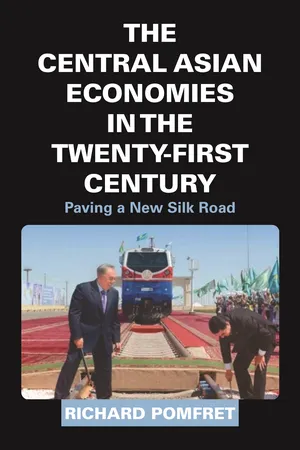
This book analyzes the Central Asian economies of Kazakhstan, the Kyrgyz Republic, Tajikistan, Turkmenistan, and Uzbekistan, from their buffeting by the commodity boom of the early 2000s to its collapse in 2014. Richard Pomfret examines the countries' relations with external powers and the possibilities for development offered by infrastructure projects as well as rail links between China and Europe.
The transition of these nations from centrally planned to market-based economic systems was essentially complete by the early 2000s, when the region experienced a massive increase in world prices for energy and mineral exports. This raised incomes in the main oil and gas exporters, Kazakhstan and Turkmenistan; brought more benefits to the most populous country, Uzbekistan; and left the poorest countries, the Kyrgyz Republic and Tajikistan, dependent on remittances from migrant workers in oil-rich Russia and Kazakhstan. Pomfret considers the enhanced role of the Central Asian nations in the global economy and their varied ties to China, the European Union, Russia, and the United States. With improved infrastructure and connectivity between China and Europe (reflected in regular rail freight services since 2011 and China's announcement of its Belt and Road Initiative in 2013), relaxation of United Nations sanctions against Iran in 2016, and the change in Uzbekistan's presidency in late 2016, a window of opportunity appears to have opened for Central Asian countries to achieve more sustainable economic futures.
eBook - PDF
The Central Asian Economies in the Twenty-First Century
Paving a New Silk Road
- 329 pages
- English
- PDF
- Available on iOS & Android
eBook - PDF
About this book
Information
Topic
ÉconomieSubtopic
Économie du développementTable of contents
- Cover Page
- Title Page
- Copyright Page
- Contents
- List of Images and Tables
- Preface
- Abbreviations
- Part I. The Background
- Part II. The National Economies
- References
- Index
Trusted by 375,005 students
Access to over 1.5 million titles for a fair monthly price.
Study more efficiently using our study tools.
Frequently asked questions
Yes, you can cancel anytime from the Subscription tab in your account settings on the Perlego website. Your subscription will stay active until the end of your current billing period. Learn how to cancel your subscription
No, books cannot be downloaded as external files, such as PDFs, for use outside of Perlego. However, you can download books within the Perlego app for offline reading on mobile or tablet. Learn how to download books offline
Perlego offers two plans: Essential and Complete
- Essential is ideal for learners and professionals who enjoy exploring a wide range of subjects. Access the Essential Library with 800,000+ trusted titles and best-sellers across business, personal growth, and the humanities. Includes unlimited reading time and Standard Read Aloud voice.
- Complete: Perfect for advanced learners and researchers needing full, unrestricted access. Unlock 1.5M+ books across hundreds of subjects, including academic and specialized titles. The Complete Plan also includes advanced features like Premium Read Aloud and Research Assistant.
We are an online textbook subscription service, where you can get access to an entire online library for less than the price of a single book per month. With over 1.5 million books across 990+ topics, we’ve got you covered! Learn about our mission
Look out for the read-aloud symbol on your next book to see if you can listen to it. The read-aloud tool reads text aloud for you, highlighting the text as it is being read. You can pause it, speed it up and slow it down. Learn more about Read Aloud
Yes! You can use the Perlego app on both iOS and Android devices to read anytime, anywhere — even offline. Perfect for commutes or when you’re on the go.
Please note we cannot support devices running on iOS 13 and Android 7 or earlier. Learn more about using the app
Please note we cannot support devices running on iOS 13 and Android 7 or earlier. Learn more about using the app
Yes, you can access The Central Asian Economies in the Twenty-First Century by Richard Pomfret in PDF and/or ePUB format, as well as other popular books in Économie & Économie du développement. We have over 1.5 million books available in our catalogue for you to explore.