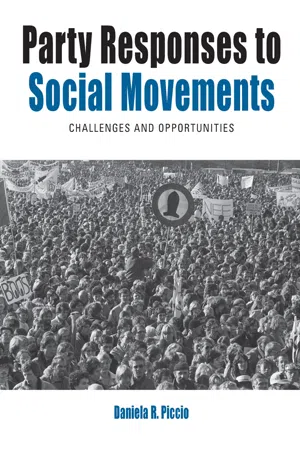
Across the West, the explosion of social movement activity since the late 1960s has constituted a "participatory revolution" that has posed profound challenges for formal political parties. Through an analysis of new interviews, institutional documents, and a host of other largely unexploited sources, Daniela R. Piccio provides a rich and empirically grounded exploration of the wide-ranging responses to these movements. Focusing on Italy and the Netherlands since the 1970s, Party Responses to Social Movements demonstrates how political parties have incorporated the demands of movements to a surprising extent, even as both have grappled with fundamental and inevitable tensions between their respective roles and aims.
- 224 pages
- English
- ePUB (mobile friendly)
- Available on iOS & Android
eBook - ePub
About this book
Trusted by 375,005 students
Access to over 1.5 million titles for a fair monthly price.
Study more efficiently using our study tools.
Information
Chapter 1
Politics beyond Parties
The late 1960s were years of major transformations in West European party systems. This happened, as it has been often noted, as soon as Lipset and Rokkan were putting the finishing touches to their analysis of the stability of these systems. Their influential ‘freezing hypothesis’ held that the configuration of West European party systems of the 1960s still reflected the 1920s cleavage structures. ‘The party alternatives,’ they argued, ‘and in remarkably many cases the party organizations, are older than the majorities of the national electorates’.1 Indeed, until the 1970s, ‘the first priority of social scientists concerned with the development of political parties and party systems [was] to explain the absence of change’.2 From the late 1960s, many countries experienced a shift from a situation of stability and tranquillity to a situation of sudden change. The Danish ‘earthquake elections’ of 1973 are traditionally known among political scientists as the most paradigmatic illustration of this turning point in Western democracies. Denmark, one of the countries that inspired Lipset and Rokkan’s book, experienced a massive shift in voting behaviour, as the number of parties represented in the Folketing doubled from five to ten, the vote share of the four traditional parties decreased from 84 per cent to 58 per cent, and a new protest party entered the parliament for the first time, with over 15 per cent of the votes. The Danish case was exceptional but not isolated, as party system stability was fractured in other countries such as Norway, the United Kingdom, Belgium and France. The two countries under consideration in this book, Italy and the Netherlands, therefore, do not stand as an insulated phenomenon. They should be understood in the context of broader changes in the social structure that led, among other things, to a waning sense of identification between particular groups of citizens and the political parties that formerly represented their interests.
The first part of the chapter will set the context of this study, explaining the ongoing changes in the meaning and the intensity of citizens’ political commitment to political parties in both countries and the formation of new channels of political engagement. The second part of the chapter critically reviews the state of the art on the relationship between social movements and political parties and advances a framework that attempts to explain what factors determine whether (and the extent to which) party responses to social movements take place. Finally, the main characteristics of the four social movements under consideration in this work are presented.
Uncertainty on the Rise
From the late 1960s, a number of external events challenged the representational strength of the traditional parties and affected, to a different extent and timing, the stability of the Italian and the Dutch party systems described earlier in the Introduction. Modernization processes, rising educational levels, urbanization, greater levels of social and territorial mobility, and the emergence of a new post-war generation laid the basis for what Andeweg called a ‘political de-confessionalization’.3
For the case of Italy, the shape of the party system remained fundamentally unaltered until the 1980s, and volatility levels show no major quantitative shifts across parties. The symptoms of a more unstable environment for parties lie rather in qualitative changes, as scholars pointed to a different and new relationship between citizens and political parties in Italy. In a study conducted at the end of the 1970s, Parisi and Pasquino observed that if vote distribution had not fundamentally changed, ‘the meaning and the intensity of political commitment have qualitatively transformed themselves and have become more instrumental, specialized and secular’.4 From the beginning of the 1970s, they argued, an increasing number of Italian voters, and young voters especially, no longer expressed a ‘vote of belonging’, as was traditional for the Italian electorate, but rather a ‘vote of opinion’. In Italy, it was not until the 1980s that the first quantifiable shifts for the traditional political parties, both at the level of their organizational strength and their pervasiveness, and the level of their traditional electoral stability could be noticed. The first elections to indicate trends of dealignment with the traditional political parties were in 1979, when the PCI decreased its electoral share by four percentage points, and electoral volatility and the emergence of a ‘protest vote’ were for the first time acknowledged.5
In the Netherlands, instead, the abrupt transformation of the social structure led to immediate quantifiable changes at the level of the political institutions. As ‘electoral behaviour was almost an exact product of the pillarization matrix’,6 as soon as the pillars started to crumble, so did voting behaviour. Indeed, the outcomes of the political elections of 1967 indicate a crucial breaking point in the history of Dutch political parties. The most remarkable changes that the 1967 elections revealed were the decline of the two largest traditional parties – eight seats were lost by the Catholic party (KVP), six seats by the Socialist party (PvdA), and the growth of two recently emerged parties (seven seats for the newly created D’66, and a further four seats for the populist Farmers’ party). The 1967 political elections did not, moreover, remain an electorally isolated phenomenon, as the trend of electoral decline of the traditional parties continued in the political elections that followed. In 1971, the KVP lost a further seven seats; the two other confessional parties – the Dutch Reformed (CHU) and the Calvinists (ARP) – lost two seats each, while the PvdA regained only two of the six seats lost in 1967. D’66 continued its electoral success gaining four more seats, and it was again a newcomer party, DS’70, born from a right-wing split-off from the PvdA, that obtained the most remarkable success by gaining eight parliamentary seats. In the 1972 political elections, while the PvdA recovered its traditional pre-1967 electoral share, the three confessional parties continued to decline (the KVP lost a further eight seats, the ARP lost one seat, and the CHU three seats). Many of the KVP’s votes went to the Radical party (PPR), which formed in 1970 from a leftist split-off from the KVP, and which gained, in its second electoral competition since its emergence, five seats, arriving at a total of seven seats of the one hundred and fifty seats composing the Dutch parliament. Certainly, symptoms of the decline of the confessional and Socialist parties had appeared earlier, but the changes seen in the 1967 elections signalled a point of no return. ‘From the end of the 1960s Dutch voters went adrift’, it was argued.7 Political parties in the Netherlands could finally experience either gains or losses, and parliamentary elections turned into true competitions.8
Not only were the traditional political institutions in Italy and the Netherlands shaken by changes in the quality and the intensity of citizens’ partisan involvement. Simultaneously to these processes of reconfiguration of the societal and political structures, both countries experienced a shift towards greater political involvement of the citizenry. From the mid-1960s, a different conception of politics was gaining ground, which could, or should, in this new perspective, exist in all spheres of society, above and beyond political parties. The symbolic benchmark of the beginning of the ‘participatory revolution’9 in Western Europe is the Parisian students’ mobilization of 1968. Since then, unconventional forms of political participation – defined as such because they go beyond the realm of conventional, institutional politics, have spread in different cycles and levels of intensity through various Western countries. ‘People were everywhere,’ a 1970s activist told me, ‘and everywhere they – we – wanted to discuss about politics’.10 People met to read books on political theory, read Marx, or discuss the most recent political debates. To the vertical structures of representative politics and political parties, to democracy intended as delegation, these groups opposed participatory and direct conceptions of democracy.
Social movements are often referred to as ‘mobilizations from below’ or expressions of ‘grassroots politics’, as they emerge in the majority of cases independently of political parties and their traditional policy agendas, offering alternative forms of political participation and expression. This was a novelty for both national contexts. After the war, Italian political parties had managed to permeate civil society in such a way as to prevent the formation of an autonomous sector. Pizzorno argued that associative life in Italy after the Second World War mainly formed around partisan identifications. Political parties were the main referent each time collective actions took place, and they were central to the promotion of political engagement.11 In an important study on the Italian cycle of protest, Sidney Tarrow underlined the exceptional pervasiveness and strength of the Italian political parties, a situation that persisted until the end of the 1960s in the form of a ‘monopoly’ on political representation. Before 1968, Tarrow argued, representation outside of party channels was ‘stifled’, and no emerging group managed to remain independent from parties.12 The shift from a civil society, defined as ‘structured, controlled and organized’,13 to an autonomous one therefore constituted a crucial breakpoint, which symbolically started with the student movement, but the implications of which constituted a point of return in the history of political representation of the Italian political parties. The obituary of political parties was soon signed. This critical moment was observed by the Italian political scientist Giovanni Pasquino, and led him to argue that Italian parties ‘no longer adequately perform their fundamental functions’, as they seemed unable to keep in touch with a society in transformation.14 The proliferation and mobilization of groups calling for a different way of handling political issues, for more direct involvement and participation in political decision making, and raising new demands not covered in the parties’ agendas, were perceived as a symptom of the fact that political parties were in crisis.
In the Netherlands too, the decades after the Second World War were characterized by a very limited degree of political mobilization, and the few forms of mobilization that did take place occurred under the control of political elites. The literature acknowledges how the collective actions that took place in the Netherlands before the 1960s were mainly organized by the Dutch Communist party and its ancillary organizations, and mainly attracted the participation of the Communist constituency.15 From the 1960s, collective action emerged abruptly, with the proliferation of different extra-parliamentary groups, moved by a sense of dissatisfaction with respect to the functioning of the political system, critical towards the system of delegation implicit in representative democracies, with a strong participatory spirit and with new demands. In the scholarly literature, much has been written about an abrupt shift of the Dutch citizenry from decades of non-activity, or ‘passification’,16 to political activity. Like Italy, these mobilizations and the speed and extent of their diffusion constituted a novelty in the social and political scenario of the time. It was the very novelty of the 1960s movements, it was suggested, that led the literature to depict the shift from a passive to an active society as too clear-cut.17 Whether the intensity of the mobilizations grew more or less abruptly, it is however unanimously acknowledged that the number of collective actions increased substantially in the 1960s.
New Challengers and the Traditional Parties
The emergence of social movements took the traditional parties by surprise. Yet, interaction between social movements and political parties is all but a novel phenomenon. In his seminal work on political parties, Maurice Duverger underlined that most of the political parties that formed after the turn of the twentieth century – that is after the enlargement of suffrage – were ‘externally created’ through the intervention of extra-parliamentary organizations.18 ‘Many parties begin life as movements’, as Tarrow noted.19 Indeed, the very origin of those that would become the most important party families of the twentieth century in Western Europe (i.e. the Socialists, the Liberals and the confessional parties), could not be understood without reference to the diverse movements and pressure groups, trade unions, workers and churches, which became involved in institutionalized campaigns and shaped the configuration of party systems throughout the region.20 According to Müller, the fundamental characteristic of the relationship between political parties and these ‘older’ movements is a dynamic of political integration between those social realities previously excluded from the parliamentary arena and the system of representative institutions.21 Similarly, Hanagan maintained that in the early twentieth century most social movements institutionalized gaining routine access to formal politics.22
Certainly, the relationship between parties and movements in the 1970s was inherently different from that at the turn of the twentieth century. The characteristics of the ‘new’ social movements were different with respect to the ‘old’ ones, as was the degree of organizational development of political parties as social and institutional actors. Unlike the older movements that focused on materialist issues concerning welfare (re)distribution...
Table of contents
- Cover Page
- Title Page
- Copyright Page
- Dedication
- Contents
- Tables and Figures
- Acknowledgements
- Abbreviations
- Introduction
- Chapter 1. Politics beyond Parties
- Chapter 2. Social Movements and the Traditional Left: A Cautious Reception
- Chapter 3. ‘And Yes, It Moves!’: The Unexpected Response of Centrist Parties to Social Movements
- Conclusion. It Was Worth the Effort
- Appendix 1. Election Outcomes and Government Coalitions
- Appendix 2. Social Movements’ Themes in Party Manifestos
- Bibliography
- Index
Frequently asked questions
Yes, you can cancel anytime from the Subscription tab in your account settings on the Perlego website. Your subscription will stay active until the end of your current billing period. Learn how to cancel your subscription
No, books cannot be downloaded as external files, such as PDFs, for use outside of Perlego. However, you can download books within the Perlego app for offline reading on mobile or tablet. Learn how to download books offline
We are an online textbook subscription service, where you can get access to an entire online library for less than the price of a single book per month. With over 1.5 million books across 990+ topics, we’ve got you covered! Learn about our mission
Look out for the read-aloud symbol on your next book to see if you can listen to it. The read-aloud tool reads text aloud for you, highlighting the text as it is being read. You can pause it, speed it up and slow it down. Learn more about Read Aloud
Yes! You can use the Perlego app on both iOS and Android devices to read anytime, anywhere — even offline. Perfect for commutes or when you’re on the go.
Please note we cannot support devices running on iOS 13 and Android 7 or earlier. Learn more about using the app
Please note we cannot support devices running on iOS 13 and Android 7 or earlier. Learn more about using the app
Yes, you can access Party Responses to Social Movements by Daniela R. Piccio in PDF and/or ePUB format, as well as other popular books in Politics & International Relations & Comparative Politics. We have over 1.5 million books available in our catalogue for you to explore.