Feminism is broken: the current attempts to protect women from sexual abuse on campus, and on line. Regulation is replacing education, and women's hard-won right to be treated as consenting adults is being repealed by well-meaning bureaucrats.
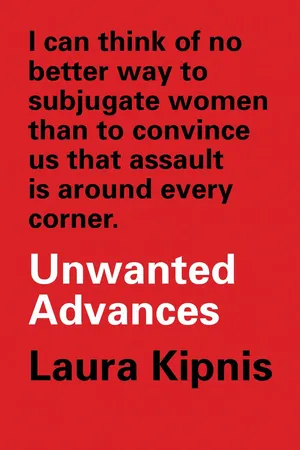
In Unwanted Advances, passionate feminist Kipnis, find the object of a protest march by student activists at her university for writing an essay about sexual paranoia on campus. In response she starts to question women's role in national debates over free speech and "safe spaces". She explores the astonishing netherworld of accused professors and students, campus witch hunts, rigged investigations, and demonstrates the chilling effect of this new sexual McCarthyism on higher education. Without minimizing the seriousness of campus assault, Kipnis argues for more honesty: a timely critique of feminist paternalism and the covert sexual conservatism of hook-up culture.
- 272 pages
- English
- ePUB (mobile friendly)
- Available on iOS & Android
eBook - ePub
About this book
Information
Topic
Sciences socialesSubtopic
Féminisme et théorie féministe
The Accusation Factory
FANTASIES AND REALITIES
Wading into the Mess
For students, campuses have always been venues for coming of age, which typically includes adopting rash ideas, living on an emotional teeter-totter, sexual experimentation, erotic confusion, and acting out on adults in self-righteous ways.
For professors, campuses are where we work, and our jobs are increasingly on the line: an offended student complains about what you thought was a harmless joke and wham, where’s the next mortgage payment coming from? Harmless joke? Forget it. The professoriate has been transformed into a sexually suspicious class—would-be harassers all, sexual predators in waiting. Why else the rash of new regulations devised to keep us in line? Avoid “unnecessary references to parts of the body” warns a recent directive from the commissars of sex on my campus. Also: sexual graffiti, sexual humor, and obscene gestures, not to mention sexual assault. Thanks for the advice.
As everyone knows, there’s an unprecedented level of sexuality on public display in the culture (viz: the Internet), and an unprecedented level of offended sensibilities on campuses. Campus culture is at once bawdier than ever, at least for the students (random drunken hookups on weekends), and more censorious than ever for all of us (speech codes and hypersensitivity during the week). The reigning versions of student feminism are a mess, a hodgepodge of gender progress and gendered conventionality: demands for female sexual equity on the one hand (fucking and drinking like the guys); extremes of sexual suspicion and injury on the other. Emotional vulnerability runs high and introspection runs low, making campus life messy for student and professor alike, though mostly for different reasons.
Sex on campus isn’t just confusing, it’s schizophrenic. Into this mess steps officialdom. It would be tough to say what’s messier, the sexual situation on campus or the insane measures being foisted on us to straighten everything out.
Here’s a capsule summary. In 2011 the Department of Education’s Office for Civil Rights (OCR) expanded Title IX’s mandate from gender discrimination to encompass sexual misconduct (everything from sexual harassment, to coercion, to assault, to rape), issuing guidelines so vague that I could be accused of “creating a hostile environment on campus” for writing an essay. These vague guidelines (never subjected to any congressional review) take the form of what are called, with faux cordiality, “Dear Colleague” letters—note the nebulously threatening inflections of overempowered civil servants everywhere.
The Dear Colleague era has been disastrous for anyone who cares about either education or democracy, beginning with the manner in which these guidelines were implemented: with a tire iron. Colleges and universities are bludgeoned into compliance because “Ed” threatens to withdraw federal funding from institutions found deficient, thus encouraging extremes of compliance. In 2013, my own school received roughly $350 million in federal funding, 70 percent of its research funds for the year, I learned online.
The legal challenges to Title IX are mounting: there are cases accusing schools of trampling on due process, there are cases alleging gender bias against men, there are cases arguing that the low standard of proof demanded by the Department of Education in Title IX cases (“preponderance of evidence”) is inherently unfair to the accused. The preponderance issue may sound obscure, but if you’re one of the 25 million or so people working or studying on an American campus—a not insignificant chunk of the populace—it’s the standard of proof that will apply if or when you’re accused of something. In other words, a 50.01 percent certainty of guilt. (“Fifty-fifty plus a feather” is how our university’s Title IX officer put it.) Note that being accused doesn’t mean you’ve actually done anything, but given the low bar for a guilty finding and the utter capriciousness of the process, an accusation itself pretty much suffices to constitute preponderance, as we’ll see.
So long to niceties such as presumption of innocence. Hello to campus as penal colony.
If you get the idea that the process is stacked against the accused, law professors around the country agree with you, and have been circulating open letters protesting the rampant rights-violations and kangaroo court procedures. The specifics vary from school to school (and are often different for students and faculty), but typically the accusee doesn’t know the precise charges, doesn’t know what the evidence is, and can’t confront witnesses. Many campuses don’t even allow the accusee to present a defense, such as introducing text messages from a complainant that contradict his or her statements.
The Department of Education responds that the Dear Colleague letters are merely “guidance” and don’t carry the force of law, though this is beyond disingenuous, since schools seen as insufficiently vigilant face being put on the “OCR watchlist” and subjected to federal investigation. Schools that are too fair toward the accused—for instance, using the “clear and convincing” standard of proof rather than the lower bar of “preponderance” demanded by Dear Colleague—will soon find OCR investigators descending on their campuses.
The cost of an OCR investigation is enormous. It can last two to four years, and those in the know say the process typically costs a school $200,000 to $350,000. Stanford, Princeton, Cornell, and Harvard have all faced at least three investigations each. As of this writing, there have been 321 investigations since 2011, with 270 currently ongoing at over 190 different schools, and the numbers are climbing. A low-end calculation of the overall cost to higher education exceeds $60 million—and that’s the price tag for investigations alone, leaving aside the hundreds of millions spent yearly on attempted compliance.
One question is whether OCR’s actions are themselves legal; critics (mostly Republicans) say the Dear Colleague letters enacted sweeping regulatory changes without first going through the notice-and-comment procedures required by the Administrative Procedure Act, which was enacted in 1946 and designed to prevent governmental agencies from foisting laws cooked up in secret on an unsuspecting public. But colleges and universities facing OCR investigations are too afraid to push back—no college presidents have dared stand up to OCR, and they’re the only ones who can.* (The reason is that they’re predominantly men and can’t risk it, one college president I spoke to said, not for attribution.) The safer path is to simply throw everyone accused of anything under the bus. Except then your school gets sued, generally by aggrieved male students found guilty of things they say they didn’t do; over a hundred and fifty such suits are currently wending their way through the courts. (Hundreds of others have been settled—one educational insurance company alone paid $36 million in settlements to falsely accused male students between 2006 and 2010.) A New York attorney known for handling such cases, including one pending against the Department of Education itself, says he averages an inquiry a day from male students who’ve been railroaded by the process. But it takes deep pockets for a student to sue: a minimum of a hundred thousand dollars, and up to a million to bring a case before a jury, one attorney told me.
Of course there are also a handful of lawsuits against schools accused of doing too little when it comes to Title IX enforcement, and in some cases they have done disgracefully little. UCLA recently settled a lawsuit (for $460,000) brought by two graduate students whose complaints about being sexually harassed by the same history professor—forcible kissing, groping, and repeated sexual advances—the school had inexplicably ignored. In other cases, the accuser is unhappy with the outcome of an adjudication. Harvard is currently being sued by a female student who said her ex-boyfriend abused her and Harvard hadn’t done enough, despite interviewing her six times, the accusee three times, speaking to seventeen other witnesses, and reviewing text and email messages. The woman charges Harvard with showing “deliberate indifference” to her case.
So nothing here is clear cut, including the 2011 Dear Colleague letter itself, which cites, as justification for the sweeping new measures, “deeply troubling statistics” indicating that “about 1 in 5 women are victims of completed or attempted sexual assault while in college.” The stat has been widely contested, including by the authors of the study from which the numbers derive. I’m not someone fascinated by statistics, but I had the good luck to hear a riveting (it’s true) presentation by Callie Rennison, formerly a senior statistician at the Bureau of Justice Statistics, now a professor at the University of Colorado Denver, comparing the methodologies of major surveys on campus assault that all, it turns out, vary greatly in terms of questions asked, response rates, whether the results were nationally representative, and time frame. Some of her presentation was a little technical—did the survey account for “telescoping,” which can increase sexual violence estimates from 10 to 50 percent?—but her overall point was that the enormous variation in estimates across participating universities means that any attempt to come up with a national rate of sexual violence (one in five, or one in four) is simplistic and misleading. There’s not even standardized language among researchers when it comes to what “rape,” “sexual assault,” or even “college student” means.
Rennison was also a bit tough on the 2007 Campus Sexual Assault Study, the one cited in the Dear Colleague letter. Though it has some good points, the findings aren’t nationally representative, and the one-in-five number rolls together completed rapes and other forms of assault such as forced kissing or unwanted groping. That stat also doesn’t distinguish between on-and off-campus assaults—in fact, college students are more likely to be assaulted off campus than on. (They also suffer sexual violence at rates lower than their non-college counterparts, as has been widely pointed out.)
I’d already read various dissents about the one-in-five estimates: in contrast to the 20 percent figure, Emily Yoffe, writing in Slate in December 2014, reviewed all the research and came up with a 0.27 percent sexual assault rate for 2012, based on both reported and unreported assaults. But during Rennison’s talk, something else was nagging at me. After the conference, I emailed her to ask, apologizing if it was a dumb question: “Is there evidence that sexual assault on campus has gone up?” The impression we’re left with from the relentless rape culture drumbeat is that sexual assault has reached a new all-time high on campus, but reading through the surveys, I couldn’t see any evidence of that.
Rennison kindly emailed back that the question was, of course, a bit complex to answer, given the non-comparability of the available data and the poorly designed wording of questions about rape prior to 1992. (The National Crime Victimization Survey didn’t even ask if rape victims, or any victims, were college students until 1995.) Her best answer, using other types of crime as a guide, was that since roughly 1992–93 other violent crime rates have plummeted, and there was “zero reason to suspect that rape or sexual assault on campus would be different than what we see with other types of violence.” There was also no evidence that rates of non-reporting have gone up over time. Someone might argue that violence that happens primarily to women follows a different pattern, she added, but intimate partner violence (also committed primarily against women) has followed the same pattern of decline since the early 1990s. She said she’d be surprised if any statisticians disagreed with this overall picture.
The question becomes whether, as with off-campus crime, sexual assault as traditionally defined may have actually gone down, while what counts as sexual assault keeps expanding. There doesn’t seem to be any way of answering this question statistically, though in the chapters that follow we’ll see that what counts as sexual assault is indeed being exponentially expanded, usually behind closed doors.
Raising questions about the definition of sexual assault is, however, verboten—and when I say verboten, I mean that doing so can mean losing your job, as happened to a professor named David Barnett, whose story I’ll be getting to. His case is a cautionary tale for me, needless to say. As someone who gets a paycheck from an institution of higher learning (not a particularly high one, but still), acclimating to these new realities sometimes feels like being a twenty-first-century Gulliver, that is, if Gulliver had awoken to find himself shipwrecked on an atoll of sanctimony where bureaucracy had supplanted education, and slogans have replaced thinking.
I hear the term sex-positive a lot from my students. What I find myself wanting to say is that the older you get, the more you realize that sex is always going to be messy, and sometimes even negative (which is what’s both appealing and also distressing about it)—and messy in ways that embarrass everyone’s good intentions, like a delinquent friend who spits in your face after you post his bail money. The messiness resides as much in your own desires as in the gross ones other people foist on you. There’s no honest sex-positivity; it’s all just a lot less simple than that.
Freud makes the point in the “Dora” case, which centers on an unwelcome sexual advance (an unwanted kiss the teenage Dora can’t seem to get past), that it’s usually not external events we can’t get over. It’s the internal ones we’re in denial about that form the basis of our accusations. “A string of reproaches against other people leads one to suspect a string of self-reproaches with the same content.” It’s the question I’d like to put to the two campus accusers featured in the chapters to follow: Is there something (or someone) you’re leaving out of the story?
A Selective Approach to Facts
A crush on a professor used to be the most ordinary thing in the world. Now, at least in public discourse, Eros runs strictly in the opposite direction: predatory professors foisting themselves on innocent and unwilling students, who lack any desires of their own. The question is what becomes of young women learning to negotiate their sexual attractions and conflicts in a campus culture that promotes so much dissimulating about them?
____________
In the fall of 2011, a Northwestern freshman I’ll call Eunice Cho, a journalism major, enrolled in a class titled Philosophy of Cyberspace, taught by Peter Ludlow. A few months after the class ended, in early February 2012, Cho emailed Ludlow: “Hi Professor Ludlow. I just wanted to let you know that I am going to Fluxfest in Chicago on Friday … I heard it’s going to be amazing. You should totally come, too.” Flux Fest is an annual avant-garde performance art event tangentially related to Second Life, the online virtual community that had been the theme of the course.
It wasn’t unusual for Cho to contact Ludlow: she’d emailed him frequently while enrolled in his class, sometimes about assignments, but about other things, too. She’d emailed after the first class to tell him she enjoyed his lecture and that she’d loved playing virtual reality games since elementary school. She emailed a few weeks later to say she was in “an extreme state of panic” because she’d missed a discussion section (led by a teaching assistant). She emailed over Thanksgiving break about a virtual Thanksgiving dinner of pixilated sweet potato casserole she’d “eaten” on Second Life. In one email, she told him she’d Googled his name and learned how famous he was, having come across an article on MTV’s website voting him one of the ten most influential video gamers in cyberspace, adding that she couldn’t “help but get more and more creeped out” by his “extremely influential cyber power.” Cho would later state that she’d kept her interactions and communications with Ludlow “professional.”
Though well known as a philosopher of language, Ludlow had been gravitating toward more cutting-edge research areas related to cyberculture: “hacktivism” (that is, online activism like WikiLeaks), cyber rights, and ethics in virtual communities, academic areas certainly new to philosophy. He’d been especially influential as an early theorist on Second Life. A 3-D virtual world started in 2003, at its peak it boasted a million users, known as Residents, who create avatars and build vast virtual cities, unencumbered by the constraints of physical reality—teleporting is possible, also virtual sex. Second Life has its own currency, called Linden dollars, named for the software’s developer, Linden Lab; more entrepreneurial Residents have figured out how to make actual money, starting businesses and speculating in Second Life real estate.
Beyond the financial possibilities, the appeal of Second Life is its open-endedness: Residents can invent new worlds instead of inheriting one handed down by developer overlords. They can create complex governance structures and new ways of relating and socializing with others in the community, though old ways of relating (aggression, misogyny) haven’t exactly been relegated to the dustbins of the “meat world,” as cyber habitués refer to “real life.” Ludlow conducted class in Second Life, meaning students did assignments and held class meetings in a 3-D digital landscape, building avatars who examined philosophical and political topics.
The class had run from September through December, and word leaked out to the meat world that intriguing things were happening. A student journalist attempted to capture the tenor in an online article, describing Ludlow as “an enigma with a dual persona,” one who split his time between the “mainland” and the online virtual world, where his avatar was named Urizenus Sklar. In the mainland classroom, he observed, Ludlow wore Gucci loafers and had a Penrose triangle tattooed on his left forearm—not your typical philosophy professor perhaps, though he was also described as treading the line “between trendy and sloppy,” which sounds closer to type. Ludlow was the kind of teacher who gets called “charismatic” on student evaluations: hip (despite being in his mid-fifties), political, unpretentiously enthusiastic about his subject, and eloquent about the subversive possibilities of new technologies. He calls everyone “dude,” regardless of gender.
Though he still wrote traditional philosophical articles, his cyberculture work made him a sought-after speaker—indeed Ludlow had been recruited to rej...
Table of contents
- Cover Page
- Title Page
- Copyright Page
- Dedication
- Contents
- Author’s Note
- Preface to the UK Edition: #MeToo and Campus Sexual Paranoia
- Introduction: Sexual Paranoia on Campus
- 1. The Accusation Factory: Fantasies and Realities
- 2. Flip-Flopping on Consent: A “Yes” Becomes a “No” Years After the Fact
- 3. My Title IX Inquisition: The “Safer” the Space, the More Dangerous for Professors
- 4. F*** Confidentiality: Reports from Secret Campus Tribunals Across America
- 5. Sexual Miseducation: A Plea for Grown-Up Feminism
- Coda: Eyewitness to a Witch Trial
- Notes
- Acknowledgments
- Selected Sources
- About the Author
Trusted by 375,005 students
Access to over 1.5 million titles for a fair monthly price.
Study more efficiently using our study tools.
Frequently asked questions
Yes, you can cancel anytime from the Subscription tab in your account settings on the Perlego website. Your subscription will stay active until the end of your current billing period. Learn how to cancel your subscription
No, books cannot be downloaded as external files, such as PDFs, for use outside of Perlego. However, you can download books within the Perlego app for offline reading on mobile or tablet. Learn how to download books offline
Perlego offers two plans: Essential and Complete
- Essential is ideal for learners and professionals who enjoy exploring a wide range of subjects. Access the Essential Library with 800,000+ trusted titles and best-sellers across business, personal growth, and the humanities. Includes unlimited reading time and Standard Read Aloud voice.
- Complete: Perfect for advanced learners and researchers needing full, unrestricted access. Unlock 1.5M+ books across hundreds of subjects, including academic and specialized titles. The Complete Plan also includes advanced features like Premium Read Aloud and Research Assistant.
We are an online textbook subscription service, where you can get access to an entire online library for less than the price of a single book per month. With over 1.5 million books across 990+ topics, we’ve got you covered! Learn about our mission
Look out for the read-aloud symbol on your next book to see if you can listen to it. The read-aloud tool reads text aloud for you, highlighting the text as it is being read. You can pause it, speed it up and slow it down. Learn more about Read Aloud
Yes! You can use the Perlego app on both iOS and Android devices to read anytime, anywhere — even offline. Perfect for commutes or when you’re on the go.
Please note we cannot support devices running on iOS 13 and Android 7 or earlier. Learn more about using the app
Please note we cannot support devices running on iOS 13 and Android 7 or earlier. Learn more about using the app
Yes, you can access Unwanted Advances by Laura Kipnis in PDF and/or ePUB format, as well as other popular books in Sciences sociales & Féminisme et théorie féministe. We have over 1.5 million books available in our catalogue for you to explore.