Disasters pose a significant threat to the sustainability of development investments. From 2007 to 2016, disasters triggered by natural hazards caused average daily physical losses of $133 million in the developing member countries of the Asian Development Bank alone. This practical guide provides technical advice on disaster risk assessment to facilitate the consideration of disaster risks in the design of development projects, seeking to ensure that disaster risks are properly identified and measures taken to reduce them where necessary. Disaster risk assessments can also help steer development investments to increase the disaster resilience of exposed and vulnerable communities more broadly.
- 72 pages
- English
- ePUB (mobile friendly)
- Available on iOS & Android
eBook - ePub
About this book
Information
1. Introduction
A. Rationale for ADB’s Engagement in Integrated Disaster Risk Management
Natural hazards pose a significant threat to development projects and the achievement of national and regional development goals in Asia and the Pacific. Many countries in the region experience both hydrometeorological, or extreme weather, and geophysical hazards. Moreover, the region experiences a disproportionate share of global human and economic impacts relative to population and gross domestic product.
Over the period 2007–2016, extreme weather events such as floods, droughts, and tropical cyclones have caused around 216,245 fatalities, affected 1.5 billion people, and resulted in direct physical damage totaling $373 billion, equivalent to $102 million per day, in the developing member countries (DMCs) of the Asian Development Bank (ADB) alone.1 Over the same period, geophysical events such as earthquakes, tsunamis and volcanic eruptions have resulted in around 105,207 fatalities, affected 69 million people, and resulted in direct physical damage totaling $113 billion, equivalent to $31 million per day, in the DMCs.
Direct physical losses are also increasing, expanding at the same pace as economic growth in ADB’s DMCs. This trend of rising losses is expected to continue at least over the next few decades, reflecting the increasing accumulation of disaster risk. Rising disaster losses partly reflect increases in exposure and vulnerability to natural hazards as countries expand and develop with insufficient regard to disaster risk. Climate change threatens to exacerbate the trend of rising disaster losses. Evidence is already beginning to suggest that weather is changing, according to the latest Intergovernmental Panel on Climate Change (IPCC) reports. By 2060, an estimated 729 million–983 million people will be living in low-elevation coastal zones in Asia (Neumann et al. 2015).
Disaster risk therefore requires due consideration in both country programming and project design and implementation. ADB’s Strategy 2020 (ADB 2008) recognizes the considerable challenges that natural hazards pose to development in Asia and the Pacific and identifies disaster and emergency assistance as one of ADB’s other areas of operations. The Midterm Review of Strategy 2020 re-emphasizes the importance of strengthening disaster resilience. ADB’s 2004 Disaster and Emergency Assistance Policy lays out key principles for ADB’s engagement in disaster risk management (DRM) (ADB 2004). The Operational Plan for Integrated Disaster Risk Management, 2014–2020 (ADB 2014c) provides operational guidance on the implementation of the Disaster and Emergency Assistance Policy, emphasizing in particular the integration of DRM into development.
Such integration rests upon an adequate disaster risk screening and assessment process that provides the information needed to protect ADB investments against natural hazards, including a better understanding of the levels of disaster risk as well as physical attributes, location, and size. More ambitiously, such assessments can help steer development investments toward increasing the resilience of exposed and vulnerable communities, for instance by helping diversify income sources or improving access to public services.
B. Past ADB Practice for Incorporating Disaster Risk Information in Project Design
The foundation of effective DRM is information and assessment. ADB considers disaster risk during project design through the preliminary climate change and disaster risk checking and screening process (section 2.A). This process serves to determine climate change and disaster risk and alert project officers to projects requiring more detailed assessment. If this preliminary screening process identifies medium or high climate change risk, this risk is further explored through a climate risk and vulnerability assessment (CRVA). CRVAs include further assessment of extreme weather events if relevant. Indeed, reducing the risks associated with extreme weather events is a substantial component of both DRM and climate change adaptation. However, there are distinct differences between CRVAs and DRAs (Table 1). CRVAs do not incorporate full DRAs and, in particular, do not take account of geophysical hazards. These differences imply that ADB’s past screening process has not supported the full, systematic consideration of disaster risk in the design of ADB projects.
Table 1: Climate Change Risk and Vulnerability Assessment and Disaster Risk Assessment: Major Commonalities and Differences
Climate Change Risk and Vulnerability Assessment |
Disaster Risk Assessment |
Purpose |
|
Identifies impact of changes in mean climatic conditions (i.e., temperature, precipitation, and wind speed) and sea levels, including impacts on the frequency and intensity of extreme weather events, to identify a range of climate change adaptation options (including DRM). |
Analyzes natural hazards, including geophysical hazards, and associated disaster risk in depth and recommends potential DRM actions as necessary. |
Assessors |
|
Carried out by experts in climate change modeling, climate change impact assessments, climate change adaptation, and economic costs of climate change. |
Carried out by experts in natural hazard and disaster risk modeling (geophysicists, geologists, hydrologists, etc.), vulnerability and disaster impact assessments (social scientists, structural engineers), disaster risk reduction interventions, and the economics of disaster risk management. |
Coverage |
|
In the context of natural hazards, deals with extreme weather events only. |
Covers all types of natural hazard, including geophysical hazards. |
DRM= disaster risk management
Source: ADB.
Other project preparatory processes have filled this gap to some degree. The exposure of ADB projects to particular types of natural hazard, in some cases including stand-alone multihazard DRAs, has been incorporated into some environmental impact assessments. DRAs pertaining to specific types of natural hazard have also been included in some instances in other technical assessments such as hydrological assessments. However, ADB has lacked a consistent approach to in-depth DRA. Moreover, the quality of these assessments has depended on the knowledge and background of the individuals concerned, including both project officers and consultants.
C. Key Objectives and Use of the Practical Guide
This practical guide addresses the need to promote a more strategic and homogeneous approach to DRA at ADB, integrated as relevant with the climate risk assessment process. It is intended to provide project officers with sufficient information to plan and oversee DRAs, in turn providing a basis for integrating disaster risk considerations into the design and implementation of individual projects where relevant. The practical guide should be consulted in cases where preliminary climate change and disaster risk screening indicates that disaster risk is medium or high, helping to ensure that disaster risks are properly identified and measures taken to reduce them where necessary.
The practical guide provides guidance to project officers on concepts and good practice in DRA and on the identification of suitable and efficient ways to include DRAs in project design processes. It includes information on the key elements of high-resolution, in-depth DRAs and on possible abbreviated processes in cases where time or resources are limited. The document cover types of output, the application of findings in project planning, and, more broadly, the integration of DRAs into ADB’s project-related business processes.
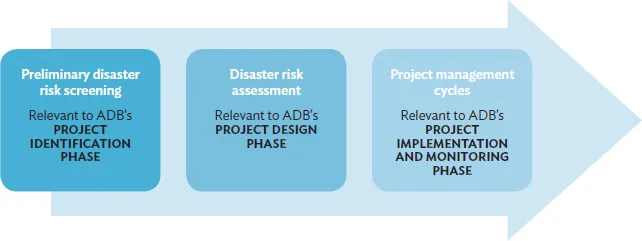
The practical guide covers the three main phases of ADB’s project cycle: project identification, project design, and project implementation and monitoring, as indicated in Figure 1.
Figure 1: Three Key Sections of the Practical Guide
ADB = Asian Development Bank
Source: ADB.
Section 2 deals with the project identification phase, outlining ADB’s preliminary disaster risk screening procedures. Sections 3, 4, and 5 are relevant to ADB’s project design phase. They deal with all stages of DRAs and the application of risk information across the sectors of ADB’s work. Users are provided with the necessary information to start planning abbreviated or full DRAs, write terms of reference, and review related technical proposals. Section 5 also discusses measures to address disaster risk in specific sectors, reflecting the ultimate purpose of assessment to incorporate appropriate disaster risk reduction (DRR) elements in project design where necessary. Finally, section 6 focuses on DRAs in the context of ADB’s business processes, in particular on DRM measures related to monitoring and evaluation.
2. Preliminary Climate Change and Disaster Risk Screening
A. Climate Change and Disaster Risk Screening in ADB
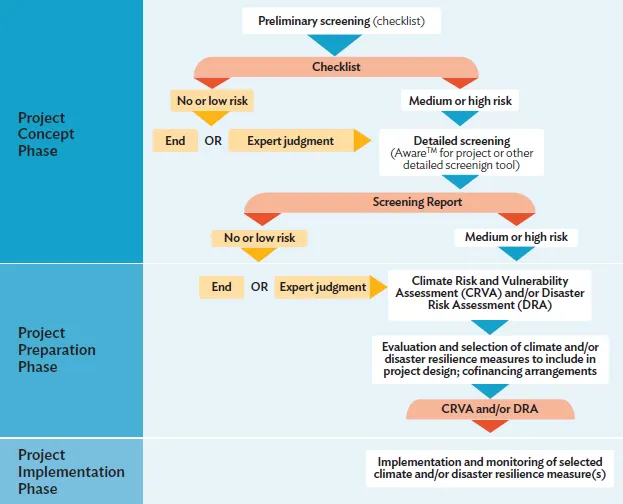
ADB examines a range of different aspects of a project during the project identification and concept phase. Climate change and disaster risks are initially covered through the rapid environmental assessment (REA). This includes a specific section on community health and safety dealing with natural hazards.2 Results feed into the environmental safeguard classification and overall quality assurance process. If the project is found to score an “A” or “B” in the safeguard categorization, closer environmental scrutiny is required.
ADB’s REA form also contains a checklist for preliminary climate change and disaster risk screening. Among other issues, this one-page checklist looks at the possible impact of extreme hazard events on a project (Figure 2). If a project is found to have a medium to high climate change or disaster risk according to this preliminary checklist, it should undergo more detailed disaster risk screening, for instance using the AWARE for Projects tool (Box 1)3 or other web-based open-access tools (Appendix 2).
Figure 2: Disaster Risk Screening in ADB
Source: Adapted from ADB (2014b).
Box 1: AWARE for Projects Risk Screening Tool
AWARE is a web-based, commercial tool that facilitates a rapid risk screening of projects and project components focusing on climate change risk and exposure to natural hazards. The tool also provides sector-specific commentary on issues that require further attention and assessment. The tool has been modified to match the project sectors and subsectors of the Asian Development Bank (ADB). An updated version incorporating geophysical hazards and enhanced assessment of near-term hydrometeorological hazards was released in May 2017.
AWARE is designed to be user-friendly and relatively rapid and is intended as a preliminary screening tool. The tool does not require expert knowledge of climate change or disaster risk. It can be used in two modes: rapid and full. A rapid mode assessment only requires the user to identify the name of the project, the ADB project sector, and subsectors; to provide the project location; and to indicate if the area is coastal. The tool then generates an assessment of the risk level (low, medium, or high) for 16 variables in a spidergram contained within a standardized report. The full mode requires the user to also answer six questions regarding any required modifications to the project design in ord...
Table of contents
- Front Cover
- Title Page
- Copyright Page
- Contents
- Acknowledgments
- Abbreviations
- Executive Summary
- 1. Introduction
- 2. Preliminary Climate Change and Disaster Risk Screening
- 3. Disaster Risk Assessment: Overview
- 4. Designing Disaster Risk Assessments for ADB’s Project Preparation Needs
- 5. Addressing Disaster Risk across ADB's Key Sectors
- 6. Disaster Risk Assessment and ADB's Business Processes
- Glossary
- References
- Further Reading
- Appendixes
- Back Cover
Trusted by 375,005 students
Access to over 1.5 million titles for a fair monthly price.
Study more efficiently using our study tools.
Frequently asked questions
Yes, you can cancel anytime from the Subscription tab in your account settings on the Perlego website. Your subscription will stay active until the end of your current billing period. Learn how to cancel your subscription
No, books cannot be downloaded as external files, such as PDFs, for use outside of Perlego. However, you can download books within the Perlego app for offline reading on mobile or tablet. Learn how to download books offline
Perlego offers two plans: Essential and Complete
- Essential is ideal for learners and professionals who enjoy exploring a wide range of subjects. Access the Essential Library with 800,000+ trusted titles and best-sellers across business, personal growth, and the humanities. Includes unlimited reading time and Standard Read Aloud voice.
- Complete: Perfect for advanced learners and researchers needing full, unrestricted access. Unlock 1.5M+ books across hundreds of subjects, including academic and specialized titles. The Complete Plan also includes advanced features like Premium Read Aloud and Research Assistant.
We are an online textbook subscription service, where you can get access to an entire online library for less than the price of a single book per month. With over 1.5 million books across 990+ topics, we’ve got you covered! Learn about our mission
Look out for the read-aloud symbol on your next book to see if you can listen to it. The read-aloud tool reads text aloud for you, highlighting the text as it is being read. You can pause it, speed it up and slow it down. Learn more about Read Aloud
Yes! You can use the Perlego app on both iOS and Android devices to read anytime, anywhere — even offline. Perfect for commutes or when you’re on the go.
Please note we cannot support devices running on iOS 13 and Android 7 or earlier. Learn more about using the app
Please note we cannot support devices running on iOS 13 and Android 7 or earlier. Learn more about using the app
Yes, you can access Disaster Risk Assessment for Project Preparation by in PDF and/or ePUB format, as well as other popular books in Business & Project Management. We have over 1.5 million books available in our catalogue for you to explore.