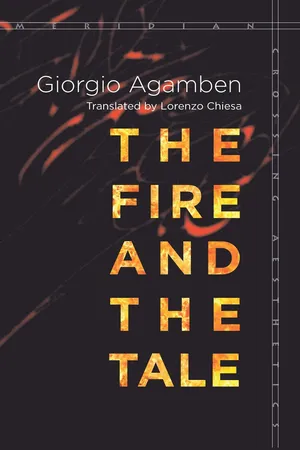
What is at stake in literature? Can we identify the fire that our stories have lost, but that they strive, at all costs, to rediscover? And what is the philosopher's stone that writers, with the passion of alchemists, struggle to forge in their word furnaces? For Giorgio Agamben, who suggests that the parable is the secret model of all narrative, every act of creation tenaciously resists creation, thereby giving each work its strength and grace. The ten essays brought together here cover works by figures ranging from Aristotle to Paul Klee and illustrate what urgently drives Agamben's current research. As is often the case with his writings, their especial focus is the mystery of literature, of reading and writing, and of language as a laboratory for conceiving an ethico-political perspective that places us beyond sovereign power.
- 160 pages
- English
- ePUB (mobile friendly)
- Available on iOS & Android
eBook - ePub
The Fire and the Tale
About this book
Information
Publisher
Stanford University PressYear
2017Print ISBN
9781503601642
9780804798716
Edition
1eBook ISBN
9781503601659
Opus Alchymicum
Claudio Rugafiori has entitled his edition of a collection of letters by René Daumal Il lavoro su di sé [The Work on Oneself]. His thesis is clear and enunciated without reservations: the author in question did not really intend to produce literary works but rather to act on himself, so as to transform and recreate himself (Daumal also speaks of “coming out of sleep, awakening”). That is, writing is part of an ascetic practice in which the production of work becomes secondary with respect to the transformation of the subject who writes. As Daumal confides to his teacher Jeanne de Salzmann, “Naturally, this renders my work as a writer much more arduous, but also far more interesting and spiritually fruitful. . . . Work becomes always more a ‘work on myself,’ rather than a work ‘for myself.’”1
From the outset, when he animated with Roger Gilbert-Lecomte the journal Le Grand Jeu, Daumal’s practice of writing was accompanied—or, rather, guided—by experiences that do not seem to have at first sight anything to do with literature (one of the most extreme was inhaling the vapors of carbon tetrachloride until losing consciousness, in an attempt to grasp the threshold between consciousness and unconsciousness, life and death). Later, after encountering the teachings of Gurdjieff and reading the Vedas and the Upanishads, Daumal abandons these experiments (in particular, the use of drugs, which Gilbert-Lecomte became addicted to) and orients the “work on oneself” in an always more spiritual direction. It is a matter of freeing oneself from the limited number of intellectual and sentimental “postures” in which we are imprisoned in an attempt to access a veritable transformation of the self. Two years before his death, Daumal writes:
I now better understand what cabbalists and Hasidim say about the “sparks” (the forces) contained in things, which man has the duty to “save”—that is, to take not for himself, and thus definitively enclose them in a greater prison, but to give them back in the end to the Force of forces. Does recalling oneself not perhaps mean, in a certain sense, feeling oneself in this way between the inferior and the superior forces, torn apart between the two, but with the possibility of becoming the transformer of the former into the latter?2
Even at the point when he is integrally focused on working on himself, Daumal never abandons writing. At the beginning of the 1940s, he starts to write a sort of tale, in which his spiritual search seems to find its final style: Mount Analogue. “I am writing a rather long tale,” he announces to a friend,
in which one will see a group of human beings who have realized they are in prison, who have understood they first of all need to quit this prison (since the tragedy is clinging on to it), and who set off in search of a superior humanity freed from the prison, where they can find the help they need. And they find it, because some friends and I have found the door. Real life begins only at this door. This tale will be structured like an adventure novel and entitled Mount Analogue: it is the symbolic mountain that unites Heaven and Earth; a way that must materially and humanly exist, since otherwise our situation would be hopeless. Probably some excerpt will be published in the next issue of the journal Mesures.3
The gap between what is at stake—the door that unites heaven and earth—and the “adventure novel” of which some extracts will be published in a literary journal is blatant. Why does the work on oneself, which has to lead to spiritual liberation, need the work on an opus [lavoro a un’opera]? If Mount Analogue materially exists, why give it the shape of a narrative fiction, which was initially presented as a “treatise of psychological mountaineering,” and which the author certainly did not care to include among the masterpieces of twentieth-century literature? Since Daumal did not either intend to set his novel on the same level as what he called the revealed “great Scriptures” (such as the Gospels and the Upanishads), should we not rather ask whether, as happens in any literary work, Mount Analogue only exists analogously in the writing that speaks about it? That is, whether, for some reason, the work on oneself is only possible in the at least apparently incongruous form of the writing of a book?
The idea that in working on a work of art, a transformation of the author is at stake—that is, in the last resort, a transformation of his life—would have in all likelihood been incomprehensible for the ancients. But the classical world knew a place—Eleusis—in which those who were initiated into the mysteries attended a sort of theatrical pantomime, the vision (the epopsia) of which transformed them and made them happier. The catharsis, the purification of passions that, according to Aristotle, was felt by the spectators of a tragedy, perhaps contained a weak echo of the Eleusinian experience. The fact that Euripides was accused of revealing in his tragedies the mysteries that had to remain ineffable nonetheless shows that the ancients considered the putting in strict relation of the religious transformation of existence and a literary work to be inappropriate (even if tragic performance was originally part of a cult).
For Daumal, however, working on an opus has a meaning only if it coincides with the edification of the self. This amounts to turning life into the stakes and, at the same time, the touchstone of the opus. For this, he can summarize his supreme belief as an itinerary from death to life:
I am dead because I have no desire,
I have no desire because I think I possess,
I think I possess because I do not try to give.
Trying to give, one sees one has nothing,
Seeing one has nothing, one tries to give oneself,
Trying to give oneself, one sees one is nothing,
Seeing one is nothing, one tries to become,
Desiring to become, one lives.
If the real work is life and not the written work, we should not be surprised that among the precepts for the liberation of the self there are also, like in any esoteric tradition, hygienic prescriptions and suggestions that seem more suitable to a diet than a mystical isagoge: “Relaxing ten or even five minutes in a reclining position before every meal will help you; in particular, it will relax the epigastric region and the throat.”4
The fact that literary creation can and even must go together with a process of self-transformation, and that poetic writing has a meaning only to the extent that it transforms the author into a prophet, was implicit in the testimony of the poet that Le Grand Jeu indeed elected as its emblem: Arthur Rimbaud. The fascination that the work he has abruptly bequeathed us continues to exert over his readers derives precisely from the twofold dimension of which it seems to consist and in which it moves. Here it is not important that asceticism has the form of a “long, immense et raisonné dérèglement de tous les sens.”5 What is again decisive is the work on oneself as the only way to access the literary work and the literary work as the protocol for the carrying out of an operation on oneself. Rimbaud’s letter to Demeny states programmatically that “la première étude de l’homme qui veut être poète est sa propre connaissance, entière; il cherche son âme, il l’inspecte, il la tente, l’apprend. Dès qu’il la sait, il doit la cultiver. . . . Je dis qu’il faut être voyant, se faire voyant.”6 But precisely for this, the book that follows—A Season in Hell—presents us with the paradox of a literary work that claims to describe and verify a non-literary experience, whose place is the subject who, transforming himself in this way, becomes capable of writing it. The value of the work derives from the experiment, but the latter serves only the writing of the work—or, at least, attests to its value only by means of it.
The contradiction in which the author has thus found himself is perhaps best conveyed by the lucid diagnosis: “Je devins un opéra fabuleux.”7 An opera, that is, a performance, in which the “simple hallucinations” and the “sacred” disorder of his mind are offered to his own disenchanted gaze as if they were staged in a third-rate theater. We are then not surprised that, facing this vicious circle, the author very soon became disgusted with both his work and the “deliriums” that it witnessed, and that he abandoned literature and Europe without regrets. According to the (not always credible) testimony of his sister Isabelle, “il brûla (très gaiement, je vous assure) toutes ses oeuvres dont il se moquait et plaisantait.”8
We are left with the peculiar and tenacious impression that the decision to abandon poetry in order to trade weapons and camels in Abyssinia and Aden is an integral part of his work. In Rimbaud’s biography, this extreme annexation of life by work does not, obviously, have any foundation; however, it bears witness to the lasting confusion between art and life that Romanticism has produced (the letter to Demeny, with its opposition between the ancient man who does not work on himself—ne se travaillant pas—and the Romantic poets, who become voyants, stands as a perspicuous document of Romanticism).
When Rimbaud wrote his letter, Hegel had already long formulated his diagnosis concerning the “death” of art—or, more precisely, concerning the fact that art had left to science the central position in the vital energies of civilized mankind. His diagnosis was actually also applied to the same extent to religion: the image Hegel uses to describe the decline and twilight of art is, in fact, that, facing the beautiful images of Christ and the Holy Virgin, “our knees no longer bend.” In Western culture, religion, art, and science seem to constitute three different and inseparable fields that rotate, join forces, and incessantly combat each other, where none of them ever manages to completely eliminate the other two. The man of science, who chased religion and art away from their glorious abodes, witnesses with Romanticism their return in a precarious and unlikely coalition. The artist now has the emaciated face of the mystic and the ascetic; his work assumes a liturgical aura and aspires to be a prayer. When the religious mask loses its credibility, the artist, who has sacrificed his art for a superior truth, shows his real worth: he is only a living body, only a bare life, who presents itself as such and demands inhuman rights.
In any case, what is acknowledged in Rimbaud’s decision is the failure of the Romantic attempt at uniting mystical practice and poetry, work on oneself and the production of a work.
The fact that exercising an artistic practice (in the broad sense that the term ars has in the Middle Ages, which includes all crafts and professions) cannot support man’s happiness and that they are, however, somehow connected is something implicit in the passage from the Summa contra Gentiles in which Thomas Aquinas briefly reflects on the matter. “The ultimate happiness [ultima felicitas] of man,” he states, “cannot amount to the operation of an art [in operatione artis].” The end of art is, in fact, the production of artifacts (artificiata), and these cannot stand for the end of human life, since, to the extent that they are made for the use of mankind, man is the end of work and not vice versa.
The ultimate happiness of man rather consists in the contemplation of God. Yet insofar as human operations, including those of art, are directed toward the contemplation of God as their own end, there exists a necessary nexus between the operations of art and happiness. “There is needed for the perfection of contemplation soundness of body, to which all the products of art that are necessary for life are directed.” The directing of every human operation toward happiness thus guarantees that the works of the arts are themselves somehow inscribed in the contemplative regime, which amounts to the supreme end of mankind.
The outcome of an imprudent juxtaposition of artistic practice and work on oneself is the cancellation of the artistic work. This is evident in the avant-gardes. Here, the primacy accorded to the artist and the creative process takes place, curiously, at the expense of what they were supposed to produce. The most characteristic intention of Dada was not so much an attack directed against art—which is rather transformed into something halfway between mystical discipline and critical operation—as against the artistic work, which was dismissed and derided. In this sense, Hugo Ball, on the threshold of religious conversion, suggested to artists to stop producing works in order to commit themselves to “energetic efforts of reanimation on oneself.” As for Duchamp, by producing The Large Glass and inventing the ready-made, he intended to show that it was possible to go “beyond the physical act of painting,” so as to bring artistic activity back to “the service of the spirit.” He writes: “Dada was an extreme protest against the physical side of painting. It was a metaphysical attitude.” But it is perhaps in Yves Klein that the abolition of the artistic work in the name of artistic activity and of the work on oneself is enunciated most clearly. Klein writes: “My paintings are the ashes of my art,” and he pushes the negation of the artistic work to its extreme consequences:
What I am trying to achieve—my future development, my solution to the problem—is to no longer do anything at all, as quickly as possible, but consciously, with care and caution. I only try to be. I will be a “painter.” People will say of me: that’s the “painter.” And I will feel myself to be a “painter,” a real one, precisely, because I won’t paint. . . . The fact of my existence as a painter will be the most “wonderful” pictorial work of all times.9
However, as shown far too evidently by these words, with the abolition of the artistic work, unexpectedly, the work on oneself also disappears. The artist, who has dismissed the artistic work in order to focus on the transformation of the self, is now absolutely unable to produce anything other than an ironic mask, or he simply exhibits his living body without restraint. He is a man who no longer has content, who observes—we do not know whether with pleasure or terror—the void that the disappearance of the work has left inside him.
From here follows the progressive displacement of artistic activity toward politics. Aristotle opposed poiesis, the activities of the artisan and the artist, which produce an independent object, to praxis, that is, political action, which has its end in itself. In this sense, we can say that avant-gardes, who want to abolish the artistic work at the expense of artistic activity, are doomed, whether they like it or not, to transfer their workshop from the floor of poiesis to that of praxis. This means that they are forced to abolish themselves and be transformed into a political movement. According to Guy Debord’s irrefutable verdict: “Surrealism wanted to realize art without abolishing it, and Dadaism wanted to abolish art without realizing it. Situationists want to abolish art and, at the same time, realize it.”
A too-close connection between the literary work and the work on oneself may take the shape of an exacerbation of the spiritual search. This is the case with Cristina Campo. Here the development of the very original talent of the writer is first guided, but then progressively eroded and finally devoured, by an obsessive search for perfection. Perfection is here formal perfection—as in the “unforgivable” writers she never tires of commending—and, at the same time and to the same extent, spiritual perfection, which almost scornfully marks in the former its contemptuousness. She almost obsessively repeats to herself, “Attention is the only path toward the inexpressible, the only way to mystery,” and, in this way, she forgets her other, more felicitous, obsession: the fairy tale, before which any demand for spiritual perfection ...
Table of contents
- Cover
- Copyright
- Title Page
- Series Page
- Contents
- § The Fire and the Tale
- § Mysterium Burocraticum
- § Parable and Kingdom
- § What Is the Act of Creation?
- § Vortexes
- § In the Name of What?
- § Easter in Egypt
- § On the Difficulty of Reading
- § From the Book to the Screen: The Before and the After of the Book
- § Opus Alchymicum
- Note on the Texts
- Notes
- Series List
Trusted by 375,005 students
Access to over 1.5 million titles for a fair monthly price.
Study more efficiently using our study tools.
Frequently asked questions
Yes, you can cancel anytime from the Subscription tab in your account settings on the Perlego website. Your subscription will stay active until the end of your current billing period. Learn how to cancel your subscription
No, books cannot be downloaded as external files, such as PDFs, for use outside of Perlego. However, you can download books within the Perlego app for offline reading on mobile or tablet. Learn how to download books offline
Perlego offers two plans: Essential and Complete
- Essential is ideal for learners and professionals who enjoy exploring a wide range of subjects. Access the Essential Library with 800,000+ trusted titles and best-sellers across business, personal growth, and the humanities. Includes unlimited reading time and Standard Read Aloud voice.
- Complete: Perfect for advanced learners and researchers needing full, unrestricted access. Unlock 1.5M+ books across hundreds of subjects, including academic and specialized titles. The Complete Plan also includes advanced features like Premium Read Aloud and Research Assistant.
We are an online textbook subscription service, where you can get access to an entire online library for less than the price of a single book per month. With over 1.5 million books across 990+ topics, we’ve got you covered! Learn about our mission
Look out for the read-aloud symbol on your next book to see if you can listen to it. The read-aloud tool reads text aloud for you, highlighting the text as it is being read. You can pause it, speed it up and slow it down. Learn more about Read Aloud
Yes! You can use the Perlego app on both iOS and Android devices to read anytime, anywhere — even offline. Perfect for commutes or when you’re on the go.
Please note we cannot support devices running on iOS 13 and Android 7 or earlier. Learn more about using the app
Please note we cannot support devices running on iOS 13 and Android 7 or earlier. Learn more about using the app
Yes, you can access The Fire and the Tale by Giorgio Agamben, Lorenzo Chiesa in PDF and/or ePUB format, as well as other popular books in Literature & Literary Criticism. We have over 1.5 million books available in our catalogue for you to explore.