This is the Center for Effective Organizations's (CEO) fourth national study of the human resources (HR) function in large corporations. It is the only long-term national study of this important function. Like the previous studies, it focuses on measuring whether the HR function is changing and on gauging its effectiveness. The study focuses particularly on whether the HR function is changing to become an effective strategic partner. It also analyzes how organizations can more effectively manage their human capital. The present study compares data from earlier studies to data collected in 2004. The results show some important changes and indicate what HR needs to do to be effective. Practices are identified that enable HR functions to be high value-added strategic partners.
eBook - ePub
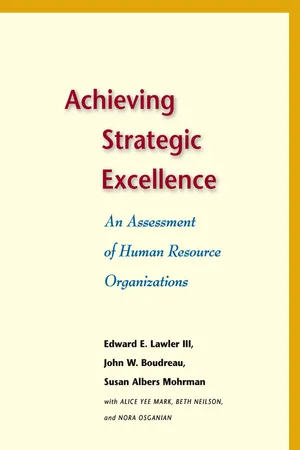
Achieving Strategic Excellence
An Assessment of Human Resource Organizations
- 160 pages
- English
- ePUB (mobile friendly)
- Available on iOS & Android
eBook - ePub
Achieving Strategic Excellence
An Assessment of Human Resource Organizations
About this book
Information
CHAPTER 1
How HR Can Add Value
Global competition, information technology, new knowledge, the increase in knowledge workers, and a host of other business environment changes are forcing organizations to constantly evaluate how they operate. In many cases they have embraced new strategic initiatives and significantly changed how they operate. They are utilizing new technologies, changing their structures, and improving their work processes to respond to an increasingly demanding and global customer base. These initiatives involve fundamental changes that have significant implications for their human capital and their human resources functions.
Human capital management should be an important part of the strategy of any corporation. The annual reports of many corporations argue that their human capital and intellectual property are their most important assets. In many organizations, compensation is one of the largest, if not the largest, cost. In service organizations compensation often represents 70 to 80 percent of the total cost of doing business. Adding the costs of training and other human resources management activities to the compensation costs, we can see that the human resources function often has responsibility for a large portion of an organization’s total expenditures.
But the compensation cost of human capital is not the only, or even the most important, consideration. Even when compensation accounts for very little of the cost of doing business, human capital has a significant impact on the performance of an organization (Cascio, 2000). In essence, without effective human capital, organizations are likely to have little or no revenue. Even the most automated production facilities require skilled, motivated employees to operate them. Knowledge work organizations depend on employees to develop, use, and manage their most important asset, knowledge. Thus, although the human capital of a company does not appear on the balance sheet of corporations, it represents an increasingly large percentage of many organizations’ market valuation (Lev, 2001).
A growing body of evidence affirms that HR practices can be a value-added function in an organization. The initial work on the relationship between a firm’s performance and its HR practices was conducted by Becker and Huselid (1998). In their study of 740 corporations, they found that firms with the greatest intensity of HR practices that reinforce performance had the highest market value per employee. They argued that HR practices are critical in determining the market value of a corporation and that improvements in HR practices can lead to significant increases in the market value of corporations. They concluded that the best firms are able to achieve both operational and strategic excellence in their HR systems.
Role of the Human Resources Organization
The HR function can add value by adopting a control-and-audit role. But two other roles that it can take on allow it to add still greater value. Lawler (1995) has developed this line of thought by describing the three roles it can take on. The first is the familiar human resources management role (Exhibit 1.1).
The second is the role of business partner (Exhibit 1.2). It emphasizes developing systems and practices to ensure that a company’s human resources have the needed competencies and motivation to perform effectively. In this approach, HR has a seat at the table when business issues are discussed and brings an HR perspective to these discussions. When it comes to designing HR systems and practices, this approach focuses on creating systems and practices that support the business strategy. HR also measures the effectiveness of the human capital management practices and focuses on process improvements.
The business partner approach positions the HR function as a value-added part of an organization. It is positioned to contribute to business performance by effectively managing what is the most important capital of most organizations, their human capital. But, this approach may not be one that enables the HR function to add the greatest value. By becoming a strategic partner, HR has the potential to add more value (see Exhibit 1.3).
In acting as a strategic partner, HR plays a role that includes helping the organization develop its strategy. Here, not only does HR have a seat at the strategy table, HR helps to set the table. Boudreau and Ramstad (2005a, 2005b) support this idea by suggesting that strategies can be shaped and enhanced by bringing a human capital decision science to HR’s role in strategy.
In the knowledge economy, a firm’s strategy must be closely linked to its human talent. Thus, the human resources function must be positioned and designed as a strategic partner that participates in both strategy formulation and implementation. Its expertise in attracting, retaining, developing, deploying, motivating, and organizing human capital is critical to both. Ideally, the HR function should be knowledgeable about the business and expert in organizational and work design issues so that it can help develop needed organizational capabilities and facilitate organizational change as new opportunities become available.
Exhibit 1.1. HR Management
| AIMS | Business orientation. |
| Services provided expressed as outputs or products. | |
| PROCESS | Build performance management capabilities. |
| Develop managers: link competencies to job requirements and career development. | |
| Succession planning. | |
| Enhance organizational change capabilities. | |
| Build an organization-wide HR network. | |
| PLANNING | HR (and all other functions) inspect business plans; inputs from HR may be inserted in the planning process. |
Exhibit 1.2. Business Partner
| AIMS | Line management owns human resources as a part of their role. HR is an integral member of management teams. |
| Culture of the firm evolves to fit with strategy and vision. | |
| PROCESS | Organize HR flexibly around the work to be done (programs and projects, outsourcing). |
| Focus on the development of people and organizations (road maps, teams, organizational design). | |
| Leverage competencies, manage learning linkages; build organizational work redesign capabilities. | |
| PLANNING | An integral component of strategic and business planning by the management team. |
Exhibit 1.3. Strategic Partner
| AIMS | HR is a major influence on business strategy. |
| HR systems drive business performance. | |
| PROCESS | Self-service for transactional work. |
| Transactional work outsourced. | |
| Knowledge management. | |
| Focus on organization development. | |
| Change management. | |
| Human resource processes tied to business strategies. | |
| PLANNING | HR is a key contributor to strategic planning and change management. |
To be a strategic partner, HR executives need an expert understanding of business strategy, organizational design, and change management, and need to know how integrated human resources practices and strategies can support organizational designs and strategies. This role requires extending HR’s focus beyond delivery of HR services and practices to a focus on the quality of decisions about talent, organization, and human capital.
As a strategic partner, HR brings to the table a perspective that is often missing in discussions of business strategy and change—a knowledge of the human capital factors and the organizational changes that are critical to determining whether a strategy can be implemented. Many more strategies fail in execution than in their conception.
Despite compelling arguments supporting human resources management as a key strategic issue in most organizations, human resource executives often are not strategic partners (Lawler, 1995; Brockbank, 1999). All too often, the human resources function is largely an administrative function headed by individuals whose roles are focused on cost control and administrative activities (Ulrich, 1997; Lawler and Mohrman, 2003a; Boudreau and Ramstad, 2005a). Missing almost entirely from the list of HR focuses are key organizational challenges such as improving productivity, increasing quality, facilitating mergers and acquisitions, managing knowledge, implementing change, developing business strategies, and improving the ability of the organization to execute strategies. Since organizations do see these areas as important, the HR function is missing a great opportunity to add value.
There is some evidence that this situation is changing, and that the human resources function is beginning to redefine its role in order to increase the value it adds. The first three phases of the present study (in 1995, 1998, and 2001) found evidence of some change, but notably there was more discussion of change than actual change (Lawler and Mohrman, 2003a).
One possible view of the human resources function of the future is presented in a study of business process outsourcing by Lawler, Ulrich, Fitz-enz, and Madden (2004). It shows how four large corporations (British Petroleum, International Paper, Prudential, and Bank of America) transferred many HR administrative activities to the line, to outside vendors, and to highly efficient processing centers. The HR function was left to focus almost exclusively on business consulting and managing the organization’s core competencies. This model is consistent with Ulrich’s argument that the HR function needs to be redesigned to operate as a business partner (Ulrich, 1997; Ulrich, Losey, and Lake, 1997). Recently, Ulrich and Brockbank (2005) have argued that the HR function needs to develop a compelling value proposition that focuses on how it can increase the intangible assets that drive the market value of organizations. Boudreau and Ramstad (1997) note that the HR profession could mature in a way similar to finance and marketing.
A number of recent studies have addressed the new competencies required when the human resources function strives to be a strategic business partner (e.g., Smith and Riley, 1994; Csoka, 1995; Eichinger and Ulrich, 1995; Ulrich, 1997; Csoka and Hackett, 1998; Brockbank and Ulrich, 2003). Identifying these competencies needs to be followed by reorganizing the HR function to develop these competencies and to provide services in a manner that adds value as organizations change their overall architecture and strategy.
Creating Change
Describing the new human resources role and the new competencies HR needs is only the first step in transitioning the HR function to a strategic business partner. For decades, the human resources function has been organized and staffed to carry out administrative activities. Changing that role will require a different mix of activities and will necessitate reconfiguring the HR function to support changing business strategies and organizational designs. It also will require the employees in the HR function to have very different competencies than they traditionally have had.
It is becoming increasingly clear that information technology will play a very important role in the future of the HR function (Lawler, Ulrich, Fitz-enz and Madden, 2004). With HR information technology (IT), administrative tasks that have been traditionally performed by the HR function can be done by employees and managers on a self-service basis. Today’s HR IT systems simplify and speed up HR activities such as salary administration, job posting and placement, address changes, family changes, and benefits administration; they can handle virtually every administrative HR task. What is more, these systems are available around the clock and can be accessed from virtually anywhere.
Perhaps the greatest value of HR IT systems will result from enabling the integration and analysis of the HR activities. They have the potential to make HR information much more accessible so that it can be used to guide strategy development and implementation. Metrics can be easily tracked and analyses performed that make it possible for organizations to develop and allocate their human capital more effectively (Boudreau and Ramstad, 2006; Lawler, Levenson, and Boudreau, 2004).
A strong ...
Table of contents
- Copyright Page
- Table of Contents
- List of Tables
- PREFACE
- THE AUTHORS
- CHAPTER 1 - How HR Can Add Value
- CHAPTER 2 - Research Design
- CHAPTER 3 - Role of Human Resources
- CHAPTER 4 - Business Strategy
- CHAPTER 5 - HR Decision Science
- CHAPTER 6 - HR Organizational Design
- CHAPTER 7 - Human Resources Activities
- CHAPTER 8 - Outsourcing
- CHAPTER 9 - Use of Information Technology
- CHAPTER 10 - Effectiveness of Information Systems
- CHAPTER 11 - HR Analytics and Metrics
- CHAPTER 12 - Human Resource Skills
- CHAPTER 13 - Effectiveness of the HR Organization
- CHAPTER 14 - Determinants of HR Effectiveness
- CHAPTER 15 - HR Excellence
- REFERENCES
- APPENDIXES
Trusted by 375,005 students
Access to over 1.5 million titles for a fair monthly price.
Study more efficiently using our study tools.
Frequently asked questions
Yes, you can cancel anytime from the Subscription tab in your account settings on the Perlego website. Your subscription will stay active until the end of your current billing period. Learn how to cancel your subscription
No, books cannot be downloaded as external files, such as PDFs, for use outside of Perlego. However, you can download books within the Perlego app for offline reading on mobile or tablet. Learn how to download books offline
Perlego offers two plans: Essential and Complete
- Essential is ideal for learners and professionals who enjoy exploring a wide range of subjects. Access the Essential Library with 800,000+ trusted titles and best-sellers across business, personal growth, and the humanities. Includes unlimited reading time and Standard Read Aloud voice.
- Complete: Perfect for advanced learners and researchers needing full, unrestricted access. Unlock 1.5M+ books across hundreds of subjects, including academic and specialized titles. The Complete Plan also includes advanced features like Premium Read Aloud and Research Assistant.
We are an online textbook subscription service, where you can get access to an entire online library for less than the price of a single book per month. With over 1.5 million books across 990+ topics, we’ve got you covered! Learn about our mission
Look out for the read-aloud symbol on your next book to see if you can listen to it. The read-aloud tool reads text aloud for you, highlighting the text as it is being read. You can pause it, speed it up and slow it down. Learn more about Read Aloud
Yes! You can use the Perlego app on both iOS and Android devices to read anytime, anywhere — even offline. Perfect for commutes or when you’re on the go.
Please note we cannot support devices running on iOS 13 and Android 7 or earlier. Learn more about using the app
Please note we cannot support devices running on iOS 13 and Android 7 or earlier. Learn more about using the app
Yes, you can access Achieving Strategic Excellence by Edward E. Lawler,John W. Boudreau,Susan Albers Mohrman,Alice Yee Mark,Beth Neilson,Nora Osganian in PDF and/or ePUB format, as well as other popular books in Business & Human Resource Management. We have over 1.5 million books available in our catalogue for you to explore.