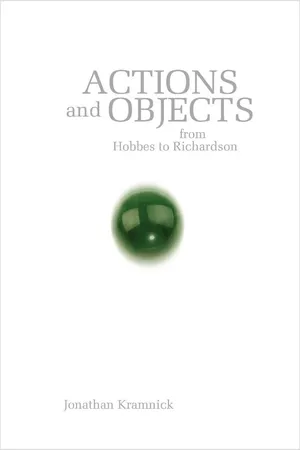
How do minds cause events in the world? How does wanting to write a letter cause a person's hands to move across the page, or believing something to be true cause a person to make a promise? In Actions and Objects, Jonathan Kramnick examines the literature and philosophy of action during the late seventeenth and early eighteenth centuries, when philosophers and novelists, poets and scientists were all concerned with the place of the mind in the world. These writers asked whether belief, desire, and emotion were part of nature—and thus subject to laws of cause and effect—or in a special place outside the natural order. Kramnick puts particular emphasis on those who tried to make actions compatible with external determination and to blur the boundary between mind and matter. He follows a long tradition of examining the close relation between literary and philosophical writing during the period, but fundamentally revises the terrain. Rather than emphasizing psychological depth and interiority or asking how literary works were understood as true or fictional, he situates literature alongside philosophy as jointly interested in discovering how minds work.
- 320 pages
- English
- ePUB (mobile friendly)
- Available on iOS & Android
eBook - ePub
Actions and Objects from Hobbes to Richardson
About this book
Information
Publisher
Stanford University PressYear
2010Print ISBN
9780804770521
9780804770514
eBook ISBN
9780804775120
Table of contents
- Cover
- Title Page
- Copyright
- Contents
- Preface
- Introduction: Nothing from Nothing
- 1. Actions, Agents, Causes
- 2. Consciousness and Mental Causation: Lucretius, Rochester, Locke
- 3. Rochester's Mind
- 4. Uneasiness, or Locke among Others
- 5. Haywood and Consent
- 6. Action and Inaction in Samuel Richardson's Clarissa
- Notes
- Index
Trusted by 375,005 students
Access to over 1.5 million titles for a fair monthly price.
Study more efficiently using our study tools.
Frequently asked questions
Yes, you can cancel anytime from the Subscription tab in your account settings on the Perlego website. Your subscription will stay active until the end of your current billing period. Learn how to cancel your subscription
No, books cannot be downloaded as external files, such as PDFs, for use outside of Perlego. However, you can download books within the Perlego app for offline reading on mobile or tablet. Learn how to download books offline
Perlego offers two plans: Essential and Complete
- Essential is ideal for learners and professionals who enjoy exploring a wide range of subjects. Access the Essential Library with 800,000+ trusted titles and best-sellers across business, personal growth, and the humanities. Includes unlimited reading time and Standard Read Aloud voice.
- Complete: Perfect for advanced learners and researchers needing full, unrestricted access. Unlock 1.5M+ books across hundreds of subjects, including academic and specialized titles. The Complete Plan also includes advanced features like Premium Read Aloud and Research Assistant.
We are an online textbook subscription service, where you can get access to an entire online library for less than the price of a single book per month. With over 1.5 million books across 990+ topics, we’ve got you covered! Learn about our mission
Look out for the read-aloud symbol on your next book to see if you can listen to it. The read-aloud tool reads text aloud for you, highlighting the text as it is being read. You can pause it, speed it up and slow it down. Learn more about Read Aloud
Yes! You can use the Perlego app on both iOS and Android devices to read anytime, anywhere — even offline. Perfect for commutes or when you’re on the go.
Please note we cannot support devices running on iOS 13 and Android 7 or earlier. Learn more about using the app
Please note we cannot support devices running on iOS 13 and Android 7 or earlier. Learn more about using the app
Yes, you can access Actions and Objects from Hobbes to Richardson by Jonathan Kramnick in PDF and/or ePUB format, as well as other popular books in Literatura & Crítica literaria inglesa. We have over 1.5 million books available in our catalogue for you to explore.