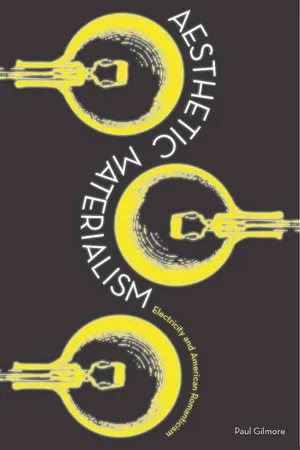
Aesthetic Materialism: Electricity and American Romanticism focuses on American romantic writers' attempts to theorize aesthetic experience through the language of electricity. In response to scientific and technological developments, most notably the telegraph, eighteenth- and nineteenth-century electrical imagery reflected the mysterious workings of the physical mind as well as the uncertain, sometimes shocking connections between individuals. Writers such as Whitman, Melville, and Douglass drew on images of electricity and telegraphy to describe literature both as the product of specific economic and social conditions and as a means of transcending the individual determined by such conditions. Aesthetic Materialism moves between historical and cultural analysis and close textual reading, challenging readers to see American literature as at once formal and historical and as a product of both aesthetic and material experience.
- 256 pages
- English
- ePUB (mobile friendly)
- Available on iOS & Android
eBook - ePub
About this book
Information
CHAPTER ONE
Idealist Aesthetics and the Republican Telegraph
In 1829, Thomas Carlyle famously denounced the nineteenth century as the “Mechanical Age,” offering what has often been taken as the quintessential romantic view of science and technology. According to Carlyle, in the physical as well as the spiritual realms, “We war with rude Nature; and, by our resistless engines, come off always victorious, and loaded with spoils.” Through this process, “nothing follows its spontaneous course, nothing is left to be accomplished by natural methods. Everything has its cunningly devised implements, its pre-established apparatus; it is not done by hand, but by machinery.” In this way, “Men are grown mechanical in head and in heart, as well as in hand.”1 Carlyle indicts a merely materialistic science and technology and an economic materialism for endangering the heart, the soul, and art, for offering only a particularizing knowledge of the physical world and not access to the deeper, unifying truths of the universe. Yet this distinctively romantic view of art as potentially enabling insights into the complex field unifying self, nature, and God grew, in large part, out of the scientific and technological developments of the eighteenth and nineteenth centuries.
As a number of literary and cultural historians over the past decades have demonstrated, romantic writers frequently drew on scientific insights into the natural world and evoked the imaginative, world-changing possibilities of technology. Similarly, historians of science have shown how a number of leading scientists were deeply influenced by romantic ideas concerning the unified nature of the universe and its forms of matter and force and the romantic emphasis on the importance of perspective. In the same way, romanticism was not simply a reactionary response to the market forces unleashing a new ethos of self-interested individualism and the philistine accumulation of wealth. Instead, the romantic ambivalence about new technologies and the economic forces that promoted them was, in fact, the product of the contradictions inherent to the emergence of industrial capitalism.
In developing my argument that a specific strain of romantic aesthetics drew on electrical science and technology to figure aesthetic experience as both material and transcendent, I first need to set up this background by returning to the eighteenth century and earlier, examining important electrical experimenters and theorists such as Isaac Newton, Benjamin Franklin, and Joseph Priestley, in the context of the emergence of romanticism in the Anglo-American world. Samuel Taylor Coleridge’s figurative uses of electricity in his early poetry tellingly hints at these connections. In the 1790s, Coleridge became friends with Sir Humphry Davy, the leading English electric scientist of the age, and was deeply engaged with both the mechanical associationist thought of David Hartley and Priestley and the radical politics of Priestley and William Godwin. Soon, however, Coleridge’s worldview would change dramatically. Where in his early career, Coleridge embraced revolutionary politics and explored a materialist understanding of the world and human consciousness, his later works consistently define truth as reflecting the ideal, mirroring relationship between consciousness and immutable natural laws. In the process, Coleridge rejected revolutionary social and political changes and refigured electricity less as a natural force than as an emblem of eternal universal laws.
In the midst of this conservative turn, Coleridge met a young American painter, Samuel F. B. Morse, who was studying in London. Morse, of course, would go on to become most famous not for his art but for his invention of the electro-magnetic telegraph. Coleridge’s romantic ideology may seem antithetical to the development of new technologies focused on transforming the physical and social world. Yet this chapter traces what I take to be important parallels between Coleridge’s later interconnected ideas about electricity, the mind, and cultural politics and Morse’s thinking about the telegraph. Like Coleridge, Morse based his politics in the commonwealth tradition of republicanism, and I contend that a confluence of romantic thought and late Federalist republican ideology gave rise to Morse’s view of electrical science as a tool paralleling the task he saw for art, the fostering and diffusing of a rational model of behavior and social structure. This model of electric art and technology attempted to harness the electrical force to suture the nation and the world together through the universalization (and de-materialization) of language, thought, and feeling even as it sought to assure the continued dominance of a Euro-American intellectual elite.
In drawing these connections between Morse and Coleridge, I locate their theories within the broader socioeconomic and philosophical changes re-shaping the Atlantic world into a market-driven capitalist realm. It is important to emphasize the transatlantic nature of these transformations, for the ability of commodities, conceptions, and people to cross national borders and move across great distances instantiated the very fluidity of the material and spiritual worlds that electricity was taken to epitomize. Turning to figures such as Franklin and Edmund Burke, I demonstrate the ways that theories about electricity both were influenced by the increased flow of persons and products back-and-forth across the Atlantic and reflected concerns about the disruptive political and social effects of that fluidity. Building on this discussion, I move forward to the mid-nineteenth century to examine how Coleridge’s and Morse’s conceptions about art and electricity prefigured the two dominant reactions to the telegraph in the United States. On the one hand, spiritualist accounts of the telegraph imagined the new technology, through its apparent dispersal of universal reason and a common language, as mirroring a spiritual telegraph permeating the universe and enabling the union of all souls. As in Coleridge’s idealist account of electricity, the telegraph for spiritualists simply emblematized a universal law of relations. While Coleridge’s romantic electricity illustrated an eternal law of structure and opposition that should be replicated in a traditional hierarchical society, spiritualists’ more sentimentalized telegraph revealed a vast egalitarian spiritual union. In both cases, however, the individual experiences of historical forces, social stratification, and lived bodily (sensuous, aesthetic) existence were sublimated in favor of the universal truth they suggested—either the universal law governing all relations or the reduction of human life and differences to a spiritual equality.
Techno-utopian celebrations, on the other hand, emphasized the telegraph’s ability to transform the social world through its conquest of nature. While frequently embracing democratic and capitalist ideologies that troubled Morse, this line of thought, nonetheless, reiterated the kind of cultural hierarchy at the center of Morse’s politics by imagining the telegraph as enabling the peaceful Euro-American conquest and transformation of the rest of the world. In concluding, I bring these different strands together by examining James W. Taylor’s The Useful and the Beautiful. Taylor’s little-known pamphlet illustrates how a utilitarian view of electricity and electrical technology could be linked to electrical imagery to describe the power of art. As such, I argue, it helps us to see how Coleridge and Morse reflect a similarly anaesthetic and idealist view of cultural production and reception that runs through one tradition of aesthetic thought in the nineteenth century from Friedrich Schiller to Matthew Arnold. This mode of aesthetic thought, as with Morse’s technological imaginings and his racist politics as well as Coleridge’s romantic idealism, expresses a fear of the very basis of aesthetic thought, the sensuous body and its chaotic, potentially indeterminate reception of the world. Anaesthetic technological and romantic attempts to define electricity come together as part of a broader attempt to stabilize and substantiate the links among art, language, political and cultural structures, and the individual mind. Reconstructing this use of electricity then sets us up to recognize, in the chapters to come, the more radical critique of traditional and bourgeois notions of the self, the body, and their boundaries offered by a more materialist version of romantic electricity.
Electric Aether and Associationism
The era of literary romanticism witnessed some of the most important breakthroughs in the scientific study of electro-magnetism, discoveries that both drew on and energized European romanticism. Luigi Galvani’s experiments in the 1790s spurred the acceptance of ideas of the animal body as electric or, at least, the notion that nervous impulses were conveyed through a medium akin to electricity, if not by electricity itself. In attempting to replicate Galvani’s experiments—and, finally, disproving his thesis about animal electricity—Allessandro Volta created the first functioning battery, the Voltaic pile. This discovery of the ability to create electricity from the chemical reactions of metals led many to begin theorizing a connection between magnetism and electricity. For German naturphilosophie, a key source for the romanticism of Coleridge and others, this connection reiterated the fact that the universe was a united, organic whole.2 Hans Christian Oersted’s discovery of electricity’s influence on magnetism was guided by such thinking, and his discovery, in turn, led to Michael Faraday’s experimental proofs of electro-magnetic induction, which made the way for the electro-magnetic telegraph as well as the dynamo. Yet even as the early decades of the nineteenth century generated scientific advances essential to modern physics and electrical technology, such developments were far from strictly progressive. Instead, as Iwan Morus has argued, debates raged over the exact nature of electricity, creating a “heterogeneity of electricity”: “The fluid had a variety of different uses. It could explain the movements of the planets, the structure of the earth, the development of plants, and the organization of the human brain.”3 While electricity’s power was increasingly harnessed and understood, it remained a mysterious force or substance, used to explain a variety of equally mysterious phenomena.
Faraday’s findings suggested that electricity was independent of matter, so that, as Barbara Doran has argued, “By the end of the nineteenth century, the mechanical notions of ‘atoms in a void’ and ‘forces acting between material particles’ had been replaced by the notions of the electro-magnetic field as a nonmaterial, continuous plenum and material atoms as discrete structural-dynamic products of the plenum.”4 Beginning with considerations of electricity in the eighteenth century as a force permeating the universe, as the life force itself, or as the nervous fluid, scientific and popular, residual and emergent, understandings of electricity challenged a Newtonian worldview of the universe, the mind, and social reality consisting of discrete particles in motion. Early-nineteenth-century thinkers could not imagine the revolution epitomized by the theory of relativity, but they readily recognized that electricity posed a vexing problem for Newtonian science, for its actions could not be easily reconciled with a mechanistic world conceived of in terms of solid atoms acting directly upon one another.
In order to resolve this difficulty, Newton had posited a nearly immaterial Aether, a “Medium exceedingly more rare and subtile than the Air, and exceedingly more elastick and active” that “readily pervade[s] all Bodies” and serves as a kind of vehicle for a variety of forces and actions, including vision and gravity. Newton even suggested that this aether might be at work in the nervous system, that “Animal Motion [is] perform’d by the Vibrations of this Medium, excited in the Brain by the power of the Will, and propagated from thence through the solid, pellucid and uniform Capillamenta of the Nerves.”5 Following his lead, most electrical scientists of the eighteenth and early-nineteenth centuries attempted to view electricity in terms of “streams of tiny invisible particles that acted on matter by direct contact.”6 While readings of electricity as the animating force and Galvani’s theory of animal electricity were largely discounted in the early decades of the nineteenth century (only to re-emerge at mid-century), their premises about an electrical fluid or aether fostered speculations about the relationships between electricity and the nervous impulse, electricity and life, and electricity and other natural forces such as gravity and magnetism. Such hypotheses would continue to appear in the work of even some of the leading thinkers on electricity throughout the first half of the nineteenth century. Bridging the spiritual and physical worlds, by providing a materialist understanding of a dynamic or divinely designed universe, electricity seemed, if not identical with the source of nervous impulses or not the prime source of life itself, to supply a ready substitute for both.
As a number of historians have argued, Newtonian mechanical physics provided a vital paradigm for eighteenth-century theories of the mind, political systems, and art. One development of this Newtonian model particularly important for late-eighteenth and early-nineteenth century Anglo-American literature and criticism was psychological associationism.7 Associationism emerged from the materialism of both Hobbes and Locke in the late seventeenth century and influenced the early thought of both Wordsworth and Coleridge. Although associationist thinkers staked out different ground on the question of how determined thought was, all associationists agreed, as James Engell summarizes, “that the mind groups together habitually, almost instantaneously, ideas or images according to certain patterns or, as they became known, ‘laws of association.’” Associationism posited that “There is not one involuntary or voluntary idea, motive, or personal feeling (‘idea of sensation’) that does not stem either from direct sense experience exciting the nerves and our ‘white medullary substance,’ or from a coalescence and mixture of nervous vibrations caused by numerous other ideas.”8 As David Hartley most fully articulated it in the first half of his Observations on Man, His Frame, His Duty, and His Expectations (1749), this meant linking Newton’s theories about physical vibrations with Locke’s ideas concerning psychological association: “The Doctrine of Vibrations may appear at first Sight to have no Connexion with that of Association; however, if these Doctrines be found in fact to contain the Laws of the Bodily and Mental Powers respectively, they must be related to each other, since the Body and Mind are.”9 As part of what has been called the first cognitive revolution, psychological associationism became an influential attempt at locating the mind as part of the body and of the physical world.
For strictly deterministic materialists like Hobbes, viewing the mind as part of the physical world led to the conclusion that “motion determines all mental activity” as thought is “determined by relations established by the original sensation.”10 But as the second half of Hartley’s treatise emphasizes, most associationists attempted—as Kant would do at the end of the century—to reincorporate ideas of free will and Christian theology with an emphasis on a mechanically determined physical world. Accounting for the intersection between a physical world and a spiritual realm—between mechanistic determinism and free choice—associationists frequently turned to electricity. Hartley, for example, cited electricity “as a Clue and Guide . . . that other reciprocal Motions or Vibrations have a great Share in the Production of Natural Phaenomena.”11 As a subtle aether permeating the universe, electricity offered a bridge between the physical and the spiritual, between the inanimate world of Newtonian physics and life itself. In fact, as Patricia Fara has noted, “one major function of electrical aethers was to account for God’s continuing involvement in the world. . . . they offered a reasonable account of how Christian dualism and electrical theory could be reconciled.”12 Despite the broad rejection of Galvani’s animal electricity and Franz Anton Mesmer’s animal magnetism, this spiritualized understanding of electricity continued to provide a powerful possibility for associationists and others concerned with maintaining a philosophical defense of Christian moral responsibility within a materialistic, scientific worldview.
The political implications of this kind of spiritualized electricity and associationism emerge in the career of the most important promoter of Hartleian associationism in the late-eighteenth century, Joseph Priestley. In his preface to Experiments and Observations on Different Kinds of Air, Priestley locates natural history within the divine and ...
Table of contents
- Title Page
- Copyright Page
- Dedication
- Acknowledgments
- Table of Contents
- Introduction: The Word “Aesthetic”
- CHAPTER ONE - Idealist Aesthetics and the Republican Telegraph
- CHAPTER TWO - Aesthetic Electricity
- CHAPTER THREE - Frederick Douglass’s Electric Words: Aesthetic Politics and the Limits of Identification
- CHAPTER FOUR - Mad Filaments: Walt Whitman’s Aesthetic Body Telegraphic
- Conclusion: Aesthetic Electricity Caged
- Notes
- Works Cited
- Index
Trusted by 375,005 students
Access to over 1.5 million titles for a fair monthly price.
Study more efficiently using our study tools.
Frequently asked questions
Yes, you can cancel anytime from the Subscription tab in your account settings on the Perlego website. Your subscription will stay active until the end of your current billing period. Learn how to cancel your subscription
No, books cannot be downloaded as external files, such as PDFs, for use outside of Perlego. However, you can download books within the Perlego app for offline reading on mobile or tablet. Learn how to download books offline
Perlego offers two plans: Essential and Complete
- Essential is ideal for learners and professionals who enjoy exploring a wide range of subjects. Access the Essential Library with 800,000+ trusted titles and best-sellers across business, personal growth, and the humanities. Includes unlimited reading time and Standard Read Aloud voice.
- Complete: Perfect for advanced learners and researchers needing full, unrestricted access. Unlock 1.5M+ books across hundreds of subjects, including academic and specialized titles. The Complete Plan also includes advanced features like Premium Read Aloud and Research Assistant.
We are an online textbook subscription service, where you can get access to an entire online library for less than the price of a single book per month. With over 1.5 million books across 990+ topics, we’ve got you covered! Learn about our mission
Look out for the read-aloud symbol on your next book to see if you can listen to it. The read-aloud tool reads text aloud for you, highlighting the text as it is being read. You can pause it, speed it up and slow it down. Learn more about Read Aloud
Yes! You can use the Perlego app on both iOS and Android devices to read anytime, anywhere — even offline. Perfect for commutes or when you’re on the go.
Please note we cannot support devices running on iOS 13 and Android 7 or earlier. Learn more about using the app
Please note we cannot support devices running on iOS 13 and Android 7 or earlier. Learn more about using the app
Yes, you can access Aesthetic Materialism by Paul Gilmore in PDF and/or ePUB format, as well as other popular books in Literature & North American Literary Criticism. We have over 1.5 million books available in our catalogue for you to explore.