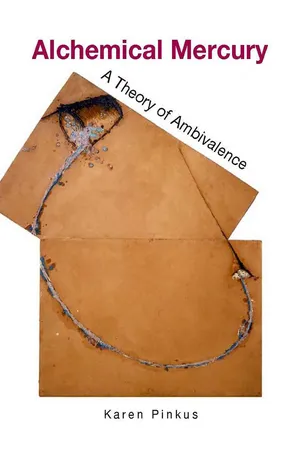
How can we account, in a rigorous way, for alchemy's ubiquity? We think of alchemy as the transformation of a base material (usually lead) into gold, but "alchemy" is a word in wide circulation in everyday life, often called upon to fulfill a metaphoric duty as the magical transformation of materials. Almost every culture and time has had some form of alchemy. This book looks at alchemy, not at any one particular instance along the historical timeline, not as a practice or theory, not as a mode of redemption, but as a theoretical problem, linked to real gold and real production in the world. What emerges as the least common denominator or "intensive property" of alchemy is ambivalence, the impossible and paradoxical coexistence of two incompatible elements. Alchemical Mercury moves from antiquity, through the golden age of alchemy in the Dutch seventeenth century, to conceptual art, to alternative fuels, stopping to think with writers such as Dante, Goethe, Hoffmann, the Grimm Brothers, George Eliot, and Marx. Eclectic and wide-ranging, this is the first study to consider alchemy in relation to literary and visual theory in a comprehensive way.
- 232 pages
- English
- ePUB (mobile friendly)
- Available on iOS & Android
eBook - ePub
About this book
Information
§ 1
Visibilia
Woe! Stuck within this dungeon yet?
Curse this dank frowsty cabinet,
Where even Heaven’s dear ray can pass
But murkily through tinted glass!
Curse this dank frowsty cabinet,
Where even Heaven’s dear ray can pass
But murkily through tinted glass!
—Goethe, Faust I, 398–401
Alchemy’s relation to “visibilia” extends beyond the extremely rich field of images that appear in alchemical manuscripts to embrace vision, transmutation, and ambivalence. Consider the Belvedere vodka advertisement (Figure 1) with its prime signifier: alchemy. Isn’t the introduction of such a “low” image already a form of reverse transmutation or debasing of the noble art? Any investigation of premodern iconology through a modern advertisement must refer itself in some measure to Aby Warburg. His unfinished project of a “universal pictorial Atlas” (his words—the geographic migrations of images seem crucial to maintain), Mnemosyne, would have brought modern advertisements into proximity with images archaic and antique.1 Warburg’s project (regardless of whether or not we wish to interpret it as a symptom of his mental illness; as schizophrenic, bipolar, or ambivalent) opens itself up to forward- and backward-moving transmissions of ideas and affect.2 His concept of pathosformel, or emotive formula, can certainly be understood as duality. In its embrace of form and content, of rational idea and irrational emotion, of ethos (interiorized self-control) and pathos (unbridled self-loss) it is filled with a life force. The conflict between ancient and modern makes a vivid formal imprint (Formegepräge) on a viewer of an image.3
The vodka advertisement is most certainly inspired—even if indirectly—by any number of early modern genre paintings, especially from the Lowlands of the seventeenth century, the most intense temporal and spatial confluence of alchemical visibilia. In particular, the two popular genres that the ad evokes are (a) a doctor (or, in some variants, a quack) analyzing a urine sample of a patient, and (b) the alchemist in his laboratory. In the first instance, a doctor may hold a clear vessel containing the urine of a female patient up to the light, as in the advertisement. Medical science of the seventeenth century (rightly) held that cloudy urine was an indicator of illness or pregnancy. Typically, the Dutch paintings in the uroscopy classification are said to contain a moral subtext. The woman patient may be pregnant by her lover, so the news delivered by the doctor is not exactly welcome. Or she may be suffering from lovesickness, and elements in the painting may highlight the vanity of impossible desire. Critics sometimes see these paintings as indictments of quack doctors with false credentials or of the gullibility of patients. The lover or husband is rarely present for the visit, so the “doctor visit” paintings normally portray an intimate interaction between a man and a woman who is not his wife. The scenes are usually highly dramatic, staging the moment at which visual proof of a yet-invisible truth is established. The mise-en-scène—and again, consider such paintings in general as a genre—does not develop in some abstract or theatricalized space, but rather, in the bedroom or sitting room of the woman; a room that is depicted in all of its bourgeois specificity with concentrated attention to the gleaming objects, paintings, furniture, and fabrics that belong to the woman, or better, to her husband or father. These are the real objects that surround her in daily life, and they form a mise-en-abîme, the inherited and accumulated wealth that will be passed on to her offspring, whose presence is perhaps signaled or negated in the liquid of the vessel itself.
Gerard ter Borch’s Consultation (Figure 3) is both typical and atypical of the urine-analysis genre. The pose of the doctor who holds the glass up to the light constitutes the signature element. The office overflows with things—an overturned broken jug, a skull, mirror, dog-eared tomes, an hourglass—that reappear so often in alchemist paintings. Tiny white flowers are scattered on the floor, symbols, perhaps, of chastity undone. Where do they come from? They are fresh, as if they have just fallen from a plant, but the room is barren and dark. And what is written on the white piece of paper that lies next to the doctor’s foot? Is it a name linked to the urine? A diagnosis? In some sense, the presence of vanitas objects on the messy desk cast suspicion on the doctor’s capabilities. The suggestion that the doctor may be a quack is certainly not unprecedented in the larger classification of doctor-visit works from the period. Similarly, it is not uncommon to find a maid delivering the urine for her mistress, perhaps because the visit is to be kept secret from the husband. So far, then, ter Borch has drawn on available conventions. But there are two rather atypical elements in this painting. First, the maid carries urine in an earthenware bowl rather than a clear glass vessel. The doctor is busy with another patient’s urine when the maid enters the room. Ter Borch has introduced narrative and serialization into what might otherwise be a fairly theatrical and static pose. Perhaps the doctor will have to pour the urine from the maid’s bowl into a clear vessel in order to make his diagnosis. Various possibilities present themselves in what appears to be a rather mysterious interaction. The maid, we should note, is reflected in the urine glass, along with the window itself—as a white dollop—which provides the light for the doctor. Indeed, there are a number of reflective surfaces, including another glass vessel in a niche, the mirror (reflecting the white papers of the doctor’s books), and the hourglass. The room, however, is extremely dark. In the left-hand corner—and this is the second surprising element—sits a figure wrapped in red cloth with his or her back to the viewer. This ghostly presence is literally marginal to the central interaction between the doctor and maid. Yet inasmuch as no detail is insignificant in a work of this nature, the fact that this figure is sketched in, but not filled out, the fact that his or her body occupies space without any particularity, seems noteworthy. 4 Perhaps this bodily mass in the corner is a gesture toward everyday life (the individual just happened to be there when ter Borch came across the scene), yet simultaneously, it hints at the shadowy nature of the doctor’s work.

FIGURE 3. Gerard ter Borch, The Consultation, 1635. Photo: Joerg P. Anders. Gemaeldegalerie, Stattliche Museen zu Berlin, Berlin, Germany. Photo credt: bildarchiv Preussischer Kulturbesitz/ Art Resource, NY.
Another variant of the urine-analysis genre, the “diagnosis of lovesickness,” popular with middle-class Dutch patrons, links the domestic scene to a long emblematic tradition: Only Love can cure Love. In Amans amanti medicus from Otto van Veen’s Amorum emblemata, Love stands in the center of the composition, holding a “clear” vial—indicated precisely by pictorial conventions of clarity—filled with urine. On the bed, a victim of lovesickness languishes. This emblem-type, then, while compositionally similar to the diagnosis of pregnancy, engages immediately with a unique symbolic register. Art historians have helped to refine the very notion of genre paintings, and sometimes to account for their popularity, on the basis that they reflect the real conditions of bourgeois life, serving as visual catalogues for the possessions of the very consumers of the paintings themselves, while they are simultaneously didactic, morally uplifting. As Hal Foster writes in an essay on fetishism, “Even today, positioned reverently before these gold chalices, fine porcelain pieces, and exquisite glasses like so many worshippers before the Golden Calf, we might believe, as perhaps did the Dutch, that these things have a mana or power of their own—a mana, moreover, that redounds to the mana or value of painting” (Foster 255). Foster goes on to cite Goethe who praised a (copy of) Dutch still life depicting gold and silver vases with great skill. “One must see this painting in order to understand in what respect art is superior to nature and what the spirit of man lends to these objects when he observes them with a creative eye. For me there is no question: If I would have to choose between the golden vases or the painting, I would choose the painting” (cited in Foster 256).
Recent art-historical work has brought to the fore a debate about Northern painting as descriptive, as opposed to (Italian) narrative. Mieke Bal, among others, has explored how these two modes work together. The dual “purpose” to genre paintings is based on an assumption, widely shared by art historians of the Northern Renaissance and Baroque, that the consumption of paintings is pleasurable in and of itself, but that consumption has to be tempered by an underlying alibi, a justification, provided precisely by the moral emblems or traditions evoked as subtext. This leads us, however, to a more troubling query that cannot be fully addressed here: Should we assume that the desire to consume, the pleasure of seeing one’s possessions reflected in the painting-as-object is primary, and the moral subtext merely adjunct? Or is the moral subject primary, and the faithful representation of daily life an added “bonus” to soften a hard lesson, the carrot before the stick, the sweet honey on the cup, like eloquence for rhetoric? This question may seem to be a digression, but it is actually essential to pose it, if only to trouble the apparently seamless account of Dutch genre painting that is offered by a certain scholarly trend. For why should we assume that the Dutch needed morality to justify their “base” greed? And why should we assume a collective desire for having that dominates over, say, a collective pleasure in economizing?
All Rubbish
The so-called moralizing subtext is not buried, but rather, quite evident in many depictions of the alchemist. Like the urine-analysis genre, the alchemist in his laboratory is a popular theme in Dutch seventeenth-century art. In general, various elements of this type engage in “the art of describing [the everyday],” in Svetlana Alpers’s influential terms, and yet symbolic elements are also often present. A well-known example of this generic type is an etching by Philippe Gallé (after a 1558 drawing by Brueghel) (Figure 4). The scene takes place in an extremely disorderly room populated by an extended family and a scholar. First, we should note that the engraving is based on a drawing, hence the original was reversed. It is specious, therefore, to make any arguments based on the lateral disposition of objects in the scene. On the right a scholar sits at his desk and points with one hand to an alchemist (presumably the father) and with his other hand to a volume open to the chapter heading Alghe Mist (All Rubbish).5 Indeed, the scholar consults several different books at once: there is no single authority for the intellectual trash that is alchemy. Various implements are scattered around the floor, including scales for weighing gold (does this imply that real gold was/is produced, or is it simply a sign of greed?), bellows (the implement of the puffers or souffleurs), a sack marked “drogery,” various pots and pans, an hourglass, and so on. In the midground, two witchlike women (presumably mother and grandmother) work. The father—the alchemist—tries to work at his desk, while one can vaguely make out the word misero on the paper pinned precariously above his head. The parents ignore their children, who climb inside a cupboard. One of the children has a pot lodged on his head. He wears it into the “next” scene, viewed through the window: the family is being led off to the poorhouse. The foreground scene, then, depicts a miserable family at work under the spurious supervision of a scholar. The composition is overcrowded, entirely antithetical to the moral ideal of the ordered Dutch (Calvinist) interior. All of the characters are completely absorbed in their respective activities, so they do not see the potentially ruinous consequences of their actions.

FIGURE 4. Philippe Gallé, The Alchemist, 1558. Etching, after a drawing by Pieter Brueghel the Elder. Photo: Jörg P. Anders. Inv.: 45-1964. Kupferstichkabinett, Staatliche Museen zu Berlin, Berlin, Germany. Photo credit: Bildarchiv Preussischer Kulturbesi...
Table of contents
- Title Page
- Copyright Page
- Table of Contents
- Table of Figures
- Acknowledgments
- Introduction
- § 1 - Visibilia
- Excursus: Ambivalence
- § 2 - Chemical Nuptials
- Excursus: Mercury
- § 3 - A Chemical Couple
- § 4 - Rumpelstiltskin
- § 5 - “The Sandman”
- Excursus: Counterfeiting
- § 6 - Reading Capital I Alchemically
- § 7 - Digital Gold
- Notes
- Bibliography
- Index
Trusted by 375,005 students
Access to over 1.5 million titles for a fair monthly price.
Study more efficiently using our study tools.
Frequently asked questions
Yes, you can cancel anytime from the Subscription tab in your account settings on the Perlego website. Your subscription will stay active until the end of your current billing period. Learn how to cancel your subscription
No, books cannot be downloaded as external files, such as PDFs, for use outside of Perlego. However, you can download books within the Perlego app for offline reading on mobile or tablet. Learn how to download books offline
Perlego offers two plans: Essential and Complete
- Essential is ideal for learners and professionals who enjoy exploring a wide range of subjects. Access the Essential Library with 800,000+ trusted titles and best-sellers across business, personal growth, and the humanities. Includes unlimited reading time and Standard Read Aloud voice.
- Complete: Perfect for advanced learners and researchers needing full, unrestricted access. Unlock 1.5M+ books across hundreds of subjects, including academic and specialized titles. The Complete Plan also includes advanced features like Premium Read Aloud and Research Assistant.
We are an online textbook subscription service, where you can get access to an entire online library for less than the price of a single book per month. With over 1.5 million books across 990+ topics, we’ve got you covered! Learn about our mission
Look out for the read-aloud symbol on your next book to see if you can listen to it. The read-aloud tool reads text aloud for you, highlighting the text as it is being read. You can pause it, speed it up and slow it down. Learn more about Read Aloud
Yes! You can use the Perlego app on both iOS and Android devices to read anytime, anywhere — even offline. Perfect for commutes or when you’re on the go.
Please note we cannot support devices running on iOS 13 and Android 7 or earlier. Learn more about using the app
Please note we cannot support devices running on iOS 13 and Android 7 or earlier. Learn more about using the app
Yes, you can access Alchemical Mercury by Karen Pinkus in PDF and/or ePUB format, as well as other popular books in Literature & Literary Criticism Theory. We have over 1.5 million books available in our catalogue for you to explore.