![]()
1
The Rackets
Entertainment Inc. and the Warners Gang (1928–1939)
There is a very general tendency to over-emphasize the moral and educational influence of the motion pictures. . . . The sole purpose of the commercial motion picture is to entertain.
Irving Thalberg1
[The executives at MGM] all point to the harm they could do me by putting me out in bad pictures, which is only too true. They also tell me that it would do them no harm, as they are so organized that they would go on just the same, but that I would suffer irreparable loss.
Lillian Gish to her lawyer2
i. Be a Camera
“Metro-Goldwyn-Mayer, largest of 124 subsidiaries owned by Loew’s Inc. is a corporation devoted exclusively to the business and the art of producing moving pictures.” So states Fortune as it begins its 1932 corporate profile of Metro-Goldywn-Mayer—its first devoted to a Hollywood studio.3 An inventory of MGM’s fifty-three acre plant, its army of employees, the names and salaries of its stars, and its box office receipts fills the page. And then the author pauses to explain why those facts and figures are worthy of attention: “For the past five years, Metro-Goldwyn-Mayer has made the best and most successful moving pictures in the United States.” Why was this the case?
It may be luck. It may be the list of MGM stars, vastly the most imposing in . . . “the industry.” It may be MGM’s sixty-two writers and eighteen directors. It may be MGM’s technicians, who are more numerous and more highly paid than those of MGM’s competitors. It may be Irving Thalberg—Norma Shearer’s husband. If no one in Hollywood knows the reason for MGM’s producing success, everyone in Hollywood believes the last. Irving Thalberg, a small and fragile young man with a suggestion of anemia, is MGM’s vice-president in charge of production. The kinds of pictures MGM makes and the ways it makes them are Irving Thalberg’s problems. He is what Hollywood means by MGM.4
To think of MGM is to think of Thalberg, the man who, to his peers, personifies the studio. Fortune will affirm that sentiment. From the outset of the business magazine, in February 1930, hard upon the crash of the stock market, it had invested in the genre of the corporate profile. Characteristically, the Fortune profile individuates its corporate subject by identifying it with one or more of its agents, the executives responsible for setting company policy and achieving the company’s objectives.5 Although Thalberg was the chief executive neither of MGM (that would be Louis B. Mayer) nor of Loew’s Inc., the company of which MGM was the corporate subsidiary (Nicholas Schenck had this role), he was the executive most responsible for molding MGM’s corporate personality as the studio of personalities. Thalberg introduced the “galactic” strategy of loading MGM films with expensive stars; he regularly ordered costly retakes to assure that each picture met his (MGM’s) standard of quality. It was not an easy job. MGM had abundant talent at its disposal, but the vice-president in charge of production had to “know how to focus all this talent.” Thalberg succeeded because he had a way with “ideas, [which] are the seeds of motion picture production—the most valuable commodity in Hollywood—Ideas for whole films, Ideas for episodes, Ideas for a single scene. . . . [In Hollywood] men get huge salaries for generating and sifting Ideas. Mr. Thalberg gets the hugest” (AFI, pp. 314–15).6 Thalberg performed those tasks with mechanical efficiency. “For Irving Thalberg’s brain is the camera which photographs dozens of scripts in a week and decides which of them, if any, shall be turned over to MGM’s twenty-seven departments to be made into a moving picture. It is also the recording apparatus which converts the squealing friction of 2,200 erratic underlings into the more than normally coherent chatter of an MGM talkie” (AFI, 313). Converting the studio’s “squealing friction” of idea after idea, of idea against idea, into the talkie’s “coherent chatter” would be pointless if there were no good reason to expect audience approval. To complete the circuit of the conversion of ideas into talkie and talkie into money required that Thalberg turn his attention from the known talents of the studio—writers, directors, designers, and producers—toward the audience, the frequent and occasional moviegoers who were the customers for MGM’s product.7 And so, after a day in which Thalberg’s efforts seemed to “follow no pattern whatsoever,” Thalberg left the studio for his home and his own private Bijou: “The chatter of Mr. Thalberg’s working day is replaced at night by an electric silence in which, pallid and intent, he performs the trick of dividing his brain into two parts. One part, reading a script, turns it into a moving picture; the other part watches this imaginary picture and, probably because it is so much like the conglomerate brain of fifty million other U.S. cinemaddicts, tells Mr. Thalberg with an astonishing degree of accuracy whether or not the picture is good” (AFI, 317–18). Hollywood personified MGM as Thalberg. Irving Thalberg merited that singular distinction because, according to Fortune, when he was alone, left to his own marvelous devices, the executive effectively impersonated the studio as a feedback mechanism that integrated production, distribution, and exhibition. He made the movie in half of his brain (the studio one) and distributed it to the other half (the exhibitor one), where he showed it to himself as a faithful representative of the mass audience.8 Faithful in his way, that is: Thalberg’s objective, MGM’s objective, was not merely to anticipate an audience’s judgment of what was good; it was to form an audience’s sense of what was good—what Fortune calls its “taste.” Universal Studio may profitably have dramatized the construction of patchwork monsters by egoistic obsessives who mix seething chemicals and ignite flashing electrodes; with the exception of Todd Browning’s scandalous Freaks, greenlit by Thalberg in 1932, however, MGM would generally abstain from horrifying its susceptible public by putting monsters or freaks on the screen. Fortune imagines, however, that behind the screen, generating and gratifying the taste of the American middle class, is an uncanny hybrid of camera and projector, which is Thalberg’s freakish brain, more efficient in producing its effects than any scientific gadget would be. This is no casual invention on Fortune’s part. Thalberg is Fortune’s version of “the structure of the mechanism which controls the public mind,”9 as public relations pioneer Edward Bernays had called it in his 1928 provocation entitled Propaganda. When Fortune declares that Thalberg “represents a new psychological type of power, which must be distinguished if you would understand the age,” it speaks on behalf of the corporate person whom Thalberg personifies; it creates “the public mind” on which it operates and from which it profits (AFI, p. 319).
After considering the challenges that confront public relations experts, Bernays formulates what would become the first principle of modern marketing: “To make customers is the new problem. One must understand not only his own business—the manufacture of a particular product—but also the structure, the personality, the prejudices, of a potentially universal public” (P, p. 65).10 Bernays boasts that the expert public relations professional can solve business’s new problem because he can manipulate “public opinion with a fair degree of accuracy by operating a certain mechanism” and thereby create a customer subject to his control (P, p. 48). Bernays is not forthcoming about what, exactly, that “mechanism” is.11 Where Bernays is vague Fortune is vivid: Thalberg becomes the mechanism he operates in order to exercise a control that goes beyond the transient manipulation of public opinion. Instead he tests the audience’s responsiveness by means of extensive previews and the acuteness of his own sensorium in order to exploit the power of motion pictures not only to appeal to an audience but to create customers by adjusting an audience’s temperament, inducing people to take on new personalities that resonate with, even mimic, the MGM stars they see onscreen and in fan magazines.12 Fortune’s conceit captures the truth that for Thalberg making good pictures meant delivering the kind of quality product that the public had come to expect from MGM because MGM had itself established the taste by which it was to be judged. Fortune calls that quality a “common denominator of goodness,” which prevails in MGM films because Thalberg’s “fine eye for contour and polish” assures that “the quality and texture of Miss Shearer’s gowns for some drama of the haut monde can be compared with the quality and texture of the hippopotamuses that Mr. Thalberg hired for Tarzan” (AFI, p. 325). Although the comparison flirts with the comic, it is not promiscuous. Fortune would not make the same claim about Paramount. No one would dare compare the quality and texture of the furs draped on Marlene Dietrich in Blonde Venus with the quality and texture of Margaret Dumont’s hippopatamine bosom in Duck Soup.
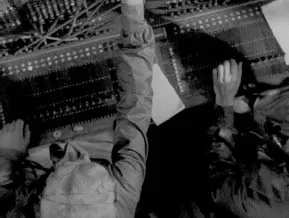
Fortune’s adoption of the figure of a hierarchical organization composed and supervised by a self-reflexive corporate mind to represent MGM attests that the studio had successfully made the business magazine a customer (and publicist) for its brand, for the conceit recapitulates the bravura opening of Grand Hotel, MGM’s banner production of 1932, to which the article respectfully refers.13 Grand Hotel begins with an overhead pan of female telephone operators speedily connecting calls amid the chatter of their workplace (Figure 1.1).
Figure 1.1
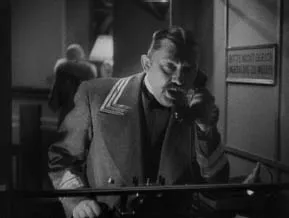
Figure 1.2
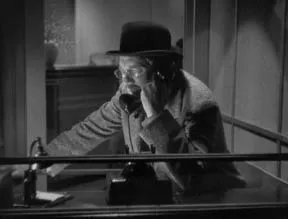
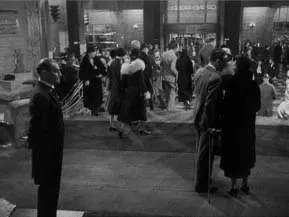
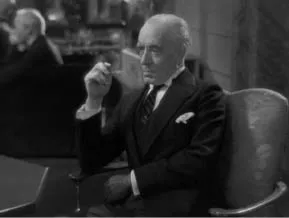
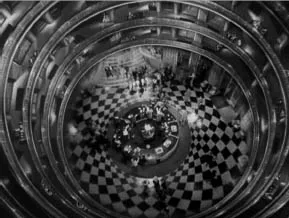
A cut connects the scene of the networkers to a montage sequence of the networked telephone users, who are individualized by faces and messages and by their isolation in telephone booths—a supposed privacy already penetrated by the camera and intermediated by montage, and that will soon be dissolved by a network of indirect connections (Figures 1.2 and 1.3). We move to a nearly eyelevel long shot of the bustling hotel lobby (Figure 1.4), which is followed by a medium close-up of Dr. Otternschlag (Figure 1.5), who, like Thalberg at MGM, visually focuses the noisy activity. He does this by being a disinterested observer, and by commenting, “People coming and going, but nothing ever happens.” Then there is a cut to a majestic shot from the ceiling of the hotel, a perspective that could only be contrived by the sophisticated tools of a studio, composing in its ambit all the workers and guests, masters and servants, rooms and corridors into a reassuring pattern of concentric circles (Figure 1.6). The shot and space order people’s apparently random comings and goings. This extraordinary shot not only represents the design that comprehends all the action that will ensue, but unlike any other shot from the Thalberg era, it reflexively refers to the camera that, transcending the action, makes it possible for that design to be recorded and projected.
Figure 1.3
Figure 1.4
Figure 1.5
The camera renders the Grand Hotel as a business that is more form than firm, an institution which in Paul Vinogradoff’s words, “has an existence of its own—a life which transcends the lives of the individuals engaged in it.” We should ask the same question of Fortune that Vinogradoff asks of the law when it faces the problem of a company that lives such a transcendent life: “How is [ Fortune] to deal with such superindividual undertakings?” And we ought to give exactly the same answer for Fortune as Vinogradoff does for the law: “The usual expedient is to assimilate [such superindividual undertakings] to live persons. We assign to them a will, i.e., the faculty of taking resolves in the midst of conflicting motives; a governing brain and nerves, in the shape of institutions and agents; a capacity for the promotion and the defense of interests by holding property, performing acts in law, and exercising rights of action in courts.”14 As for the law, so for Fortune, which represents each company it profiles in person; we may attribute to it the mental traits and physical capacities of actual humans. I add “in the process” because no matter how legal realists repudiated the sterile debate between artificial entity theorists (those who saw the corporation as a construction of the state) and natural entity theorists (those who regarded the modern corporation as an organic development in the evolution of capitalism), and sought sheerly functional justifications for legal rights acquired by the modern corporation, no one—not even John Dewey in his famous call in 1926 to eliminate “the idea of personality until the concrete facts and relations involved have been faced and stated on their own account”—could forestall the attribution of human traits to the corporate person.15 Dewey’s sensible advice to abstain from indulging in the idea of personality could not prevent the popular perception that a description of a person with no human sympathies or any regard for community standards of behavior is a description of a person without a soul. That corporations feared the consequences of such a widespread perception was, as Roland Marchand demonstrates in his magisterial Creating the Corporate Soul, amply confirmed by increased investment in public relations aimed at rehabilitating their humanity before the market crash.16 In 1937 Thurman Arnold would argue that any truly realistic account of the role that corporations play in American society would have to consider the anthropomorphism to which they have been subject, the apparently ineradicable tendency of people to personify groups of men and women working together as one gigantic human being. For Arnold, to acknowledge that there is what Dewey calls “social reality . . . back of or in corporate action” entails the recognition that most people must have an idea of personality in order to organize social facts into an intelligible pattern. Fortune did not need Arnold to inform it that a folklore that venerates the idea of personality and a business that capably manufactures new personalities adequate to whatever social facts might emerge are vital to the continued legitimacy of capitalism. Fortune’s essay is a self-conscious contribution to that folklore, and self-reflexive to the degree that it celebrates the genius of a man who concocts personalities that people will admire and animates them in stories that people will believe—and who can do so not only because he knows what they want but, more important, because he sells to no one what he has not already sold to himself as the self-created customer of his wares. Just as Fortune establishes that Thalberg’s executive undertaking on behalf of MGM is a making, it urges that his making is a marketing: Thalberg only oversees movies that can be marketed as MGM movies—movies packaged with “so high a sheen that it sometimes constitutes [the movies’] major box office appeal” (AFI, p. 325)—movies, that is, packaged the way that the Grand Hotel packages its customers, and the way that Grand Hotel lustrously packages its stars, and, not incidentally, the way that Fortune, resplendent with brilliant graphic art, handsomely packages its corporate executives.
Figure 1.6
Fortune’s version of Thalberg spins the romantic myth of the myth maker himself. To understand the studio’s double-minded “business and the art of producing moving pictures” is to acquire special insight into the value added to economic ...