- 240 pages
- English
- ePUB (mobile friendly)
- Available on iOS & Android
About this book
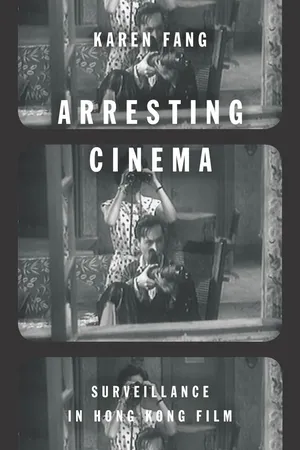
When Ridley Scott envisioned Blade Runner's set as "Hong Kong on a bad day," he nodded to the city's overcrowding as well as its widespread use of surveillance. But while Scott brought Hong Kong and surveillance into the global film repertoire, the city's own cinema has remained outside of the global surveillance discussion.
In Arresting Cinema, Karen Fang delivers a unifying account of Hong Kong cinema that draws upon its renowned crime films and other unique genres to demonstrate Hong Kong's view of surveillance. She argues that Hong Kong's films display a tolerance of—and even opportunism towards—the soft cage of constant observation, unlike the fearful view prevalent in the West. However, many surveillance cinema studies focus solely on European and Hollywood films, discounting other artistic traditions and industrial circumstances. Hong Kong's films show a more crowded, increasingly economically stratified, and postnational world that nevertheless offers an aura of hopeful futurity. Only by exploring Hong Kong surveillance film can we begin to shape a truly global understanding of Hitchcock's "rear window ethics."
Frequently asked questions
- Essential is ideal for learners and professionals who enjoy exploring a wide range of subjects. Access the Essential Library with 800,000+ trusted titles and best-sellers across business, personal growth, and the humanities. Includes unlimited reading time and Standard Read Aloud voice.
- Complete: Perfect for advanced learners and researchers needing full, unrestricted access. Unlock 1.4M+ books across hundreds of subjects, including academic and specialized titles. The Complete Plan also includes advanced features like Premium Read Aloud and Research Assistant.
Please note we cannot support devices running on iOS 13 and Android 7 or earlier. Learn more about using the app.
Information
Table of contents
- Cover
- Copyright
- Title Page
- Dedication
- Contents
- Preface
- Introduction: A Race of Peeping Toms? “Rear Window Ethics” in Hong Kong
- One. Watching the Watchman: Michael Hui’s Surveillance Comedies
- Two. On the “China Watch”: Prosperity and Paranoia in Reunification-Era Cinema
- Three. “Only” a Policeman: Joint Venture Cinema and the Mediatization of the Hong Kong Police
- Four. “Representing the Chinese Government”: Hong Kong Undercover in an Age of Self-Censorship
- Conclusion: Toward a Global Surveillance Cinema
- Appendix: Chinese Glossary
- Notes
- Bibliography
- Index