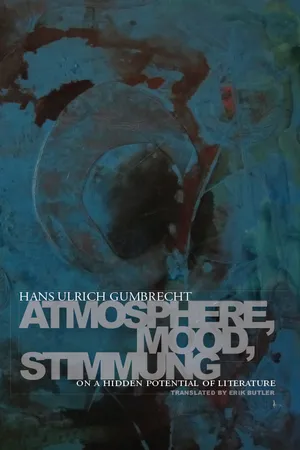
Atmosphere, Mood, Stimmung
On a Hidden Potential of Literature
- 152 pages
- English
- ePUB (mobile friendly)
- Available on iOS & Android
About this book
What are the various atmospheres or moods that the reading of literary works can trigger? Hans Ulrich Gumbrecht has long argued that the function of literature is not so much to describe, or to re-present, as to make present. Here, he goes one step further, exploring the substance and reality of language as a material component of the world—impalpable hints, tones, and airs that, as much as they may be elusive, are no less matters of actual fact.
Reading, we discover, is an experiencing of specific moods and atmospheres, or Stimmung. These moods are on a continuum akin to a musical scale. They present themselves as nuances that challenge our powers of discernment and description, as well as language's potential to capture them. Perhaps the best we can do is to point in their direction. Conveying personal encounters with poetry, song, painting, and the novel, this book thus gestures toward the intangible and in the process, constitutes a bold defense of the subjective experience of the arts.
Frequently asked questions
- Essential is ideal for learners and professionals who enjoy exploring a wide range of subjects. Access the Essential Library with 800,000+ trusted titles and best-sellers across business, personal growth, and the humanities. Includes unlimited reading time and Standard Read Aloud voice.
- Complete: Perfect for advanced learners and researchers needing full, unrestricted access. Unlock 1.4M+ books across hundreds of subjects, including academic and specialized titles. The Complete Plan also includes advanced features like Premium Read Aloud and Research Assistant.
Please note we cannot support devices running on iOS 13 and Android 7 or earlier. Learn more about using the app.
Information
Table of contents
- Cover
- Copyright
- Title Page
- Contents
- Reading for Stimmung: How to Think About the Reality of Literature Today
- Moments
- Situations
- Acknowledgments
- Bibliographical References