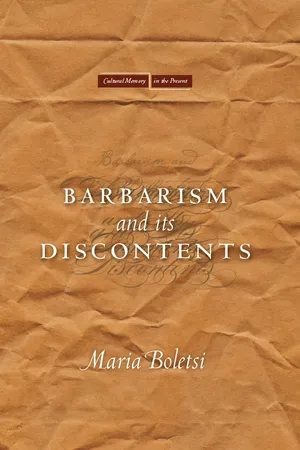
Barbarism and civilization form one of the oldest and most rigid oppositions in Western history. According to this dichotomy, barbarism functions as the negative standard through which "civilization" fosters its self-definition and superiority by labeling others "barbarians." Since the 1990s, and especially since 9/11, these terms have become increasingly popular in Western political and cultural rhetoric—a rhetoric that divides the world into forces of good and evil. This study intervenes in this recent trend and interrogates contemporary and historical uses of barbarism, arguing that barbarism also has a disruptive, insurgent potential. Boletsi recasts barbarism as a productive concept, finding that it is a common thread in works of literature, art, and theory. By dislodging barbarism from its conventional contexts, this book reclaims barbarism's edge and proposes it as a useful theoretical tool.
- 328 pages
- English
- ePUB (mobile friendly)
- Available on iOS & Android
eBook - ePub
Barbarism and Its Discontents
About this book
Information
1
Piecework
Something there is that doesn’t love a wall,
That sends the frozen-ground-swell under it,
And spills the upper boulders in the sun
And makes gaps even two can pass abreast.
—Robert Frost, from “Mending Wall”
Through Franz Kafka’s “The Great Wall of China” (Beim Bau der chinesischen Mauer, 1930), a short story of an unfinished wall, I offer a “sneak preview” of several barbarian operations that will be laid out in this book and present some of its main threads:1 the relation between civilization and barbarism; the features and functions of what I call “barbarisms”; the relation of the concept of barbarism to questions of knowing; its involvement in comparative acts; and the ways in which we can imagine a creative recasting of this concept. The wall and its construction system in Kafka’s story function as a model for mapping out the structuring principles of this book as a whole.
In “The Great Wall of China,” barbarism unravels as a force that ruptures the epistemological premises of established discourses and imbues them with foreign and erratic elements. Through such interventions, barbarism overthrows the epistemological priority of civilization and promises other ways of knowing, which spring out of a constant tension with negation, ambivalence, contradictions, and possible impossibilities.
The concept of barbarism has a significant comparative aspect. The “barbarian” can be seen as a figure of comparison by definition because it is the product of a comparative act: someone receives the label “barbarian” after having been compared to, and found the opposite of, the civilized subject. The barbarian is the measure against which civilization acquires its self-validation. The comparative gesture embedded in the barbarian is part of a hierarchical comparative framework that establishes “civilization” as the referent of supremacy and the measure of excellence. It is therefore a fake comparison played out between two constructions devised by the (civilized) subject: the “civilized” and the “barbarian.” The outcome of this comparative “act” is always the same: the comparison with the barbarian makes the civilized look good. Self-proclaimed civilized subjects need to measure themselves against barbarians, and they always win this competition, since both parts of the comparison are products of their own representational system.
The figure of the barbarian, however, does not always fall prey to quasi-comparative acts to the benefit of civilizational discourse. Precisely due to its comparative nature, the barbarian can operate between worlds. Acting in the interstices of languages (in the broadest sense of the word), the barbarian can create fissures in the languages and objects involved in comparative encounters. Barbarism can be involved in a mode of comparing that demands a radical change of perspective as well as a shifting of the grounds of the comparison.
Barbarism and Civilization: An Unfinished Business
The narrator in “The Great Wall of China” is one of the Chinese builders of the wall. He aspires to put together a historical inquiry by combining the fragmented, inconclusive, and contradictory narratives and theories that surround the construction of the Great Wall of China. The project of the wall was meant to reinforce China’s ideal of national purity and keep the country isolated and protected from contamination from the barbarous outside world. Nevertheless, Kafka’s narrator informs us that the project ended up defeating its purpose because of gaps rumored to exist between several blocks of the wall. The incompleteness of the wall—the fact that pieces are missing along its perimeter—is the result of the so-called system of piecemeal construction, which takes center stage in the narrator’s exposition. “Piecemeal construction” denotes the practice of building different blocks of the wall in different places at the same time, which would be joined together at a later stage. According to the narrator, some of these blocks were possibly never joined, leaving openings in the construction. In the story, we read that the piecemeal construction “is one of the crucial problems in the whole building of the wall” (Kafka 1999, 238). Thus, his narrative sets out to shed light on this system.
His first question concerns the incongruity between the wall’s purpose and effect. If the purpose of the wall was to offer “a protection against the peoples of the north,” the narrator wonders, “How can a wall protect if it is not a continuous structure? Not only can such a wall not protect, but what there is of it is in perpetual danger” (235). The wall is porous, vulnerable to its outside. Yet the construction “probably could not have been carried out in any other way” (236). His first explanation is based on psychological and practical reasons. The piecemeal system ensured variation and change of scenery for the supervisors of the construction. By moving around to build different parts of the wall, the supervisors could see finished sections on their way, renew their belief in their work, and feel they contributed to a great project that unified the nation. “Thus,” the narrator concludes, “the system of piecemeal construction becomes comprehensible” (238).
But not quite. In the narrative there are only provisional conclusions, constantly overthrown by new ones. Thus, the psychological explanation gives way to a theological or transcendental one. The narrator brings in the “high command” (die Führerschaft) as the invisible authority behind the decision for the piecemeal construction—an authority whose decrees are not to be questioned. “And for that reason,” the narrator remarks, “the incorruptible observer must hold that the command, if it had seriously desired it, could also have overcome those difficulties that prevented a system of continuous construction” (240). Yet the narrator immediately notices a paradox: “But the piecemeal construction was only a makeshift and therefore inexpedient. Remains the conclusion that the command willed something inexpedient [unzweckmäβig]. Strange conclusion!” (240). By suggesting that the decision of the high command was improper and ineffective, the narrator corrupts his own statement of belief in the unlimited power of the command. He thereby imbues his previous statement with a “barbarism,” a trace of self-canceling doubt, which leads his reasoning to an impasse (“Strange conclusion!”). The fact that he corrupts his own statement makes his address to an “incorruptible observer” ironic and, indeed, “inexpedient.” While the narrator constructs an “incorruptible observer” who must accept the infallibility of the high command, his narrative is replete with logical errors and paradoxes, bound to corrupt any “incorruptible observer.”
The narrator continues his line of questioning: “Against whom was the Great Wall to serve as a protection? Against the people of the north.” His reply is again instantly questioned and negated: “Now, I come from the southeast of China. No northern people can menace us there” (241). Not only have they never seen those barbarian nomads but even if they existed, the land is so vast that the northern people would never reach the southern villages. Once more, the narrator employs a strategy that Bianca Theisen calls “self-referential negation,” whereby “a statement invites and seems to entail the following one, only to then be negated and cancelled by it” (2006, 3). If the barbarians posed no threat, then the question that logically follows is, again, why the wall needed to be built: “Why, then, since that is so, did we leave our homes . . . our mothers and fathers, our weeping wives, our children . . . Why?” (Kafka 1999, 241).
For an answer he resorts again to the high command, which he now believes “has existed from all eternity, and the decision to build the wall likewise” (242). According to this new explanation, the construction of the wall had neither to do with a barbarian threat nor with the Emperor’s decision. It has no origin or cause whatsoever, since it has always existed. For the narrator-historian, this sudden cancellation of all causality behind the wall’s building makes the question of why utterly impertinent—“inexpedient.” The recourse to the high command as an all-explanatory mechanism undermines the purpose of his narrative. If the decision has always existed, then why explore its causes in the first place? However, what seems to make the whole inquiry pointless may also be read as an exposure of the arbitrary structures according to which causes and effects are constructed as such. If the decision for the wall always existed, then the perceived causes for the wall’s construction—protecting the country from barbarians, safeguarding the purity of the nation, strengthening its unity—come after the decision for the wall and are produced as the wall’s effects. The Emperor’s decree for the wall’s construction, the lifelong devotion of the Chinese people to its building, and the construction of outside others as threatening barbarians, are all effects—not causes—of the wall. By suggesting that national identity and the categories of “civilized” and “barbarian” are effects of discourse, the narrative deessentializes them. This deessentialization also highlights one of this book’s main premises: Barbarians do not exist as such but are constructions of a discursive structure that produces others as threatening and inferior.
The decision for the wall’s construction has no origin but merely effects, which are expected to be enhanced with the actual construction. However, a glitch appears in this project as soon as the theoretical decision for the wall turns into an actual construct. The actualization of the wall endangers the ideological structures that demanded its construction, because the system of piecemeal construction leaves fissures in the Empire’s borders, making them vulnerable to invasions from the outside. If the purpose of a wall is to seal borders, then this wall is strategically useless. The greatest monument to China’s civilization is also the greatest proof of its inability to exclude foreignness from its territory. As Wendy Brown argues in her recent study on walled states, while walls may appear as “hyperbolic tokens” of sovereignty, in fact their presence betrays an instability at the core of the message they are trying to convey. Therefore, walls can be signs of the waning of a nation’s sovereignty (2010, 24). In Kafka, the Chinese wall becomes an ambivalent symbol of power as well as vulnerability.
Although the narrator fails to adequately account for the wall’s construction system, it is noteworthy that those who have a better grasp of the project are the barbarian nomads themselves. It is probable, the narrator informs us, that the nomad tribes against which the wall was built “kept changing their encampments with incredible rapidity, like locusts, and so perhaps had a better general view of the progress of the wall than we, the builders” (Kafka 1999, 235–36). As Stanley Corngold observes, the design of the wall is incomprehensible, “except, perhaps, to the nomads whom it exists to ostracize.” This, Corngold argues, opens up the great paradox “that the builders are dependent on the beings from whom it is their entire purpose to obtain independence” (2002, 105).
The paradoxical dependence of civilization on its barbarians is thereby underscored. Civilization aspires to establish a proper locus from which to speak, exert power, and identify others as barbarians. In practice, however, this locus is precarious and unstable: the civilized center (in Kafka’s story, the Empire of China) is never identical to itself, as it can exist only in relation to a barbarian exteriority. This reflects the paradox of a civilized society priding itself on its self-sufficiency yet needing inferior or subjugated others in order to reaffirm this self-sufficiency. Thus, although civilization appears to be the powerful, superior term in the opposition with the barbarians, its dependence on them also makes it vulnerable.
Presented as inexpedient, the system of piecemeal construction itself can be viewed as a barbarism—a foreign, inexplicable element—at the heart of China’s civilization. The barbarism that this system constitutes does not come from the outside but is internally generated: it is the decision of the high command. This fact, as we have seen, puzzles the narrator. Why would civilization (wittingly or not) produce the barbarisms that undermine the completion of its own project? This question gives rise to opposing assumptions. Does the piecemeal construction signal civilization’s self-destructive drive, which makes it plant the seeds of its own potential demise in the form of gaps in the wall? Or does this barbarism in fact protect the Empire from turning into an isolated, self-regulating system without connections to its outside? Following the latter assumption, the real threat to civilization does not come from the nomads but from the desire for national purity and the exclusion of foreignness. The piecemeal construction blurs the borders between inside/outside, civilization and barbarism, enabling their interpenetration. By allowing foreign elements to enter, this design may fail to protect civilization from its outside, but it safeguards its potential for change and renewal.
The incomplete wall in the story underscores the unsettled relation between civilization and barbarism. The relation between civilization and barbarism is an unfinished business, with different, unpredictable effects each time it is activated. Through openings in the “wall” of civilizational discourse barbarism enters as a force that foils the completion of this wall and enables alterity to affect its structures.
Possible Impossibilities and Three Incomplete Walls
In the second part of “The Great Wall of China,” the narrator focuses on the strange relation between imperial center and periphery within the wall of China. Although the opposition between the intra and extra muros is not very convincing in the story (the barbarian nomads have not even been seen), inside the wall incongruities and improbabilities thrive. Within the Chinese universe, the people and the Empire are barbarian to each other, as they live in different worlds. In the narrator’s description of the Empire’s modus operandi, especially of the way common people relate to it, a universe replete with barbarisms comes alive. These barbarisms—in the form of paradoxes, hyperboles, irregularities, incompatibilities, and strange mixtures of heterogeneous orders—pertain both to notions of time and space and to the relation between fiction, myth, and reality.
The relation between the Empire in Peking and the “common people” is marked either by miscommunication or by total lack of communication. Regarding temporality, the people in China live in a mythical past, which they perceive as the Empire’s present. Information about dead emperors and their dynasties travels so slowly that old stories reach people as “news” thousands of years after occurrence. “Battles that are old history are new to us,” writes the narrator. And while nothing is known about the present Emperor, “long-dead emperors are set on the throne in our villages.” The living Emperor, on the other hand, “they confuse among the dead” (Kafka 1999, 245). The past is kept alive as present.
At first glance, this unorthodox temporality indicates that people live out of sync with the present, trapped in a mythical past. However, their time-conception also results in a perpetual performance of the past in the present. In this “present,” “the wives of the emperors . . . vehement in their greed, incontrollable in their lust, practice their abominations ever anew” (245, emphasis added). This repetitive performance of the past as present ensures that the past is never solidified but is constantly transformed from a present perspective.
The flow of information in the country is reminiscent of the way we view stars from the earth: most visible stars have been destroyed for millions of years. In Kafka’s story, however, not only is history performed as present but the inverse is true as well: for the Chinese people, the present of the Empire is already history. The narrator recalls that when a beggar came to the village to read a revolutionary leaflet by the rebels of the neighboring village, the villagers sent him away without believing a word he said. Although the text of the leaflet gives vivid descriptions of “the gruesomeness of the living present,” the dialect in which it is written sounds archaic to them. Hence, the content of the leaflet is perceived as ancient history. “So eager are our people to obliterate the present,” writes the narrator. The gruesome present of the neighbors is a barbarism in their own present—a foreign sound dismissed as obsolete, unworthy of attention (246).
China’s parallel temporalities usually do not interfere with each other. But whenever they cross each other momentarily—as in the last example—they imbue each other with barbarisms, which unsettle people’s time-conception and the truths by which they live. By juxtaposing these temporalities in the story, the narrator unleashes barbarisms that turn the familiar into something foreign and erratic and challenge the secure contexts of people’s lives. The elements I call “barbarisms” have a relational meaning: their identification as barbarisms is dependent on the context in which they appear. Thus, when there is no contact between different temporal frameworks in the story, the same elements I here call “barbarisms” may very well reinforce rather than undermine the borders of each temporal framework.
The reality of Peking and the existing Emperor are just as foreign and inaccessible to common people as the northern barbarians they have never seen. “Peking itself is far stranger to the people in our village than the next world,” the narrator concedes (246). Yet this does not deter them from keeping the myth of the Empire alive. The sacred dragon—the symbol of Peking—is always honored in their village, because, the narrator says, no people are “more faithful to the Emperor than ours” (246). The Emperor as symbol and the Empire as myth are far more indispensable to them than “reality.” Even if they long to clasp the Empire “in all its palpable living reality,” in the end they are not willing to exchange the safety of their mythical present for a chunk of the “real” (247). This would subject their age-old beliefs to the risk of falsification from another reality. Therefore, the reality of Peking is to them a barbarism they try to exclude from their discourse.
By juxtaposing reality and fiction, history and myth, past and present, the narrative does not project these categories as irreconcilable hierarchical oppositions. Nor does it collapse them by eradicating their differences. Because they operate on an equal level in the story’s universe, they are able to interpenetrate and affect each other: fiction is no less “real” than reality, for history is shown to be replete with mythical constructions, and the past can be just as “present” as the present, if not more. The discursiv...
Table of contents
- Cover
- Copyright
- Title Page
- Series Page
- Dedication
- Contents
- Preface
- Acknowledgments
- Introduction
- 1. Piecework
- 2. Thinking Barbarism Today
- 3. It’s All Greek to Me: The Barbarian in History
- 4. A Positive Barbarism?
- 5. Barbarism in Repetition: Literature’s Waiting for the Barbarians
- 6. Another “Kind of Solution”? Art’s Waiting for the Barbarians
- 7. New Barbarians
- Afterword
- Notes
- References
- Index
- Series List
Trusted by 375,005 students
Access to over 1.5 million titles for a fair monthly price.
Study more efficiently using our study tools.
Frequently asked questions
Yes, you can cancel anytime from the Subscription tab in your account settings on the Perlego website. Your subscription will stay active until the end of your current billing period. Learn how to cancel your subscription
No, books cannot be downloaded as external files, such as PDFs, for use outside of Perlego. However, you can download books within the Perlego app for offline reading on mobile or tablet. Learn how to download books offline
Perlego offers two plans: Essential and Complete
- Essential is ideal for learners and professionals who enjoy exploring a wide range of subjects. Access the Essential Library with 800,000+ trusted titles and best-sellers across business, personal growth, and the humanities. Includes unlimited reading time and Standard Read Aloud voice.
- Complete: Perfect for advanced learners and researchers needing full, unrestricted access. Unlock 1.5M+ books across hundreds of subjects, including academic and specialized titles. The Complete Plan also includes advanced features like Premium Read Aloud and Research Assistant.
We are an online textbook subscription service, where you can get access to an entire online library for less than the price of a single book per month. With over 1.5 million books across 990+ topics, we’ve got you covered! Learn about our mission
Look out for the read-aloud symbol on your next book to see if you can listen to it. The read-aloud tool reads text aloud for you, highlighting the text as it is being read. You can pause it, speed it up and slow it down. Learn more about Read Aloud
Yes! You can use the Perlego app on both iOS and Android devices to read anytime, anywhere — even offline. Perfect for commutes or when you’re on the go.
Please note we cannot support devices running on iOS 13 and Android 7 or earlier. Learn more about using the app
Please note we cannot support devices running on iOS 13 and Android 7 or earlier. Learn more about using the app
Yes, you can access Barbarism and Its Discontents by Maria Boletsi in PDF and/or ePUB format, as well as other popular books in Literature & Literary Criticism. We have over 1.5 million books available in our catalogue for you to explore.