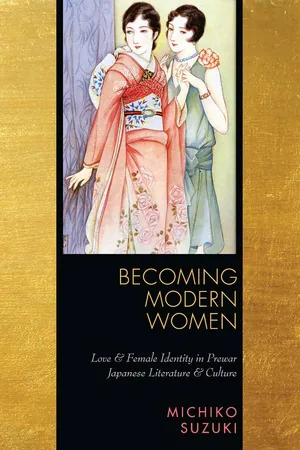
Presenting a fresh examination of women writers and prewar ideology, this book breaks new ground in its investigation of love as a critical aspect of Japanese culture during the early to mid-twentieth century. As a literary and cultural history of love and female identity, Becoming Modern Women focuses on same-sex love, love marriage, and maternal love—new terms at that time; in doing so, it shows how the idea of "woman," within the context of a vibrant print culture, was constructed through the modern experience of love. Author Michiko Suzuki's work complements current scholarship on female identities such as "Modern Girl" and "New Woman," and interprets women's fiction in conjunction with nonfiction from a range of media—early feminist writing, sexology books, newspapers, bestselling love treatises, native ethnology, and historiography. While illuminating the ways in which women used and challenged ideas about love, Suzuki explores the historical and ideological shifts of the period, underscoring the broader connections between gender, modernity, and nationhood.
eBook - ePub
Becoming Modern Women
Love and Female Identity in Prewar Japanese Literature and Culture
- 248 pages
- English
- ePUB (mobile friendly)
- Available on iOS & Android
eBook - ePub
Becoming Modern Women
Love and Female Identity in Prewar Japanese Literature and Culture
About this book
Information
Publisher
Stanford University PressYear
2009Print ISBN
9780804761987
9780804761970
Edition
1eBook ISBN
9780804772952
PART ONE
Girls and Virgins
TWO
Same-Sex Love
Introduction
Female-female love as a practice did not begin suddenly during the modern period, but in the early twentieth century it became a prominent topic of discussion and debate in Japan. The rise of same-sex love discourse occurred with the creation of the schoolgirl (jogakusei), a modern female identity that emerged from new institutions: the higher girls’ school (kōtō jogakkō) and the women’s college. With the passage of the 1899 Higher Girls’ School Act (kōtō jogakkō rei), schools for secondary education were established throughout Japan and their numbers increased dramatically from the late 1910s to the mid-1920s;1 and in 1901, Japan Women’s University was established in Tokyo as the first women’s college for higher girls’ school graduates. As many works of Meiji literature indicate, schoolgirls captured the cultural imagination as potential partners in romantic (heterosexual) love.2 From the 1910s through the 1930s, however, they were also seen as practitioners of same-sex love, confined as they were in sexually segregated environments and discouraged from socializing with young men. Indeed, a popular writer suggested in 1926 that “same-sex love play” (dōsei no koi ome gokko) among schoolgirls started with the establishment of the first women’s college.3 Also, with the proliferation of higher girls’ schools and schoolgirls during the prewar period, the term “same-sex love” (dōseiai), used for both sexes, came to be associated especially with female-female relationships.4
In addition to dōseiai, a number of other words for female same-sex love—including ome and esu (or S )—were created or developed within the higher girls’ school context.5 The meanings and nuances associated with these and other terms shifted during the period, but broadly speaking, same-sex love was construed through what might be called a dualistic continuum: on the one hand, there was the adolescent romantic friendship, pure and platonic; on the other, there was the sexual deviancy practiced by degenerates and so-called “inverts” (seiteki tentōsha), born with an “inverted” masculine nature, whose desire was for members of the same sex. This continuum, based on a binary of “normal” and “abnormal,” reflects an effort to understand a complex phenomenon inevitably intertwined with questions of environmental influence, congenital character, the length and nature of the emotion or practice, the age of the lovers, and the process of female sexual development.
Cultural critics of modern Japanese sexuality agree that the key incident that brought female same-sex love to national attention occurred in 1911, when two higher girls’ school graduates in Niigata Prefecture committed a love suicide (shinjū, jōshi).6 These two girls from upper middle-class families killed themselves because their love for one another could not be sustained in the heterosexual world outside school. Immediately after their suicide, a flurry of articles attempting to explicate such relationships appeared in the media. One such commentary from Fujo shinbun (Women’s newspaper), for instance, offers a typical gauge for understanding same-sex love:
As a result of our studies, we can say that there are two kinds of same-sex love [dōsei no ai]. One is a passionate form of pure friendship, whereas the other is the so-called ome relationship [ome no kankei], which is a kind of female husband-and-wife couple. The former . . . is a case in which the females make a vow of sisterhood, and promise to be with each other in life or death. This is nothing more than a passionate friendship, and there is nothing in this relationship that is shameful or despicable. Thus, in this case, the love is a mutual love but is no more than an extremely close friendship [kyokudo no nakayoshi]. . . . But as for the latter ome relationship, this is truly a strange phenomenon . . . and it is probably a phenomenon of disease.
The romantic friendship was “pure,” whereas the ome relationship was based on “bodily degeneracy” (nikuteki daraku) and characterized as an abnormality in which a “woman of a masculine character [danseiteki seikaku kyōgū no joshi] controls the other woman.”7
After this famous love suicide, intimacy among young women came to be considered potentially dangerous, particularly because it was recognized that even “pure” passionate friendships could lead to the undesirable outcome of love suicide.8 In the unequivocally “sick” ome relationship, the masculine woman was viewed with great fear, as having the power to corrupt and transmit same-sex desire to the nonmasculine (and therefore “normal”) woman. The Women’s Newspaper article, for example, expresses incredulous wonder that the nonmasculine woman seems to be “truly in love” in such a relationship. 9 Although female-female love as a whole caused some level of unease and increased scrutiny, discourses about such relationships tended to be polarized throughout the period, most often oscillating between ideas of purity and innocence and those of sexuality and deviance.
During the prewar period, same-sex love discourse became an important part of society’s understanding of young women in general, in addition to its views on the specific figure of the schoolgirl. This is not to say that female-female love suddenly became a dominant practice for all girls and women. Rather, ideas of “normal” romantic friendship and “abnormal” same-sex desire, as well as ideas about the connection between gender and sex (femininity and masculinity), helped form the concept of the young female, and even determined correct and incorrect trajectories for her process of growth and development.
Sexology Discourse
The views of female-female love as both “normal” and “abnormal” developed concurrently with the rise of sexology discourse since the 1910s. Sexology, the field of scientific inquiry into the “truth about sex,”10 was originally established during the 1900s in Germany and quickly spread to other parts of the world.11 In Japan, sexology was a subject of academic and popular interest throughout the prewar period; the publication of various books and articles by both Western and Japanese sexologists contributed to a so-called sexology boom.12 Female same-sex desire and practice were important areas of sexological inquiry, part of its endeavor to understand the “truth” about modern female sexuality and identity.
In Japan, the major works of Western sexology that included discussions of female same-sex love, such as Psychopathia Sexualis (1886) by Richard von Krafft-Ebing (1840–1902) and Studies in the Psychology of Sex (1897) by Havelock Ellis (1859–1939), circulated widely in translation.13 Japanese sexologists such as Habuto Eiji, Yamamoto Senji, and Yasuda Tokutarō also wrote about female-female love in a number of venues, from mainstream magazines to academic books.14 In addition to sexologists, women writers and feminists also disseminated sexological discourse. In 1914, for example, Bluestocking published the first Japanese abbreviated translation of “Sexual Inversion in Women,” a chapter from Ellis’ Studies in the Psychology of Sex, with a foreword by Hiratsuka Raichō.15 Edward Carpenter’s (1844–1929) The Intermediate Sex (1908), another influential work that includes a discussion of female same-sex relationships, was translated by socialist feminist Yamakawa Kikue (1890–1980) and published in a magazine in 1914 and in book form in 1919.16
Within sexology discourse in general, same-sex relationships between girls were more likely to be perceived as platonic, innocent friendships, and thus “normal.” Such female ties were considered an expected outcome of a sexually segregated society; in other words, the girls were seen as simply expressing their affectionate, emotive natures and budding sexuality (unperceived by themselves) within a same-sex environment. Havelock Ellis, who observes that these “ardent attachments” can be “found in all countries where girls are segregated for educational purposes,” characterizes these relationships as normal love, stressing that most girls grow out of such “Platonic” emotions when they leave school, and thus such a relationship “cannot be regarded as an absolute expression of real congenital perversion of the sex-instinct.”17 The young virgin was typically seen as a sexual tabula rasa, without desire until first incited by a man. As expressed by romantic poet and Bluestocking contributor Yosano Akiko in 1917, it is “a woman’s biological and psychological reality” to have no awareness of sexual desire until a man approaches her.18 Thus, although some higher girls’ schools discouraged younger students from socializing with older ones, Numata Rippō, a prominent educator and editor of a famous girls’ magazine (shōjo zasshi), stressed in 1916 that such preventative measures are actually unnecessary because most intense relationships between girls are harmless.19 Sexologist Yamamoto Senji reiterated this view in 1924, and criticized educators who confused the immoral practices of male same-sex love by schoolboys, such as masturbation and sodomy, with the harmless “platonic love” practiced by schoolgirls.20
Sexologists also explained this love in terms of the human developmental process, highlighting youth as a transitional state of not yet full maturity. Habuto Eiji, in his 1920 classic Ippan seiyokugaku (General sexology), explains that adolescence is the “period of nondifferentiation” (musabetsuki); both girls and boys experience this time of sexual development as a time of confusion in which it is “completely normal” to manifest a “tendency toward same-sex love.” Later on they transition to a “period of differentiation” (sabetsuki) in which “sexual desire is turned in the normal direction, toward the opposite sex.”21 In 1935, Yasuda Tokutarō, a medical doctor and sex historian, asserted that same-sex love between female students is normal, because it is “a kind of love play in adolescence, a preparatory stage that leads to future heterosexual love.” He notes that many of those who practice such love later enter into normal married life. These adolescent relationships are “platonic, and there is no sexual contact [nikutaiteki kōshō] . . . at most, [the girls] caress each other.” Although Yasuda admits that it is “difficult to determine, even in scientific terms, what we can gauge as normality and what we can gauge as abnormality,” same-sex love in youth seems to have become more or less accepted as part of the normal female growth process.22
Sexological discourse was, in a sense, able to legitimize adolescent same-sex love as a kind of rehearsal for entry into adulthood, that is, heterosexuality and motherhood. Although such love among adolescents could be accepted as normal, adult same-sex love was considered an unnatural deviation from the proper trajectory of maturity, a failure to enter correctly into heterosexual normality. In particular, postadolescent ome relationships, in which masculine and feminine roles were visibly defined, were considered “abnormal same-sex love” (hentai dōseiai).23 The “abnormal woman” associated with this love was discussed from a variety of perspectives: as a result of the decadent “gender ambivalence” of modernity, as an “invert” born with a congenital inner masculine self, or as a result of parent-child relationships.24 Jennifer Robertson’s work shows that the ome relationship was particularly taboo because the cross-gendered masculine female was a threat to social stability, to institutions such as marriage and the family system, and to the integrity of the nation state as a whole.25 It is also important to recognize that in addition to the visual appearance of cross-gendering, the age of the participants and the context of the practice would have been additional determinants for sexologists trying to decipher the nature of the love relationship. Yasuda, for example, questions the idea that gender-role division in schoolgirl love (the presence of a “male role player” [otokogata] and a “female role player” [onnagata]) signifies sexual abnormality on the part of masculine girls; he observes that they often transform into unremarkable wives and mothers after graduation. 26 In addition to the presence of masculinity, therefore, factors such as age, the female developmental process, and the context of the love’s expression also provided a gauge for sexologists to determine the “truth” about same-sex love.
Obviously such schemas for understanding the normality or abnormality of same-sex love could never be fully adequate; sexological discourse attempted to map out the complex terrain of human emotion, experience, and practice even as they were being newly articulated and perceived within modernity. Girls could potentially be actual “inverts,” not going through a temporary phase; older women could maintain their pure, romantic friendships beyond the space of school. In cases of love suicide, even nonsexual romantic friendships could potentially ...
Table of contents
- Title Page
- Copyright Page
- Dedication
- Table of Contents
- Acknowledgments
- Note on Names and Terms
- ONE - Introduction
- PART ONE - Girls and Virgins
- PART TWO - The Wife’s Progress
- PART THREE - Reinventing Motherhood
- Conclusion
- Reference Matter
- Notes
- Bibliography
- Index
Trusted by 375,005 students
Access to over 1.5 million titles for a fair monthly price.
Study more efficiently using our study tools.
Frequently asked questions
Yes, you can cancel anytime from the Subscription tab in your account settings on the Perlego website. Your subscription will stay active until the end of your current billing period. Learn how to cancel your subscription
No, books cannot be downloaded as external files, such as PDFs, for use outside of Perlego. However, you can download books within the Perlego app for offline reading on mobile or tablet. Learn how to download books offline
Perlego offers two plans: Essential and Complete
- Essential is ideal for learners and professionals who enjoy exploring a wide range of subjects. Access the Essential Library with 800,000+ trusted titles and best-sellers across business, personal growth, and the humanities. Includes unlimited reading time and Standard Read Aloud voice.
- Complete: Perfect for advanced learners and researchers needing full, unrestricted access. Unlock 1.5M+ books across hundreds of subjects, including academic and specialized titles. The Complete Plan also includes advanced features like Premium Read Aloud and Research Assistant.
We are an online textbook subscription service, where you can get access to an entire online library for less than the price of a single book per month. With over 1.5 million books across 990+ topics, we’ve got you covered! Learn about our mission
Look out for the read-aloud symbol on your next book to see if you can listen to it. The read-aloud tool reads text aloud for you, highlighting the text as it is being read. You can pause it, speed it up and slow it down. Learn more about Read Aloud
Yes! You can use the Perlego app on both iOS and Android devices to read anytime, anywhere — even offline. Perfect for commutes or when you’re on the go.
Please note we cannot support devices running on iOS 13 and Android 7 or earlier. Learn more about using the app
Please note we cannot support devices running on iOS 13 and Android 7 or earlier. Learn more about using the app
Yes, you can access Becoming Modern Women by Michiko Suzuki in PDF and/or ePUB format, as well as other popular books in Literature & Asian Literary Criticism. We have over 1.5 million books available in our catalogue for you to explore.