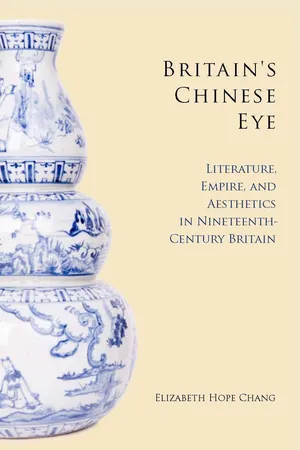
This book traces the intimate connections between Britain and China throughout the nineteenth century and argues for China's central impact on the British visual imagination. Chang brings together an unusual group of primary sources to investigate how nineteenth-century Britons looked at and represented Chinese people, places, and things, and how, in the process, ethnographic, geographic, and aesthetic representations of China shaped British writers' and artists' vision of their own lives and experiences. For many Britons, China was much more than a geographical location; it was also a way of seeing and being seen that could be either embraced as creative inspiration or rejected as contagious influence. In both cases, the idea of China's visual difference stood in negative contrast to Britain's evolving sense of the visual and literary real. To better grasp what Romantic and Victorian writers, artists, and architects were doing at home, we must also understand the foreign "objects" found in their midst and what they were looking at abroad.
eBook - ePub
Britain's Chinese Eye
Literature, Empire, and Aesthetics in Nineteenth-Century Britain
- 256 pages
- English
- ePUB (mobile friendly)
- Available on iOS & Android
eBook - ePub
Britain's Chinese Eye
Literature, Empire, and Aesthetics in Nineteenth-Century Britain
About this book
Information
Notes
Introduction
1
Jonathan Crary, Techniques of the Observer: On Vision and Modernity in the Nineteenth Century (Cambridge, MA: MIT Press, 1990).
2
For a broader consideration of Chinese aesthetics, see Haun Saussy, The Problem of a Chinese Aesthetic (Stanford: Stanford University, Press, 1993). See also Eric Hayot, Haun Saussy, and Steven G. Yao, eds., Sinographies: Writing China (Minneapolis: University of Minnesota Press, 2008).
3
Leigh Hunt, “The Subject of Breakfast Continued—Tea-drinking,” London Journal 9 (July 1834): 113–14, 113.
4
William Rossetti, “The Royal Academy Exhibition,” Fraser’s Magazine, Vol. 71, (July 1865): 57–74, 67.
5
As Colleen Lye reminds us, “We easily recognize the presence of race in visual media because of its identification with a set of phenotypical traits and a relative absence of interiority. Yet the visuality of the Asiatic racial form has a distinctive character insofar as the sense of its deceitfulness or mystery always points to the presence of something not shown. To put it another way, we recognize the Asiatic as a figure for the unrepresentable. Yet how is the unrepresentable to be visualized? Does it have a human body? If not, what shape, as a whole or in part, does it take? These are the kinds of questions that are bypassed if our study of racial figuration begins by supposing the anthropomorphism of Asiatic form.” America’s Asia: Racial Form and American Literature 1893–1945 (Princeton: Princeton University Press, 2005),7.
6
See Martin Jay’s critique of such cultural differentiations in “Cultural Relativism and the Visual Turn,” Journal of Visual Culture 1 (2002): 267–79. On the stereotype, see Homi Bhabha, The Location of Culture (London: Routledge, 1994).
7
On earlier explications of particular kinds of eyes, see Michael Baxandall, Painting and Experience in the Fifteenth Century: A Primer in the Social History of Pictorial Style (Oxford: Clarendon, 1972); Svetlana Alpers, The Art of Describing: Dutch Art in the Seventeenth Century (Chicago: University of Chicago Press, 1983); Norman Bryson, Vision and Painting: The Logic of the Gaze (New Haven: Yale University Press, 1983); and Peter De Bolla, The Education of the Eye: Painting, Landscape and Architecture in Eighteenth-Century Britain (Stanford: Stanford University Press, 2003).
8
See Charles Dickens and R. H. Home, “The Great Exhibition and the Little One,” Household Words 3 (5 July 1851): 356–60.
9
On visual culture and British realism, see Nancy Armstrong, Fiction in the Age of Photography: The Legacy of British Realism (Cambridge, MA: Harvard University Press, 1999).
10
In Erwin Panofsky’s seminal account Perspective as Symbolic Form, he argues: “Perspective creates distance between human beings and things... but then in turn it abolishes this distance by, in a sense, drawing this world of things, an autonomous world confronting the individual, into the eye. Perspective subjects the artistic phenomenon to stable. . . rules, but on the other hand, makes that phenomenon contingent upon human beings, indeed upon the individual: for these rules refer to the psychological and physical conditions of the visual impression, and the way they take effect is determined by the freely chosen position of a subjective ‘point of view’” (New York: Zone Books, 1997), 67. See also Hubert Damisch’s reconsideration of Panofsky in his The Origin of Perspective (trans. John Goodman, Cambridge, MA: M.I.T. Press, 1991).
For explorations of the priority of the eye and the image among Western viewers in general, see Donald M. Lowe, History of Bourgeois Perception (Chicago: University of Chicago Press, 1982); W. J. T. Mitchell, Iconology: Image, Text, Ideology (Chicago: University of Chicago Press, 1986); and Martin Jay, Downcast Eyes: The Denigration of Vision in Twentieth-Century French Thought (Berkeley: University of California Press, 1993).
11
Patricia Laurence’s Lily Briscoe’s Chinese Eyes: Bloomsbury, Modernism, and China (Columbia: University of South Carolina Press, 2003) gives a rich survey of the connections between Chinese writers and artists and the British writers and artists that made up the Bloomsbury group, while also acknowledging the Victorian roots of this interchange. As Laurence explains, Virginia Woolf’s designation of her To the Lighthouse character Lily Briscoe’s “Chinese eyes” “suggests then not only the incorporation of the Chinese aesthetic into the ‘English’ artist, but also European modernism’s. . . questioning of our cultural and aesthetic place or ‘universality.’ Chinese spaces are then m...
Table of contents
- Title Page
- Copyright Page
- Dedication
- Acknowledgments
- Table of Contents
- Table of Figures
- Introduction
- ONE - Garden
- TWO - Plate
- THREE - Display Case and Den
- FOUR - Photograph
- Conclusion
- Notes
- Works Cited
- Index
Trusted by 375,005 students
Access to over 1.5 million titles for a fair monthly price.
Study more efficiently using our study tools.
Frequently asked questions
Yes, you can cancel anytime from the Subscription tab in your account settings on the Perlego website. Your subscription will stay active until the end of your current billing period. Learn how to cancel your subscription
No, books cannot be downloaded as external files, such as PDFs, for use outside of Perlego. However, you can download books within the Perlego app for offline reading on mobile or tablet. Learn how to download books offline
Perlego offers two plans: Essential and Complete
- Essential is ideal for learners and professionals who enjoy exploring a wide range of subjects. Access the Essential Library with 800,000+ trusted titles and best-sellers across business, personal growth, and the humanities. Includes unlimited reading time and Standard Read Aloud voice.
- Complete: Perfect for advanced learners and researchers needing full, unrestricted access. Unlock 1.5M+ books across hundreds of subjects, including academic and specialized titles. The Complete Plan also includes advanced features like Premium Read Aloud and Research Assistant.
We are an online textbook subscription service, where you can get access to an entire online library for less than the price of a single book per month. With over 1.5 million books across 990+ topics, we’ve got you covered! Learn about our mission
Look out for the read-aloud symbol on your next book to see if you can listen to it. The read-aloud tool reads text aloud for you, highlighting the text as it is being read. You can pause it, speed it up and slow it down. Learn more about Read Aloud
Yes! You can use the Perlego app on both iOS and Android devices to read anytime, anywhere — even offline. Perfect for commutes or when you’re on the go.
Please note we cannot support devices running on iOS 13 and Android 7 or earlier. Learn more about using the app
Please note we cannot support devices running on iOS 13 and Android 7 or earlier. Learn more about using the app
Yes, you can access Britain's Chinese Eye by Elizabeth Chang in PDF and/or ePUB format, as well as other popular books in Literature & British History. We have over 1.5 million books available in our catalogue for you to explore.