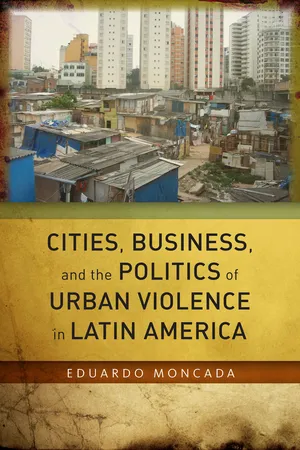
This book analyzes and explains the ways in which major developing world cities respond to the challenge of urban violence. The study shows how the political projects that cities launch to confront urban violence are shaped by the interaction between urban political economies and patterns of armed territorial control. It introduces business as a pivotal actor in the politics of urban violence, and argues that how business is organized within cities and its linkages to local governments impacts whether or not business supports or subverts state efforts to stem and prevent urban violence. A focus on city mayors finds that the degree to which politicians rely upon clientelism to secure and maintain power influences whether they favor responses to violence that perpetuate or weaken local political exclusion. The book builds a new typology of patterns of armed territorial control within cities, and shows that each poses unique challenges and opportunities for confronting urban violence. The study develops sub-national comparative analyses of puzzling variation in the institutional outcomes of the politics of urban violence across Colombia's three principal cities—Medellin, Cali, and Bogota—and over time within each. The book's main findings contribute to research on violence, crime, citizen security, urban development, and comparative political economy. The analysis demonstrates that the politics of urban violence is a powerful new lens on the broader question of who governs in major developing world cities.
- 248 pages
- English
- ePUB (mobile friendly)
- Available on iOS & Android
eBook - ePub
Cities, Business, and the Politics of Urban Violence in Latin America
About this book
Information
1
Rethinking the Politics of Urban Violence
Medellin is a new city. The King of Spain came to Medellin, the Organization of American States held its annual meeting here, people are back on the streets because they feel safe, new businesses have emerged and the city is a magnet for international business, four and five star hotels are under construction, foreign capital is back, and the homicide rate has dropped significantly, which is how safety is measured abroad.
—Fabio Orlando Acevedo, aka “Don Efe” (former paramilitary leader in the Bloque Cacique Nutibara of Medellin, Colombia, January 9, 2009, author interview)
This statement was how Don Efe responded when I asked him how it was that the city of Medellin, which in the early 1990s was considered the most violent in the world, had become a global model of urban governance. The interview took place six years after Don Efe and other members of the urban paramilitary unit known as Bloque Cacique Nutibara (BCN) demobilized in Medellin, and six months before he was arrested and jailed in the same city on charges of coordinating extortion rackets, drug trafficking, forced displacement, illegal capture of private lands, and several homicides. And although I was not completely aware of it while I was interviewing Don Efe, his statement alluded to some of the basic elements of the main argument that I develop in this book to explain what shapes the nature and trajectory of the political projects that cities launch in response to urban violence.
During the late twentieth century Medellin was the epicenter of a global illicit narcotics trade coordinated by the Medellin drug cartel headed by the infamous Pablo Escobar. Efforts by the Colombian government to dismantle the drug trafficking organization (DTO) and extradite its leaders to the United States in the late 1980s prompted the DTO to launch a war against the state that unfolded partly on Medellin’s streets. The city’s homicide rate peaked in 1991 at an astonishing 381 per 100,000 people. During this conflict a novel political project was launched to stem urban violence in Medellin by strengthening violence control measures and increasing socioeconomic investment to peripheral parts of the city where the majority of the victims and perpetrators of the violence resided.1 But more broadly, the project explicitly sought to increase the participation of socioeconomically marginalized communities in local governance via new participatory institutions and greater inclusion in the formal political spaces long controlled by a local ruling class of political and economic elites. The architects of this ambitious participatory political project argued that deconstructing the historically exclusionary nature of local politics would reduce violence in the long term and, more broadly, deepen local democratic rule. The participatory project, however, was derailed. The city soon reverted back to its historical struggle to maintain order through a mix of coercive force by state and nonstate actors, fleeting and fragile peace pacts with armed actors, and robust networks of clientelist exchange coordinated by local traditional parties—what I call reactionary political projects.
A decade later violence in Medellin again escalated when leftist insurgents and right-wing paramilitaries from the country’s decades-long civil war entered peripheral neighborhoods where lucrative illicit markets and hundreds of small but powerful armed actors were based. The city once more attempted a participatory political project that focused in part on the peripheries that had been the target of the earlier failed participatory project. This time, however, the participatory project was sustained, and soon became the foundation for Medellin’s dramatic rebranding from the world’s most violent city to a dynamic emerging global city. Spaces for political participation increased at multiple scales, including community involvement in the development of major urban infrastructural projects and neighborhood-level participatory budgeting (Brand and Dávila 2011; Castro and Echeverri 2011). Between 2002 and 2009, foreign direct investment (FDI) into Medellin increased tenfold,2 and the city soon joined the ranks of the top Latin American metropolises for doing business.3 Medellin is today widely touted as a model of how urban governance can be reshaped to address violence in major developing world cities in ways that increase local economic competitiveness and foster inclusionary local governance. And though this book shows that the construction and nature of the “Medellin miracle” is far more complex than either its political architects or international donors concede, as in the other cases analyzed in this book, it is emblematic of the significant ways in which the politics of urban violence can restructure urban governance in complex and far-reaching ways. Hence it is important that we develop our understanding of the factors that shape how different cities respond to violence. This is the central objective of this book.
PREVIEWING THE ARGUMENT
Multiple scales of power overlap, intersect, and interact within cities (Davis 2011; Sellers 2002). This confluence imparts both substance and political form to the political projects that cities deploy in response to urban violence. And while power within cities is deployed to advance the interests of formal political authorities, it is also exercised to generate gains among the many informal and alternative forces that operate within and outside of cities. Because cities are entangled in complex crosscurrents of political power rooted in both jurisdictional and nonjurisdictional authority, explaining the nature and trajectory of political projects in response to urban violence requires a multilevel analytic framework. Such a framework must unpack political dynamics within the formal political spaces that govern cities while also theorizing the conditions under which the efforts of actors operating at other territorial and institutional scales are able to influence the institutional outcomes of the politics of urban violence. Thus to account for why cities pursue distinct political projects in response to urban violence, and why these projects can sometimes assume forms quite different from those originally envisioned by the political forces that develop them, I build a novel analytic framework that focuses on interaction between urban political economies and patterns of armed territorial control.
By urban political economy I am referring to the nature of the relationship between city governments headed by popularly elected mayors and urban business,4 two actors that have long constituted the local ruling class within major developing world cities. These relationships are shaped by the interaction between the individual preferences of the public and private sectors and the formal and informal linkages that join the two. The resulting relations can be collaborative, conflictive, or mired in a state of disengagement. The nature of these relations weighs heavily on the degree to which other actors within or outside of a city are able to influence the nature and trajectory of political projects in response to violence, or what I refer to as the scope of the politics of urban violence.
Patterns of armed territorial control vary in their coordination of criminal leadership and the level of lethal violence. Criminal coordination refers to the degree to which the regulation of illicit markets within peripheral urban territories is concentrated in a single or small group of armed actors (high coordination) or is dispersed and disconnected across an array of competing armed actors (low coordination). “Violence” in this book refers to the use or threat of physical force to inflict bodily or psychological harm against an individual, community, or social group (see WHO 2002). By “level of lethal violence,” I am referring to the most visible form of violence: homicide. The intersection between these two dimensions represents distinct types of territorial control that pose different challenges and opportunities for actors seeking to influence the trajectory of political projects in response to urban violence. Taken together, a focus on the nature of urban political economies and patterns of armed territorial control strengthens our understanding of the politics of urban violence, which scholars and policy-makers alike consider a major challenge to the construction and deepening of democracy in Latin America (Koonings and Kruijt 2007; Moncada 2013a; World Bank 2011) and other parts of the developing world, including Africa (LeBas 2013), the Caribbean (Jaffe 2013), and South Asia (Varshney 2002; Weinstein 2013).
WHY STUDY THE POLITICS OF URBAN VIOLENCE?
Urban violence disproportionally impacts the most vulnerable and marginalized segments of society that are the focus of international development efforts (Moser and McIlwaine 2006; Winton 2004). Violence exacerbates poverty and worsens inequality, which is positively associated with violence (Fajnzylber et al. 2002). The result is a vicious and deadly circle that inhibits both social mobility and productivity. And while cities are increasingly seen as the engines of economic growth in the developing world, urban violence constrains growth through multiple direct and indirect channels, ranging from the redirection of scarce public resources into efforts to stem and address the consequences of violence to the negative effects of violence on investor confidence (Muggah 2012, 36). Frustration and fear in the face of intense violence and heightened feelings of insecurity can contribute to the emergence of vigilantism and strategies of “popular justice” as ways to establish order (Godoy 2006; Goldstein 2004).5 These same sentiments can reshape the physical geography of a city as wealthier segments of society retreat to privately guarded compounds that foster self-segregation along class lines (Caldeira 2000). Finally, violence can erode the legitimacy of state institutions, including democratic political regimes.6
More than half of the world’s population now resides in cities. Latin America is today the world’s most urbanized region, with over 80 percent of its population residing in cities. It is also the world’s most violent region, accounting for more than one-third of the world’s homicides in 2012 (UNODC 2013). And it is in the region’s large cities where citizens are most vulnerable to becoming the victims of criminal violence (Gaviria and Pagés 2002). Both emerging and growing cities thus confront the challenge of intense violence. A key focus in this book is unpacking the political conditions that shape and result from the varying ways in which cities respond to this violence after inheriting a range of formal political powers and resources delivered by the wave of decentralization that washed over the developing world in the late twentieth century (Dickovick 2011). These institutional outcomes in the politics of urban violence provide a powerful new lens on the broader question of who governs in major developing world cities.
Finally, it is important to note that whereas urban politics is an important vein of research within the discipline of political science (see, for example, Dahl 1961; Stone 1989), the study of urban politics within political science has long been the domain of scholars focused on cities located in the Global North. Many of our theories and concepts of urban politics are therefore rooted in studies of “city politics” in Atlanta, Chicago, and Detroit, among others. The institutional and socioeconomic contexts of these cities differ in important ways from those of Bogota, Johannesburg, Rio de Janeiro, and other cities in the Global South where the pace of urbanization has far exceeded that of North America and Europe (Cohen 2004). Thus an overarching aim of this book is to underscore the need for greater dialogue among scholars of urban politics whose work center on distinct regional settings, but who may be analyzing similar issues, including microlevel political relations, the forces that mediate access to public goods and services, dynamics of local democracy, and challenges to development.
The remainder of this chapter is divided into three sections. In the next section I discuss how existing scholarly approaches to the study of the politics of criminal violence provide limited analytic traction for explaining the institutional outcomes of the politics of urban violence. In the third section I build the new analytic framework to explain the institutional outcomes of the politics of urban violence using a focus on urban political economies and patterns of armed territorial control. I conclude in the fourth section by previewing the subsequent empirical chapters in which I use this analytic framework to develop controlled-comparative analyses of the politics of urban violence in Colombia.
RECONCILING MACRO- AND MICROLEVEL APPROACHES TO THE POLITICS OF CRIMINAL VIOLENCE
Existing scholarly treatments of the politics of criminal violence fall under one of two overarching analytic approaches. The first is a “macrolevel” approach that looks to the national level to explain patterns of violence and state efforts to establish order. In contrast, scholars using a “microlevel” approach develop nuanced accounts of the dynamics and consequences of violence at the ground level most proximate to where violence unfolds. Both macro- and microlevel approaches provide important insights into patterns of criminal violence, the actors that carry it out, and the ways in which states respond. Yet, neither approach can satisfactorily account for the nature and trajectory of the political projects that cities launch in response to violence. Doing so requires an approach that takes the city as the primary unit of analysis but that also theorizes how and when forces situated above or beneath the city level influence the institutional outcomes of the politics of urban violence.7
Scholars working from a macrolevel approach explain cross-national patterns of criminal violence by analyzing where countries reside on the production chains of global illicit economies. Changes in cross-national patterns of violence are attributed to geographic shifts in the production sites and trafficking routes associated with illicit markets, often prompted by state efforts to disrupt these processes in one set of countries that, in turn, displaces the processes to another set of countries.8 Violence increases as new and competing criminal organizations struggle to establish control over reconfigured illicit supply chains (Bagley 2012, 11–13; Shifter 2007, 59). Both criminal organizations and states are conceptualized as locked in perpetual battle, which entails a combination of violence and corruption that challenges national security by destabilizing state institutions, fraying state relations between producer and consumer countries, and weakening the perceived legitimacy of democratic regimes as they struggle to stem violence and impose order (Bailey and Chabat 2002; Rabasa and Chalk 2001; Shifter 1999; Tokatlian 1988). Other scholars unpack the consequences of the overwhelmingly militarized nature of state responses to these challenges (MacCoun and Reuter 2001). The anti-narcotics efforts of the United States in Latin America, for example, have long emphasized disrupting and dismantling the production, processing, and transport of illicit narcotics while largely neglecting domestic consumer demand. This has generated counterproductive effects in target countries, including undermining human rights, generating new opportunities for the corruption of state security forces, and weakening incentives for national politicians to uphold democratic practices (Youngers and Rosin 2005).
A macrolevel approach provides important insights into the national and global dimensions of criminal violence, but offers weak leverage for unpacking the politics of urban violence. The focus on the national level makes it difficult to detect subnational variation in the frequency and forms of criminal violence. The focus on violence wielded by large criminal organizations overlooks how these institutions and illicit markets are reliant upon diverse arrays of smaller armed actors based in subnational locales and who exhibit varying levels of autonomy from larger criminal groups. But most importantly, the national-level emphasis limits our ability to analytically disaggregate the state and criminal organizations and, in turn, theo...
Table of contents
- Cover
- Copyright
- Title Page
- Contents
- Acknowledgments
- Abbreviations
- 1. Rethinking the Politics of Urban Violence
- 2. Parties, Clientelism, and Violence: Exclusionary Political Order in Colombia
- 3. Medellin: Reshaping Political Order and Criminal Coexistence
- 4. Cali: The Derailment of a Pioneering Participatory Project
- 5. Bogota: Building and Branding a Global City
- 6. The Politics of Urban Violence: Comparisons and Next Steps
- Notes
- References
- Index
Trusted by 375,005 students
Access to over 1.5 million titles for a fair monthly price.
Study more efficiently using our study tools.
Frequently asked questions
Yes, you can cancel anytime from the Subscription tab in your account settings on the Perlego website. Your subscription will stay active until the end of your current billing period. Learn how to cancel your subscription
No, books cannot be downloaded as external files, such as PDFs, for use outside of Perlego. However, you can download books within the Perlego app for offline reading on mobile or tablet. Learn how to download books offline
Perlego offers two plans: Essential and Complete
- Essential is ideal for learners and professionals who enjoy exploring a wide range of subjects. Access the Essential Library with 800,000+ trusted titles and best-sellers across business, personal growth, and the humanities. Includes unlimited reading time and Standard Read Aloud voice.
- Complete: Perfect for advanced learners and researchers needing full, unrestricted access. Unlock 1.5M+ books across hundreds of subjects, including academic and specialized titles. The Complete Plan also includes advanced features like Premium Read Aloud and Research Assistant.
We are an online textbook subscription service, where you can get access to an entire online library for less than the price of a single book per month. With over 1.5 million books across 990+ topics, we’ve got you covered! Learn about our mission
Look out for the read-aloud symbol on your next book to see if you can listen to it. The read-aloud tool reads text aloud for you, highlighting the text as it is being read. You can pause it, speed it up and slow it down. Learn more about Read Aloud
Yes! You can use the Perlego app on both iOS and Android devices to read anytime, anywhere — even offline. Perfect for commutes or when you’re on the go.
Please note we cannot support devices running on iOS 13 and Android 7 or earlier. Learn more about using the app
Please note we cannot support devices running on iOS 13 and Android 7 or earlier. Learn more about using the app
Yes, you can access Cities, Business, and the Politics of Urban Violence in Latin America by Eduardo Moncada in PDF and/or ePUB format, as well as other popular books in Politics & International Relations & Comparative Politics. We have over 1.5 million books available in our catalogue for you to explore.