![]()
1
Humanism Goes East
THE SON OF BOURGEOIS German-Jewish parents, Erich Auerbach was born in 1892 in Berlin, imperial Germany’s glittering capital. The neighborhood where the family lived, Berlin-Charlottenburg, was a prosperous part of the city and home to many middle-class Jewish residents, including the great thinker and writer Walter Benjamin, born in the same year. Between 1895 and 1910, Charlottenburg’s Jewish population more than quadrupled, reaching some 22,500 inhabitants. This growth in population warranted the building of a new place of worship and, two houses from the Auerbach residence on Fasanenstraße, there appeared a large synagogue consecrated by the rabbi Leo Baeck (1873–1956) in 1912.1 The fact that there was a synagogue practically next door and a growing number of Jewish Germans in the neighborhood did not, of course, mean that Auerbach was raised in a religious household. Rather, the family’s lifestyle was similar to that of most assimilated Jewish Germans in Berlin. The young Auerbach was enrolled in a French school founded by the late seventeenth-century Protestant emigrants from France, the Huguenots. This Französisches Gymnasium provided a comprehensive humanist education and prided itself on having educated prominent writers like Adelbert von Chamisso (1781–1838) and Heinrich von Kleist (1777–1811). Around the turn of the century, the Romance philologist Victor Klemperer (1881–1960) and the writer Kurt Tucholsky (1890–1935) were enrolled in the same school. Here the young Auerbach learned French and acquired a firm grounding in classical Roman and Greek texts. He would take a number of intellectual detours before dedicating his life fully to philology, but the influence of his early schooling is clear.
As a young man, Auerbach first studied law, a decision that might have been influenced by the professional restrictions imposed on Jews during the Wilhelminian era (1871–1918).2 Although he eventually abandoned this career path for a degree in Romance languages and literatures, for most of his life he would insist on the validity of the law, even when doing so flew in the face of all common sense. It could not be said that the young Auerbach subscribed to any of the political and religious enthusiasms that gripped his contemporaries: we can think of him neither as a revolutionary Marxist, pacifist, nor Zionist but instead as a conformist. With the outbreak of World War I, he committed himself to the cause of the German Empire, volunteered as an infantryman, and fought in northern France.3 After four brutal years of warfare, he was among the millions of veterans to be awarded a second-grade military medal. With a scar on his foot left by a severe injury, Auerbach returned from the front to his native Berlin.4
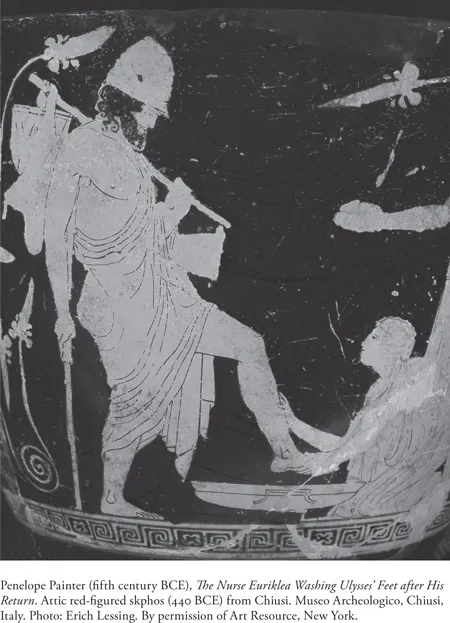
Almost thirty years later, shortly after the subsequent world war, Auerbach published his groundbreaking work, Mimesis: The Representation of Reality in Western Literature, which famously opens with the image of Odysseus’s long-anticipated and oft-deferred homecoming. The chapter, “Odysseus’ Scar,” opens with a scene in which the long-lost warrior, disguised as a stranger, is welcomed as a guest into his own home. When his old nurse, Euryclea, washes his feet in a gesture of hospitality, she recognizes Odysseus through a scar he acquired in his youth. At the very moment of recognition the scene is interrupted and the story of the hero’s scar unfolds. Auerbach analyzes this scene in conjunction with another famous scene of crisis and disclosure in ancient texts—the biblical story of Abraham’s interrupted sacrifice of Isaac. By distinguishing the Homeric from the biblical style, Auerbach shows how narrative styles are connected to evolving concepts of history and reality, and this insight has become the hallmark of his scholarship. Needless to say, there is more that could be made here of Auerbach’s choice of textual excerpts—something that David Damrosch, Djelal Kadir, Vassilis Lambropoulos, Seth Lerer, and James Porter have shown in their discussions of this opening.5 But suffice it to say that Auerbach’s use of Odysseus’s scar is indicative of his own method: he treats the scar like a fragment representing a greater reality, while the textual fragment of the Odyssey is, in turn, shown to be emblematic of the Homeric style generally. It is thus not incidental that the motifs of this first chapter characterize elements of Auerbach’s own life—rupture, sacrifice, exile, hospitality, and new beginnings.
We need only look to Auerbach’s return from the battlegrounds of World War I to find one such new beginning and the decision to pursue a calling in philology. The veteran was now determined to write a dissertation in Romanistik, the discipline of Romance languages and literatures, where he specialized in the early French and Italian Renaissance. Romanistik allowed German scholars of his generation to avoid what he called “the spirit of their own nation.” By studying this field, Auerbach wrote, “there was little danger that they would be carried away by a patriotic involvement with their own national character.”6 This might have explained the initial appeal of the discipline.7 Certainly, Romance scholarship in Weimar Germany opened up a broader view of culture than Germanistik, the discipline devoted to the study of German languages and literatures, but Romanistik also likely appealed to Auerbach because it was strongly influenced by German historicism. By emphasizing the classical and Christian civilizations as the common ground between German and Romance cultures, Romanistik offered him a “historical perspective embracing Europe as a whole.”8
Auerbach first deepened this historical perspective, which would remain central to all his scholarship, when he began translating the work of the Italian philosopher Giambattista Vico (1668–1744) into German. Vico had gone unrecognized among his contemporaries because of his stance against Cartesian philosophy and the idea of progress. Auerbach, however, showed Vico’s significance to nineteenth-century Romanticism.9 By translating a selection from Scienza Nuova (New Science, 1725) Auerbach reintroduced Vico, who imagined history to evolve in cyclical stages, to a modern German audience in the early 1920s. Notwithstanding the religious dimension of Vico’s views—Auerbach disparagingly referred to his “tedious Catholicism”—Vico’s notion of history laid the ground for a secular vision of culture and history.10 Auerbach’s Vico translation also revived what seems like a most modern idea, namely, that narration is the foundation of history. Vico’s theory of historical knowledge is based on the assumption that it is possible to understand the past because we are in fact the ones who generate history’s narrative.11 The Italian philosopher claimed specifically that the “entire development of human history, as made by men, is potentially contained in the human mind, and may therefore, by a process of research and re-evocation, be understood by men.”12 The task of the historian is thus to re-create a mental map of the past.13 For Auerbach, whose purpose was “always to write history,” this approach provided the critical bridge between his own interests in philology and history.14
The conflagrations of the early twentieth century triggered a renewed discussion about the philosophy of history. The mass destruction seemed to prompt scholars to question earlier assumptions about progress and change. Auerbach’s interests thus overlapped with those of other scholars of his generation—in particular, Walter Benjamin (1892–1940), who likewise came from a bourgeois and assimilated German-Jewish family in Berlin-Charlottenburg. By the time Auerbach returned from the battlefield, Benjamin had already studied Germanistik and developed close relationships with intellectuals like Ernst Bloch (1885–1977) and Gershom Scholem (1897–1982). While there were clear political differences between Auerbach and Benjamin, they shared the same sociocultural background and intellectual passions, and it comes as no surprise that their paths should have crossed at the end of World War I. The two men probably first met at the Preußische Staatsbibliothek Berlin (Prussian State Library), where Auerbach worked as a librarian from 1923 until 1929 while writing his Habilitationsschrift (professorial thesis) on Dante Alighieri. At the time, Benjamin was researching the origins of German tragic drama and worked regularly at the library. We know this because of a letter Benjamin wrote to Scholem, telling of his important discoveries about French baroque literature in the state library and his indebtedness to the librarian. In all likelihood, the librarian was none other than Auerbach.15
The relationship between Benjamin and Auerbach—both prominent intellectuals of the twentieth century—was not only pragmatic.16 Karlheinz Barck and Carlo Ginzburg suggest that the two thinkers exchanged their ideas because of their common interest in questions like the changing relationship between fate and character during the course of history.17 Theirs is a reasonable assumption, but I would emphasize that both scholars also asked how innovative works like the Commedia, Scienza Nuova, or, in Benjamin’s case, bourgeois drama set the parameters for modern literature and for a new understanding of history. Given these shared interests, it is unsurprising that Benjamin and Auerbach were both preoccupied with Marcel Proust; they were among the first German scholars to recognize the significance of the French modernist’s work.18 Benjamin’s 1929 essay on Proust, for instance, was concerned with the links between the subjective nature of memory and a broader philosophy of history. Here, Benjamin specifically addressed the problem of experience, remembrance, and forgetting.19 It is, however, a little-known fact that Auerbach had applied himself to the problem of subjectivity and memory four years earlier. In his own 1925 article on Proust’s Recherche, Auerbach analyzed the relationship between memory and reality, drawing on Dante to establish the particularity of Proust’s narrative and the act of remembrance.20 Through this work on Vico and Proust, Auerbach came to distinguish between different concepts of reality, that is, between inneres Leben (inner reality) and irdischer Verlauf (earthly course), or what he later called irdische Wirklichkeit (earthly reality). In his Proust essay, Auerbach interpreted the French masterpiece as a form of memory work. The narrator, he said, substitutes “empirical chronology” for the “secret and often neglected nexus between events which the biographer of the soul, who gazes back and inside, perceives as real.”21 Key to his approach in Mimesis would be this distinction—the subject’s personal experience of reality versus a spatially and temporally bounded reality.
It seems significant that Auerbach attended to such questions as early as the 1920s. It means that long before he fled National Socialism and went into exile, long before he was deprived of the world that had shaped him, intellectuals like himself and Benjamin were already reflecting on the challenges posed by recalling and representing past experience. This thematization of memory was not, as one might suppose, first triggered by anti-Semitic persecution during the Nazi period: it was part of a wider interwar discourse concerning the representation of reality in modernity. Only later did memory work come to assume the significance that it has today, namely, a basis for diasporic identities that, to some considerable extent, define themselves in terms of what they lost. It was, in other words, when an entire generation of German Jewish scholars, artists, and writers was eradicated in Nazi Germany that remembering became the appointed task of the modern exile.
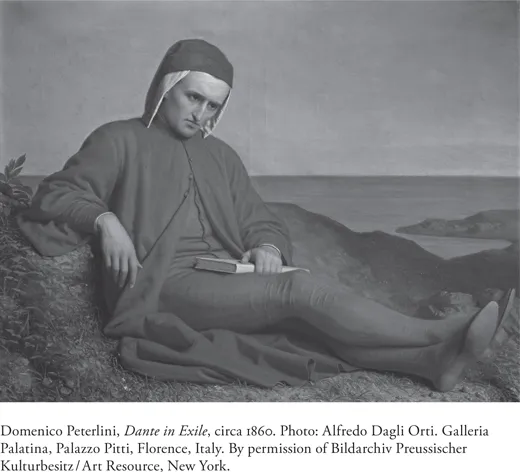
For Auerbach, the idea of detaching oneself from “earthly reality” (or “earthly course,” as he variously called it) was central to his thinking. Specifically, he wondered whether divorcing oneself from one’s environment afforded one greater perspicuity. It was a question he took up in a number of pre-exilic studies. In the preface to his translation of Scienza Nuova, for example, he characterized Vico as an unacknowledged “stranger in his native town,” someone who lived detached from his surroundings.22 He also admired Vico as a scholar who was able to think beyond the limits of his own time and hence anticipate nineteenth-century Romanticism and historicism. Auerbach believed that Vico’s own äußeres Schicksal (manifest fate) was so unimportant to him that he could develop his ideas untrammeled by the spirit of his time and place.23 The idea of an entirely solitary existence gripped Auerbach, who was by now working on Dante. In Dante: Dichter der irdischen Welt (Dante: Poet of the Secular World), published in 1929, Auerbach analyzed the Commedia, where Dante envisions an infernal journey accompanied by the classical Roman poet Virgil. Auerbach interpreted the Commedia as the author’s attempt to recuperate a world that had been lost as the result of exile.24 He suggested that Dante’s exile from Florence in 1302 sharpened his poetic talents and motivated him to write the Commedia. Not yet foreseeing that he would soon have to go into exile himself, Auerbach stressed that Dante’s exilic work constituted the founding moment for national literatures, not only in Italy but in Western Europe generally. In taking on this project, Auerbach seems to have unwittingly chosen a model for his own exile.
Both Auerbach’s early work and Mimesis link mental disassociation to a certain psychological disposition and to the experience of sociopolitical rupture and spatial dislocation. The dream state, for example, signifies a condition of mental detachment from the world around one. This is how he saw Vico, as someone so “fanatically” immersed in his pursuit of truth that he “went through his earthly life as if it were a dream.”25 The same image occurs in Auerbach’s later review of Proust’s Rech...