Empowerment Evaluation in the Digital Villages analyzes a $15 million community change initiative designed to bridge the digital divide in East Palo Alto, East Baltimore, and San Diego. Involving a partnership between Hewlett-Packard, Stanford University, and three ethnically diverse communities, this initiative enabled its constituencies to build their own technology-oriented businesses, improve their education systems, and improve their economic health. While examining this large-scale, multi-site case, Fetterman highlights the potential for empowerment evaluation to build local capacity and sustain improvements within communities. He provides deep insights into key steps in empowerment evaluation by exploring the way that each of these phases took place in the digital villages. Additionally, the text provides evaluators with real-world stories and practical advice from the front lines. The Digital Village case also demonstrates the social value of combining corporate philanthropy, academic prowess, and community empowerment—highlighting the role of evaluation in this process.
eBook - ePub
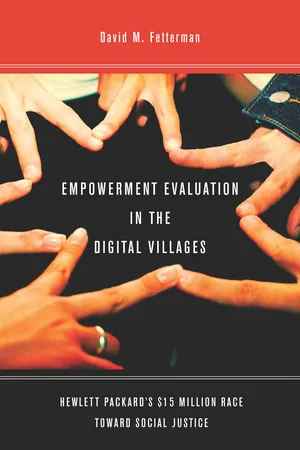
Empowerment Evaluation in the Digital Villages
Hewlett-Packard’s $15 Million Race Toward Social Justice
- 168 pages
- English
- ePUB (mobile friendly)
- Available on iOS & Android
eBook - ePub
Empowerment Evaluation in the Digital Villages
Hewlett-Packard’s $15 Million Race Toward Social Justice
About this book
Information
Publisher
Stanford Business BooksYear
2012Print ISBN
9780804781121
9780804781114
Edition
1eBook ISBN
9780804784252
1 THE FUEL: THE DESIRE FOR A BETTER LIFE
Desire is the key to motivation, but it’s the determination and commitment to an unrelenting pursuit of your goal—a commitment to excellence—that will enable you to attain the success you seek.
—Mario Andretti
People, however evolved, rely on food to function. It is actually ironic how simple, almost archaic, our bodily systems function. We do not beam nutrients into our blood vessels, muscles, and tissues. Our nutrients come from simple and complex sugars, carbohydrates, proteins, and of course water. However, the diet for comprehensive community change1 is more complex than our normal menu of daily calories. Just as a race car needs a higher-octane fuel than a streetcar, a human being in a race against time and extraordinary odds needs to be supplied by a much richer mixture. Desire is the fuel of choice that drives any successful community change initiative.
People have to want to see things get better for themselves, for their families, and for their community. It is that insatiable thirst for a better life that sustains the often Herculean effort required to transform the world around us. It is a challenge in part because of the natural forces of inertia that reinforce the status quo. It is Herculean because many of the people in this story began from a starting point that few of us can imagine. Many of the communities, such as tribes brought to the brink of extinction, have been disempowered for generations.2 Alcohol and drug abuse, domestic violence, and unemployment all loom in the background of these stories. But this is not another story about blaming the victim,3 victimization, or any of those stigmatizing tales. This is a story of resilience,4 the single-minded pursuit of a goal, and an unrelenting commitment to excellence. It is also a story about people learning to help themselves and the often untold story about people helping people to help themselves. But before we get too far ahead of ourselves, let us begin with what this story is about, why it was written, and what you might hope to get out of it.
WHAT THIS BOOK IS ABOUT
This book is about helping to navigate a $15 million Hewlett-Packard venture called the Digital Village. It was a large-scale, community-based initiative,5 funded at a level designed to make a difference. It was a successful effort. It helped people bridge the digital divide.6 This venture involved a partnership between Hewlett-Packard, Stanford University, and three Digital Villages, ethnically diverse communities of color throughout the United States.
WHY I HAVE WRITTEN THIS BOOK
I have written this book to share what people can accomplish on their own when given the opportunity and the right tools and resources. The potential of the most disenfranchised—the people we have left behind—is enormous. However, converting potential into productivity can’t be left to chance. If success is largely attributable to an accumulation of opportunities that are acted on at successive stages, as Malcolm Gladwell (2008) suggests, the opposite also holds true. Denying opportunities over time is cumulative and potentially devastating, not only to the individual but to entire communities. The story that is about to unfold demonstrates how it is possible to break free from a negative spiral. It describes how a “safe track” that is designed to cultivate educated guesses, risk taking, and seizing opportunities can transform society.
I have also shared this story to highlight the power of the engine behind this tale: “empowerment evaluation.”7 It is logical that if you want to turn society around 180 degrees, you have to use an equally radical or different set of driving instructions than the ones we have used in the past. Empowerment evaluation is an approach that is at least a standard deviation away from the status quo. This brand of evaluation focuses on building capacity and improving communities. It has been successful internationally8 because it is simple—only three steps—and because it works. It is a radically different view of evaluation. In fact, many believe it stands evaluation on its head. The community is in charge of the evaluation, instead of the individual expert or evaluator. The speed and direction of the evaluation are determined and controlled by the community. The empowerment evaluator is a coach, a facilitator, and a mentor. Evaluators keep the project rigorous, on track, and under control. However, empowerment evaluators do not control the evaluation—the evaluation remains in the hands of those who have a stake in the community long after any individual project has come and gone.
Finally, I have written this book to demonstrate the power of corporate philanthropy,9 academic prowess, and community empowerment. When these societal forces converge, they can forge a team that is powerful enough to help people help themselves—and in this case, that is exactly what Hewlett-Packard, Stanford University, and three communities of color accomplished. However, we cannot expect people to “pull themselves up by their bootstraps” without assistance or guidance. That would be an abdication of responsibility. Instead, a collaboration, a partnership, or even a marriage is necessary—a plan that is designed for the “long haul” and that produces real, measurable outcomes. It is my hope that the example laid out in this book can serve as a model for those committed to social change and social justice. Ideally, it can also serve to revitalize the triumvirate of philanthropic, academic, and community forces throughout the United States and the world. The time is right to reassemble this socially conscious team to address new challenges on the social horizon.
WHO I HOPE WILL READ THIS BOOK
At the broadest level, this book was written for citizens who are committed to constructive, progressive social change. These include community organizers and activists, social workers, clergy, city planners, foundation officers, and politicians. It was also written to help individual concerned citizens in communities throughout the world who wish to make a difference. For many, this book will serve as a blueprint for change. Others will simply use it as a guide, or set of general directions, to be adapted to their own local environment. In any case, these readers are some of the most powerful change agents in society. They are rooted in and invested in the community. They understand the value of selecting an authentic process and the moral and economic imperative of producing results. They are also not interested in reinventing the wheel. This book saves time and precious resources by providing a model of success.
I have also written this book for my academic colleagues, particularly evaluators, educators, and health-care providers. They were the first to see the power of the empowerment approach and the synergy generated by combining the forces of corporate philanthropy, academia, and community. They were the first to accept the proposition that evaluation could be used as a tool to help people help themselves by offering local control, rigor, honesty, and effectiveness—a rare combination. This book builds on their knowledge of the literature by providing a large-scale case example. It provides the theory, concepts, principles, and even a set of step-by-step instructions in the guise of a story—three stories, actually—about socially constructed change.
Finally, this book was written for the skeptic who no longer believes that social change is possible, nor that it can be orchestrated by people in their own communities. This example of a social experiment that worked was written to remind those who have lost their optimism, hope, and faith in the future what is possible and within their reach. As Mark Twain wrote: “Few things are harder to put up with than the annoyance of a good example.”10
WHAT READERS STAND TO GAIN
This book provides the reader with an insight into the power of community to harness the energy within itself, turn itself around, and be its own driving force into the future. These stories are expressions of self-determination,11 self-efficacy,12 and local control. They are the powerful forces, often dormant, in a community. However, they are predictably poised to help a community leap forward. They are the invisible forces standing a little ahead of the curve waiting to be transformed into action in any community. Empowerment evaluation is simply one of many tools to harness and to redirect social energy.
On a practical level, reading these stories and understanding empowerment evaluation is like learning to drive a car around a curve. Normally you learn to start steering into the curve far in advance of the bend in the road. You are anticipating it. This process is similar to the way normal incremental change happens in a community. It is driving with an eye ahead of where you are going. However, in any comprehensive community initiative designed to change the social fabric of a community, the pace is accelerated. You are no longer just driving to get from one destination to another, you are racing and racing rules apply.
When you race you learn to drive the driver’s line13 (the straightest path from one point to another), which means using every inch of the road. You learn to aim for the apex or the center of the turn in order to maximize your speed, minimize the distance you travel, and produce the fastest exit speed. Empowerment evaluation helps a community to anticipate and to embrace the power behind the curve. It helps them to position themselves so that they remain on the driver’s line on the other side of the curve, even though they can’t see the other side as they approach it. The curve, from a social reform perspective, is simply a series of obstacles reframed and transformed into opportunities. Every group faces them as they forge a new future together. Empowerment evaluation helps people to maximize the power of group problem solving and transform this power into strategies and solutions that catapult the community into the future.
Failure to anticipate the curve and to adjust for it before you enter the curve typically results in overcorrection, which pushes the social agenda off its track. The same holds true for comprehensive community initiatives and evaluation. Large-scale change is like building a highway while racing on it. A conceptual lens such as empowerment evaluation can help keep things in focus along the way. Empowerment evaluation enables the community to steer in the right direction and to stay on course even when there are no street signs or signals because community members build the road and they draw the conceptual map to their desired destination.
The stories about these Digital Villages can help readers learn how to look ahead of the curve. They provide a peek into the future and the future is more, not less, local control. People in communities around the world have been mistreated or exploited by politicians, physicians, social scientists, and external experts. The Tuskegee syphilis experiment14 is a case in point. African Americans were used as human guinea pigs. They were diagnosed and left untreated by physicians in order to study the natural history of the disease. This kind of treatment by external experts explains in large part the low participation of African Americans in clinical trials, organ donation efforts, and routine preventive care. People have good reason to be skeptical about outsiders. More and more, they have come to trust themselves as constructive agents of social change in their own communities.
The Digital Villages have embraced the popularized “glocalization” concept: think globally, act locally (Wellman, 2002). Subway does not have beef in its stores in India, and McDonald’s has a Teriyaki McBurger with Seaweed Shaker Fries in Japan. Likewise, the Digital Villages learned to listen to members of their communities and to shape their services accordingly to meet their varying needs. The results for one Digital Village ranged from the noble task of preserving native languages and cultural traditions on the reservation to the economically pragmatic step of creating the Tribal Print Source (formerly the Hi Rez [high-resolution] printing service).15
Once a community has even a taste of what it feels like to effect change and improve itself, especially on a grand scale, there is no going back. The feeling of control over a community’s life is intoxicating as it demonstrates its self-efficacy. It also has a force all its own, commanding the attention of people from all walks of life. Human beings are social animals. They are drawn to the collective will, particularly when it is successful, productive, and in their self-interest. This small core of individuals becomes the catalyst for change, attracting neighbors and friends who enlist in the campaign for social change.
This story also reminds us of what we can do to change our own world, once freed from the self-imposed slavery of antiquated ways of thinking and conceptualizing the boundaries of our universe. The story of Hewlett-Packard, Stanford, and the local communities of color working together can renew our faith in people as responsible agents working together for the common good. This story demonstrates how individual self-interest and the community’s larger interests can converge to produce radically successful outcomes.
Readers may also gain a less jaundiced view of corporate America and academia as they turn each page. Both are in dire need of reinventing or at least repackaging themselves, and this story provides a credible portrait of their efforts to reform and refocus their “eyes on the prize.”16 Discussing problems and airing disagreements and conflicts as we work to facilitate local capacity provides a more realistic, authentic, and replicable model of social intervention and change. It also provides a more nuanced, less predictable view of these powerful agents in action.
Finally, evaluators will be able to see another powerful example of what happens when you turn evaluation on its head. Many evaluators have long held the belief that only they can conduct evaluations. They are the only ones who can be objective, honest, critical, and accurate. However, as this and many other examples confirm, that view is not only wrong, it is misguided and no longer productive.
Evaluations are not neutral or free from political or economic influences.17 Moreover, people (given guidance and appropriate tools) are typically more critical of their own organizations because they have to live with them and they want them to work. Similarly, empowerment evaluators who are sympathetic toward a certain type of program are typically more critical because they believe in the concept or theory behind a program and want them to serve the intended purpose.
Much knowledge is lost in evaluation because it resides in a report that is sitting on a shelf and gathering dust. These reports are read by a few and used by no one. Empowerment evaluation findings are used routinely to inform decision making. People have a sense of ownership when they are responsible for their own evaluations and are thus more likely to use the findings and to follow the recommendations—because they are theirs.
For those who have already seen the power of this ...
Table of contents
- Cover
- Copyright
- Title Page
- Dedication
- Contents
- Acknowledgments
- Chapter 1. The Fuel: The Desire for a Better Life
- Chapter 2. The Sponsor and the Crew: Hewlett-Packard and Stanford University
- Chapter 3. The Drivers: The Three Digital Villages
- Chapter 4. The Engine: Empowerment Evaluation
- Chapter 5. The Starting Line: The Mission
- Chapter 6. The Pit Stop: Taking Stock
- Chapter 7. Back on the Track: Planning for the Future or Implementing an Innovation
- Chapter 8. The Finish Line: Measuring Change Over Time
- Chapter 9. The Real Winners: Building Capacity
- Chapter 10. Reflections on the Race Toward Social Justice: What Have We Learned?
- Notes
- References
- Index
Trusted by 375,005 students
Access to over 1.5 million titles for a fair monthly price.
Study more efficiently using our study tools.
Frequently asked questions
Yes, you can cancel anytime from the Subscription tab in your account settings on the Perlego website. Your subscription will stay active until the end of your current billing period. Learn how to cancel your subscription
No, books cannot be downloaded as external files, such as PDFs, for use outside of Perlego. However, you can download books within the Perlego app for offline reading on mobile or tablet. Learn how to download books offline
Perlego offers two plans: Essential and Complete
- Essential is ideal for learners and professionals who enjoy exploring a wide range of subjects. Access the Essential Library with 800,000+ trusted titles and best-sellers across business, personal growth, and the humanities. Includes unlimited reading time and Standard Read Aloud voice.
- Complete: Perfect for advanced learners and researchers needing full, unrestricted access. Unlock 1.5M+ books across hundreds of subjects, including academic and specialized titles. The Complete Plan also includes advanced features like Premium Read Aloud and Research Assistant.
We are an online textbook subscription service, where you can get access to an entire online library for less than the price of a single book per month. With over 1.5 million books across 990+ topics, we’ve got you covered! Learn about our mission
Look out for the read-aloud symbol on your next book to see if you can listen to it. The read-aloud tool reads text aloud for you, highlighting the text as it is being read. You can pause it, speed it up and slow it down. Learn more about Read Aloud
Yes! You can use the Perlego app on both iOS and Android devices to read anytime, anywhere — even offline. Perfect for commutes or when you’re on the go.
Please note we cannot support devices running on iOS 13 and Android 7 or earlier. Learn more about using the app
Please note we cannot support devices running on iOS 13 and Android 7 or earlier. Learn more about using the app
Yes, you can access Empowerment Evaluation in the Digital Villages by David Fetterman in PDF and/or ePUB format, as well as other popular books in Business & Processo decisionale. We have over 1.5 million books available in our catalogue for you to explore.