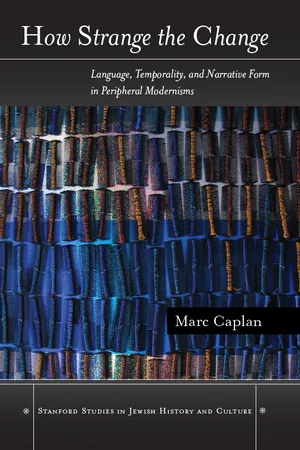
In this book, Marc Caplan argues that the literatures of ostensibly marginal modern cultures are key to understanding modernism. Caplan undertakes an unprecedented comparison of nineteenth-century Yiddish literature and twentieth-century Anglophone and Francophone African literature and reveals unexpected similarities between them. These literatures were created under imperial regimes that brought with them processes of modernization that were already well advanced elsewhere. Yiddish and African writers reacted to the liberating potential of modernity and the burdens of imperial authority by choosing similar narrative genres, typically reminiscent of early-modern European literatures: the picaresque, the pseudo-autobiography, satire, and the Bildungsroman. Both display analogous anxieties toward language, caught as they were between imperial, "global" languages and stigmatized native vernaculars, and between traditions of writing and orality. Through comparative readings of narratives by Reb Nakhman of Breslov, Amos Tutuola, Yisroel Aksenfeld, Cheikh Hamidou Kane, Isaac Meyer Dik, Camara Laye, Mendele Moykher-Sforim, Wole Soyinka, Y. Y. Linetski, and Ahmadou Karouma, Caplan demonstrates that these literatures' "belated" relationship to modernization suggests their potential to anticipate subsequent crises in the modernity and post-modernity of metropolitan cultures. This, in turn, leads him to propose a new theoretical model, peripheral modernism, which incorporates both a new understanding of "periphery" and "center" in modernity and a new methodology for comparative literary criticism and theory.
eBook - ePub
How Strange the Change
Language, Temporality, and Narrative Form in Peripheral Modernisms
- 360 pages
- English
- ePUB (mobile friendly)
- Available on iOS & Android
eBook - ePub
How Strange the Change
Language, Temporality, and Narrative Form in Peripheral Modernisms
About this book
Information
Table of contents
- Cover
- Title Page
- Copyright
- Dedication
- Contents
- Acknowledgments
- Introduction: Apples and Oranges: On Comparing Yiddish and African Literatures
- Part One: The Origin of Stories: A Story of Origins
- Part Two: Eyn Kemakh, Eyn Toyre; Eyn Toyre, Eyn Kemakh
- Part Three: “Thank You (Falettinme Be Mice Elf Agin); Thank You for Talkin’ to Me, Africa”
- Conclusion: At the Limits of the Periphery: The Future of the “Minor” in Minority Literatures
- Notes
- Bibliography
- Index
Trusted by 375,005 students
Access to over 1.5 million titles for a fair monthly price.
Study more efficiently using our study tools.
Frequently asked questions
Yes, you can cancel anytime from the Subscription tab in your account settings on the Perlego website. Your subscription will stay active until the end of your current billing period. Learn how to cancel your subscription
No, books cannot be downloaded as external files, such as PDFs, for use outside of Perlego. However, you can download books within the Perlego app for offline reading on mobile or tablet. Learn how to download books offline
Perlego offers two plans: Essential and Complete
- Essential is ideal for learners and professionals who enjoy exploring a wide range of subjects. Access the Essential Library with 800,000+ trusted titles and best-sellers across business, personal growth, and the humanities. Includes unlimited reading time and Standard Read Aloud voice.
- Complete: Perfect for advanced learners and researchers needing full, unrestricted access. Unlock 1.5M+ books across hundreds of subjects, including academic and specialized titles. The Complete Plan also includes advanced features like Premium Read Aloud and Research Assistant.
We are an online textbook subscription service, where you can get access to an entire online library for less than the price of a single book per month. With over 1.5 million books across 990+ topics, we’ve got you covered! Learn about our mission
Look out for the read-aloud symbol on your next book to see if you can listen to it. The read-aloud tool reads text aloud for you, highlighting the text as it is being read. You can pause it, speed it up and slow it down. Learn more about Read Aloud
Yes! You can use the Perlego app on both iOS and Android devices to read anytime, anywhere — even offline. Perfect for commutes or when you’re on the go.
Please note we cannot support devices running on iOS 13 and Android 7 or earlier. Learn more about using the app
Please note we cannot support devices running on iOS 13 and Android 7 or earlier. Learn more about using the app
Yes, you can access How Strange the Change by Marc Caplan in PDF and/or ePUB format, as well as other popular books in Literature & Jewish Literary Criticism. We have over 1.5 million books available in our catalogue for you to explore.