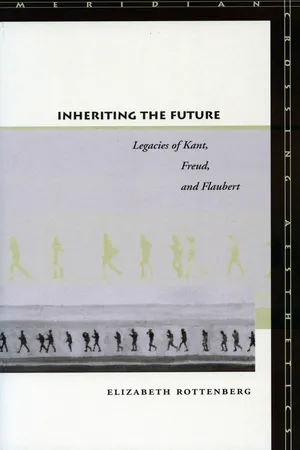
This book explores several canonical works of philosophy, psychoanalysis, and literature. The surprising juxtaposition of Kant's moral philosophy, Freud's reflections on obsessional neurosis, and Flaubert's peculiar late novel Bouvard et Pécuchet forms the basis of a compelling argument linking each of these central works around the problem of moral thought as it fundamentally determines the modern subject in relation to time. The book engages an area of emerging importance in contemporary critical thought, the problem of ethics or "otherness" as a crucial factor at play in speculative and literary works. The readings in this book provide insight into the ways in which three fundamental philosophical, psychoanalytic, and literary texts can be reread in light of their confrontation with a seemingly inhuman force at the heart of the foundation of the human subject.
- 208 pages
- English
- ePUB (mobile friendly)
- Available on iOS & Android
eBook - ePub
About this book
Trusted by 375,005 students
Access to over 1.5 million titles for a fair monthly price.
Study more efficiently using our study tools.
Information
Publisher
Stanford University PressYear
2005Print ISBN
9780804751148
9780804751131
eBook ISBN
9780804780940
§1
The Legacy of the Future Kant and the Ethical Question
Ne pas avoir choisi sa liberté—voilà la suprême absurdité et le suprême tragique de l’existence, voilà l’irrationnel.
—(Emmanuel Levinas, Totalité et Infini)
Invitation
There is a much noted strangeness about Kant’s invocation of Copernicus in support of his own revolutionary turn in the Preface to the second edition of the Critique of Pure Reason.1 The reference to Copernicus is strange, so it is argued, because of what appears to be Kant’s anthropocentric (or geocentric) fallacy.2 As Freud makes clear in another revolutionary context, the name and work of Copernicus signify for us the end of an illusion; they mark, in Freud’s language, the final and decisive break with the narcissistic presumption of the earth’s central and stationary position in the universe.3 Troubling and strangely incomprehensible, therefore, becomes Kant’s appeal to a radical decentering of the universe when his own analogy is made in view of a no less radical, transcendental recentering of human knowledge in its a priori conditions of possibility. Missing from Kant’s revolutionary perspective, it would seem, is the cosmological turn of Copernicus. Transcendental idealism would not be a Copernican change in point of view, in other words, because its orientation remains abidingly human.
But perhaps the trouble lies in our not being troubled enough. Perhaps, on the contrary, it is we who should be more cautious, more tentative in our judgment, more distrusting of our senses when an essential feature of Copernicus’s “change in point of view [Umänderung der Denkart]” (B xxii) is its capacity to venture forth against the senses—“auf eine widersinnische... Art” (B xxii).4 Can we be so certain, in other words—given our natural tendency to laziness and inertia (indeed to narcissism)5–that we, like those thinkers who “entangle themselves to the point of absurdity in Tychonic cycles and epicycles” (SF 149; 83), have not remained fixed in our “way of explaining appearances” and in our original “Standpunkt” (SF 149; 83)? Could it not be that like these thinkers—“otherwise not unwise” (SF 149; 83)—we too have obstinately refused to assume the implications of a radical change of perspective, that we too have missed the revolution?
What if Kant’s most revolutionary turn were not to be located in his Critique of Pure Reason? What if, furthermore, this revolutionary turn were the one in which we were not only implicated but newly implicated? What if, in other words, we played a necessary role in the emergence of what is distinctly Kantian about this revolution? What if we were not simply the passive recipients but also the acting heirs—a passivity that would not be incompatible with freedom and autonomy—of a legacy that was itself radically ethical in nature? Such, I will suggest, is the properly Kantian (Copernican) revolution: a turn that is no longer an attempt, even a revolutionary one, to make possible (or conceivable) that which was formerly impossible (or inconceivable) but rather a shift in the notion of possibility itself. This shift introduces, I will argue, a condition of possibility that is distinct and inseparable from an epistemological condition of possibility, on the one hand, and from a practical condition of possibility on the other. For what we will see emerge is a passage (which has nothing to do with the aesthetic), the irreversible passage from speculative “sources of cognition [Erkenntnisquellen]” (B xxvi) to non-speculative or practical “sources of cognition”—a passage or transition that belongs thus to neither realm exclusively. As such, it is a passage that is neither theoretical nor practical (it is not practical reason itself because practical reason exists independently of any critical or epistemological examination of it: indeed it is found in the most ordinary human reason according to Kant); rather it is equally poised between both. Furthermore, it is to such a possibility of passage, I will claim, that we are called on to respond.6 We are “summoned [aufgefordert]” (B xxi), in other words, against the very nature of our representations, “auf eine widersinnische, aber doch wahre Art” (B xxii), against the very modality of possibility; we are being called per impossibile to a possibility beyond theoretical and practical possibility, which, it will turn out, is nothing less than the possibility of the future. Like the “invisible, world-binding force” (B xxii, modified) of the Newtonian attraction that “would have remained forever undiscovered” (B xxii) had it not been for Copernicus’s daring hypothesis—Kant’s revolution opens a space for future revolutions. But it does something more as well: and it is “this something more [dieses Mehrere]” (B xxvi) that makes the space left “empty [leer]” (B xxi) by speculative reason not a blank but already a bequest and thus already the possibility of the step beyond.
Thus, besides the perhaps inescapable risk of oedipal overzealous-ness in accusing Kant of an anthropocentric “fallacy”—a rather minor risk if one is to judge by the unrestrained tones of his accusers—there lies, I will suggest, the risk of skirting an ethical revolution (a revolution that takes place without violence, without hostility) whose emergence on the scene may bespeak an anthropotropism far more revolutionary7 and decentering than what has yet been understood under the name “Kant.”
Laying the Groundwork
THE THREAT OF HETERONOMY
In the Second Section of the Grounding for the Metaphysics of Morals, written in 1785, one finds an argument structured very closely along the lines of the turn that Kant will later associate with the name Copernicus. In the same way that it is impossible in the epistemological realm to explain the possibility of a priori knowledge if one assumes that knowledge must conform to objects, “so too, in the practical context, one cannot explain the possibility of a categorical imperative, or more generally, an a priori practical principle with the requisite universality and necessity”8 if one continues to assume that an object of the will is the source of moral requirements.
In every case where an object of the will [ein Objekt des Willens] must be laid down as the grounds [zum Grunde gelegt werden muß] for prescribing a rule to determine the will, there the rule is nothing but heteronomy; the imperative is conditioned, viz.: if or because one wills this object, one should act thus or thus; hence the imperative can never command morally, i.e. categorically. (Gr 444; 47)
If the will goes outside of itself and seeks the law of its determination “in the property [Beschaffenheit] of any of its objects [Objekte]” (Gr 441; 45) then heteronomy is always the result. Heteronomy is the result when the will is determined by any “foreign impulse [fremder Antrieb]” (Gr 444; 47) whatsoever, whether this foreign impulse determines the will by means of sensibility or by means of reason directed to objects of our possible volition (e.g. the pursuit of perfection).
Autonomy of the will, on the other hand, is introduced in the Grundlegung as the necessary condition of the possibility of moral law. In the case of a finite rational being, the defining characteristic of autonomy of the will is not an independence from causal determination by alien sources—our needs or desires as sensuous beings—since such independence (which Kant calls “negative freedom”) is already presupposed by Kant’s notion of practical spontaneity and by the very concept of an arbitrium liberum. Rather it is a “motivational independence, that is, a capacity for self-determination independently of, and even contrary to these needs.”9 Kant identifies autonomy with “the property [Beschaffenheit ] that the will has of being a law to itself (independently of any property of the objects of volition [Gegenstände des Wollens])” (Gr 440; 44). Only if the will possesses this property, only if the will is its own supreme lawgiver, can one account for the possibility of something other than a conditioned or hypothetical imperative. The principle of autonomy, “das alleinige Prinzip der Moral” (Gr 440), is, consequently, the expression of the requirement to act on the basis of this property. As principle, autonomy demands that one act from a self-determined, desire-independent motive (for imperfectly rational beings who are constitutionally susceptible to self-deception, this expression must take the form of a command, namely the categorical imperative). The supreme principle of morality enjoins all rational beings with a will to choose maxims that are suitable as universal laws not because of some outside interest or desire but rather because of their very suitability for universal law. An unconditioned practical principle knows no restrictions; it contains only the necessity that universalizability function as the ultimate standard governing all choice of maxims. Thus, on the one hand, a universally and unconditionally valid practical law must be formal in the sense that it must abstract from any material object of the will; on the other hand, it requires that a maxim be adopted solely for its legislative form, i.e. its universalizability. Autonomy of the will is therefore both the necessary condition of the possibility of the moral law (it must be a property of the will) and the expression of this possibility as law (it is the principle of morality).
But a necessity “that is unconditioned and ... objective and hence universally valid” (Gr 416; 26) such as the moral law requires cannot be derived from the particular constitution of human beings. For no example drawn from human experience can testify to a will that has been determined solely by universal law without other incentive or desire (such may appear to be the case, of course, but, as Kant reminds us, the possibilities of self-deception are infinite and imperceptible). Indeed the threat of heteronomy is so great for human beings and one’s human allegiance to the “dear self [das liebe Selbst]” (Gr 407; 20) so ineradicable that the world has perhaps never seen an example of a moral action that “would have sprung [entsprungen wäre]” (Gr 408; 20) from pure and unmixed sources.
And the threat of heteronomy is greater still, for, as Kant declares, the principle of heteronomy is the bane of all moral theories. Not only are morals “liable to all kinds of corruption” (Gr 390; 3), but moral philosophy itself risks confusing pure principles with impure ones and thus “spoil[ing]... the purity of morals and counteract[ing] its own end” (Gr 390; 3). When moral philosophy does not begin with pure philosophy (metaphysics), when moral philosophy does not begin by purifying its principles of the very conditions of human desire10—conditions that can only be known a posteriori—then “there can be no moral philosophy at all” (Gr 390; 3), that is, no moral philosophy that could give account of the objective necessity (non-anthropological, non-theological) of moral law. As sensuous beings, we have a natural “propensity [Hang]” to quibble with the strict laws of duty and to make them, wherever possible, “more compatible with our wishes and inclinations” (Gr 405; 17). But when the language of desire (inclination, taste) permeates so much of our contemporary literature on Kant—whether it be in terms of making Kant’s moral philosophy more “palatable” or less “repugnant” in the tradition of Schiller, or dismissing it as “unsatisfying” in the tradition of Hegel11—it becomes not only timely but urgent to raise the question of Kant’s formalism once again. Is it possible that, in the name of our palate and our sensibility, in the name of heteronomy itself, Kant’s defenders and prosecutors alike have in fact, right from the start, “corrupted” the moral law in its foundation and destroyed its “dignity [Würde]” (Gr 405; 17)? For, as we all know—and the practical threat is very real today in academic philosophy—it is certainly bad for the business of moral philosophy when it does not give us what we want.
Indeed Kant’s formalism has inspired such resistance that one begins to suspect that it is formalism itself that must be banished from our midst (like Coriolanus), no matter how rigorous and enriching its analytic powers.12 In the wake of Kant’s categorical imperative, how many a well-intentioned moral theory has arisen whose aim is always to bring the abstract, formal structures of philosophy into a harmonious expression with their concrete, human , and worldly effects?13 And yet, as Kant warns us repeatedly, theories based on human inclination or desire can produce only monstrosities. Such theories leave us not with morality at all but, much to our horror and surprise, with “some ill-begotten bastard patched up from limbs of quite varied ancestry [einen aus Gliedern ganz verschiedener Abstammung zusammengeflickten Bastard]” (Gr 426; 34). The defenders of Kant who fear the great philosopher may have forsaken or betrayed the world by being too formalistic may be assuming all too readily that when we refer to something called “the human” we know what it is we are talking about, even though there is probably no word whose changing definition in thi...
Table of contents
- MERIDIAN - Crossing Aesthetics
- Dedication
- Title Page
- Copyright Page
- Dedication
- Acknowledgments
- Table of Contents
- Note on Sources and Key to Abbreviations and Translations
- Prefatory Note
- Introduction - Of Human Bondage
- §1 - The Legacy of the Future Kant and the Ethical Question
- § 2 - Freud When Morality Makes Us Sick: Disavowal, Ego Splitting, and the Tragedy of Obsessional Neurosis
- § 3 - Flaubert Testament to Disaster
- Postscript - Last Words
- Notes
- Works Cited
- Index
- MERIDIAN - Crossing Aesthetics
Frequently asked questions
Yes, you can cancel anytime from the Subscription tab in your account settings on the Perlego website. Your subscription will stay active until the end of your current billing period. Learn how to cancel your subscription
No, books cannot be downloaded as external files, such as PDFs, for use outside of Perlego. However, you can download books within the Perlego app for offline reading on mobile or tablet. Learn how to download books offline
Perlego offers two plans: Essential and Complete
- Essential is ideal for learners and professionals who enjoy exploring a wide range of subjects. Access the Essential Library with 800,000+ trusted titles and best-sellers across business, personal growth, and the humanities. Includes unlimited reading time and Standard Read Aloud voice.
- Complete: Perfect for advanced learners and researchers needing full, unrestricted access. Unlock 1.5M+ books across hundreds of subjects, including academic and specialized titles. The Complete Plan also includes advanced features like Premium Read Aloud and Research Assistant.
We are an online textbook subscription service, where you can get access to an entire online library for less than the price of a single book per month. With over 1.5 million books across 990+ topics, we’ve got you covered! Learn about our mission
Look out for the read-aloud symbol on your next book to see if you can listen to it. The read-aloud tool reads text aloud for you, highlighting the text as it is being read. You can pause it, speed it up and slow it down. Learn more about Read Aloud
Yes! You can use the Perlego app on both iOS and Android devices to read anytime, anywhere — even offline. Perfect for commutes or when you’re on the go.
Please note we cannot support devices running on iOS 13 and Android 7 or earlier. Learn more about using the app
Please note we cannot support devices running on iOS 13 and Android 7 or earlier. Learn more about using the app
Yes, you can access Inheriting the Future by Elizabeth Rottenberg in PDF and/or ePUB format, as well as other popular books in Philosophy & Ethics & Moral Philosophy. We have over 1.5 million books available in our catalogue for you to explore.