This work traces the changes in classical Marxism (the Marxism of Karl Marx and Friedrich Engels) that took place after the death of its founders. It outlines the variants that appeared around the turn of the twentieth century—one of which was to be of influence among the followers of Adolf Hitler, another of which was to shape the ideology of Benito Mussolini, and still another of which provided the doctrinal rationale for V. I. Lenin's Bolshevism and Joseph Stalin's communism. This account differs from many others by rejecting a traditional left/right distinction—a distinction that makes it difficult to understand how totalitarian political institutions could arise out of presumably diametrically opposed political ideologies. Marxism, Fascism, and Totalitarianism thus helps to explain the common features of "left-wing" and "right-wing" regimes in the twentieth century.
eBook - ePub
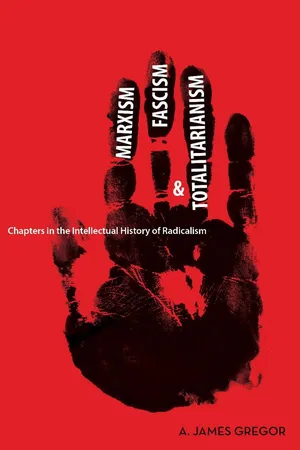
Marxism, Fascism, and Totalitarianism
Chapters in the Intellectual History of Radicalism
- 416 pages
- English
- ePUB (mobile friendly)
- Available on iOS & Android
eBook - ePub
Marxism, Fascism, and Totalitarianism
Chapters in the Intellectual History of Radicalism
About this book
Information
Publisher
Stanford University PressYear
2008Print ISBN
9780804760348
9780804760331
eBook ISBN
9780804769990
CHAPTER ONE
Introduction
As we move further and further into the twenty-first century, the twentieth takes on more and more an air of unreality. In one sense, its features recede, and in another, some of those same features become caricatures of themselves. Our memories have become uncertain. Mussolini’s Fascism becomes a burlesque,1 and Lenin’s Bolshevism the antechamber of gulags and killing fields.2 One is left with a feeling of disquiet, as though one does not understand any of it.
For a very long time the twentieth century seemed to make sense. The planet was caught up in a Manichean struggle of light against darkness. Marxism, embodying all the values of the Enlightenment, found itself opposed by the irrational evil of reactionary and counterrevolutionary fascism. Fascism, ignominiously struck down in the course of the Second World War, quickly lost whatever cachet it briefly enjoyed among some intellectuals in the West, to be reduced to little more than a public expression of private pathologies.3 For the nations of the world, antifascism became a compulsory patrimony.
FASCISM AND COMMUNISM
Until the coming of the Second World War, both Mussolini’s Fascism and generic fascism had been the subjects of passionate debate. There had been perfectly rational and objective discussion of their respective merits and deficits. Mussolini’s Fascism, for example, could be spoken of as possessed of a “complete philosophy” articulated by a number of “young intellectuals” fully competent to argue in defense of their positions. Economists could speak of the “gains and losses” of Fascist economic policy and affirm that “the mass of Italians sympathize with Fascism and, on the whole, support the regime.”4
After the war, none of that was possible any longer. Antifascism became the negation that unified the capitalist, democratic West and the socialist, nondemocratic East. Fascists were banished from humanity. They became the unprecedented objects of general reprobation. Their very essence was deemed barbarous. Their sole motivation understood to have been war and violence.
Conversely, for years after the Second World War, Joseph Stalin’s Soviet Union, triumphant in that conflict, the presumptive embodiment of Marxism, became the hope of a surprisingly large minority of Western intellectuals. Fascism was remembered as the tool of a moribund capitalism—seeking to preserve its profits at the cost of war and pestilence. It was seen as the extreme opposite of Soviet socialism. All the simplisms that had been the content of the Marxist interpretation of fascism in the interwar years were seen by many as having been confirmed by the war. Many on the left were persuaded that monopoly capitalism, in its death agony, had unleashed fascism on the world in its desperate effort to stay the hand of history.
The Second World War was understood to have been a war between imperialists who each sought advantage over the other. The Soviet Union, innocent of all that, became the victim of National Socialist Germany—but had heroically succeeded in emerging victorious. The Red Army was depicted as an antifascist army that had sacrificed itself in defense of humanity. For their part, the Western powers were seen as craven spoilers who sought only profit, and worldwide hegemony, from the defeat of fascism.
Some intellectuals in Europe and North America found such an account convincing. Winston Churchill and Charles de Gaulle, Europe’s most consistent antifascists before the advent of the war, were somehow transformed into “cryptofascists.” Churchill’s postwar “Iron Curtain” speech at Fulton in 1946 was understood to constitute a provocation calculated to support the effort of “industrialists” who hoped to use a contest with the Soviet Union as the pretext for “curbing the claims of the working classes with the help of the authorities and thus complete the [postwar] process of reorganizing production on monopolistic lines at the expense of the community.” General de Gaulle, in turn, long known to be an anticommunist, could only be an enemy of the poor and underprivileged, and, as a consequence, one expected to extend aid and comfort to fascists and “reactionaries” of all sorts.5
So convinced of all this were some European and American intellectuals that they could only speak of fascism as an excrescence of capitalism. Some Europeans solemnly maintained that “those who have nothing to say about capitalism should also be silent about fascism.”6 The relationship between the two was conceived as one of entailment.
Marxists, for more than half-a-hundred years, had argued that there could only be “two paths . . . open before present society.... [The] path of fascism, the path to which the bourgeoisie in all modern countries . . . is increasingly turning . . . or [the] path of communism.”7 Marxists and leftist liberals in the West had been convinced by the war that Soviet theoreticians had always been correct. Capitalism was the seedbed of fascism, and the only recourse humanity had was to protect, sustain, foster, and enhance Soviet socialism and its variants. Only with Nikita Khrushchev’s public denunciation of Stalin’s crimes at the 20th Party Congress of the Communist Party, did the support of Western leftists for the Soviet Union show any signs of flagging.
Immediately after Stalin’s death in March 1953, oblique criticisms of his regime, by the leaders of the Communist Party of the Soviet Union, signaled the forthcoming denunciation—and in February 1956, Khrushchev delivered his catalog of charges against the departed leader in a “secret speech” to the leadership of the Party. In that speech, Stalin’s dictatorship was characterized as tyrannical, arbitrary, and homicidal, having created a system in which many, many innocents perished, and in which prodigious quantities of the nation’s resources had been wasted. Largely unexpected both within and outside the Soviet Union, the disclosures of the 20th Party Congress created political tensions within the Party and among Soviet sympathizers throughout the West.
Stalin’s successors were burdened with the unanticipated necessity of renouncing the tyrannical and homicidal rule associated with his name, while seeking to perpetuate the regime he had created. They were obliged, by their leadership responsibilities, to continue to speak of “socialism in one country,” while at the same time, denouncing its architect. They spoke of a “return to Leninism” while abandoning some of Lenin’s most important policies. They spoke of the commitment to classical Marxism, while at the same time beginning the process that would conclude with the creation of a socialist “state of the whole people”—an arrant affront to classical Marxism’s emphatic insistence that socialism would see the inevitable “withering away of the state.”8
Nikita Khrushchev fashioned himself master of a system that revealed itself as increasingly nationalistic in inspiration, militaristic in deportment, industrializing in intent, and statist by choice. It was a system that sought uniform control of all the factors of production, enlisted in the service of an economic plan calculated to make the nation a major international power, restoring “lost territories” to the motherland, and securing its borders against external “imperialists.” It was an elitist system, with minority rule legitimized by a claim of special knowledge of the laws governing the dialectical evolution of society.9
In the years that followed, more and more Soviet intellectuals reflected more and more critically on the properties of their political and economic system. They seemed to recognize, at least in part, that the special claim to wisdom and moral virtue by the ruling elite had occasioned the creation of a “cult of personality” around their leader, Joseph Vissarionovich Stalin, from which they had all suffered. They appreciated the fact that Stalin had proceeded to implement views that “in fact had nothing in common with Marxism-Leninism”—but which he invoked in order “to substantiate theoretically the lawlessness and the mass reprisals against those who did not suit him.”10 Possessed of “unlimited power” in an “administrative system”—typified by “centralized decision-making and the punctual, rigorous and utterly dedicated execution of the directives coming from the top and, particularly, from Stalin”—Stalinism devolved into a morally defective system in abject dependence on the whims of a single man, whose sense of infallibility and omnipotence, ultimately and irresistibly, led to his utter “irrationality.” 11
Before the close of the system, Soviet theoreticians had begun to draw conclusions from the role played by Stalin in their nation’s revolutionary history. They suggested that “Stalin quickly grew accustomed to violence as an indispensable component of unlimited power”—to ultimately conceive it a “universal tool”—a conception that opened the portals to a “tragic triumph of the forces of evil.”12 Soviet analysts concluded that all of that, apparently, “was payment for building socialism in a backward country—by the need to build in a short space of time a heavy (above all, defence) industry, and thousands of enterprises in these industries,” in circumstances in which the motherland was “surrounded by enemies.”13
By the time of its passing, the apologists for the Soviet system, under the uncertain leadership of Mikhail Gorbachev, had taken the measure of the system they staffed. They sought to abandon all its ideological pretenses as well as its institutional forms, to replace them with the values and fashions of the liberalism Marxism-Leninism had long deplored. In the years between Stalin’s death and the appearance of Gorbachev, all the properties associated with Lenin’s Bolshevism, and Stalin’s “socialism in one country,” were made subject to corrosive review by Soviet Marxist-Leninists themselves—and were found wanting.
The impact of all that on Western academics varied from person to person. 14 Some saw their earlier commitment to the Soviet Union the product of an infatuation with an unattainable dream—and proceeded to abandon socialism as the only alternative to fascism. Others dismissed the entire Soviet sequence as the consequence of one man’s perversity. Others simply shifted their allegiance to other, more appealing, socialisms—in China, Cuba, or Ethiopia. The schematization of history, with exploitative capitalism at one pole and socialist liberation at the other, was simply too familiar and attractive to forsake. What would change would be the socialist country that would be the object of their allegiance. Marxist socialism as the paradigm of virtue appears fitfully in the writing of intellectuals to the present day.15 The possibility never appears to have occurred to them that the socialism they had embraced, in the form it had assumed in the twentieth century, was hardly the incarnation of the Marxism of which they approved.
SOVIET COMMUNISM, NATIONALISM, AND FASCISM
Before Khrushchev’s “secret speech” at the 20th Party Congress in 1956, there had been scant tolerance for any resistance to the political systems imposed on Eastern Europe by the Soviets at the conclusion of the Second World War. At the end of the Second World War, among the first responses of many Western intellectuals, was the depiction of the entry of the Red Army into the heartland of Europe as the coming of an avenging host of decency and liberation. Soon, however, the restiveness of those “liberated,” and the heavy-handed suppression that followed, produced disquiet among intellectuals in the industrial democracies.
The system imposed on a fragment of what had been Germany, for example, was a purgatory of expiation for the atrocities committed by Adolf Hitler’s National Socialism. East Germany, under Soviet occupation, and the regime imposed upon it by Moscow, was expected to provide prodigious amounts of industrial goods and material resources to the Soviet Union as compensation for the destruction of assets and loss of life that resulted from the Nazi invasion of the homeland. Even after the East Germans emerged from the desolation of the war, the “German Democratic Republic,” cobbled together by the Soviets, soon revealed itself to be an ineffectual, incompetent, and unpopular police system, which, in the final analysis, was justified only by its “antifascist” credentials.16 In fact, through the long years between the Second World War and the collapse of the Soviet Union, Moscow employed its certification as antifascist to legitimate its rule over much of Eastern Europe.
During that same period, international communism, with Moscow at its core—having achieved its apotheosis in its defeat of fascism in the Second World War—faced the first critical challenge to its dominance and control in the defection of Tito’s Yugoslavia. It was immediately clear that Tito’s defection from the highly centralized organization constructed around the Soviet center was not the consequence of ideological disagreement. Originally, there were no doctrinal problems between Tito and Stalin. Their shared ideology notwithstanding, Tito simply refused to surrender control over any of his nation’s sovereignty to Moscow. The Yugoslav defection from “proletarian internationalism” brought to public attention what long had been a private apprehension among Marxist thinkers. “Titoism” was to be symptomatic of a critical problem at the heart of “international socialism.”
Since its very founding, Bolshevism had struggled not only against “bourgeois nationalist,” but “national communist,” factions as well. Even before the Bolshevik revolution, Lenin had been bedeviled by the nationalisms of Polish, Baltic, and Jewish revolutionaries. Dismissed as apostasies by Lenin and his followers, after the October revolution, the leaders of those factions were incarcerated, exiled, or murdered.
There could be none of that in dealing with Tito. Tito Broz was a heretic of a different sort. He could not be dealt with as others had been. Tito was the leader of an independent nation, and his national communism heralded the prospect of a proliferation of just such state systems.
While, in the past, there had been any number of Marxist heretics who had advocated various forms of national communism, it was only with Tito that heresy spread to a ruling party and to an extant state. Tito’s “nationalist deviation” compromised the proletarian international. The vision of an international proletarian revolution that would result in a worldwide socialism lost whatever credibility it had hitherto enjoyed. At the time, observers could not know that a new chapter in the history of communism had begun with the long anti-Tito Cominform resolution of June 1948.
What Tito had done was to reaffirm the coupling of the ideas of nationhood and revolution. In declaring his independence from institutional Stalinism, T...
Table of contents
- Title Page
- Copyright Page
- Dedication
- Acknowledgments
- Table of Contents
- Preface
- CHAPTER ONE - Introduction
- CHAPTER TWO - The Roots of Revolutionary Ideology
- CHAPTER THREE - The Heterodox Marxism of Ludwig Woltmann
- CHAPTER FOUR - The Heterodox Marxism of Georges Sorel
- CHAPTER FIVE - The Heterodox Marxism of V.I. Lenin
- CHAPTER SIX - The Heterodox Marxism of Benito Mussolini
- CHAPTER SEVEN - The National Question and Marxist Orthodoxy
- CHAPTER EIGHT - Revolutionary Syndicalism and Nationalism
- CHAPTER NINE - The Great War and the Response of Revolutionary Marxists
- CHAPTER TEN - The Great War, Revolution, and Leninism
- CHAPTER ELEVEN - The Great War, Revolution, and Fascism
- CHAPTER TWELVE - Conclusions
- Notes
- Index
Trusted by 375,005 students
Access to over 1.5 million titles for a fair monthly price.
Study more efficiently using our study tools.
Frequently asked questions
Yes, you can cancel anytime from the Subscription tab in your account settings on the Perlego website. Your subscription will stay active until the end of your current billing period. Learn how to cancel your subscription
No, books cannot be downloaded as external files, such as PDFs, for use outside of Perlego. However, you can download books within the Perlego app for offline reading on mobile or tablet. Learn how to download books offline
Perlego offers two plans: Essential and Complete
- Essential is ideal for learners and professionals who enjoy exploring a wide range of subjects. Access the Essential Library with 800,000+ trusted titles and best-sellers across business, personal growth, and the humanities. Includes unlimited reading time and Standard Read Aloud voice.
- Complete: Perfect for advanced learners and researchers needing full, unrestricted access. Unlock 1.5M+ books across hundreds of subjects, including academic and specialized titles. The Complete Plan also includes advanced features like Premium Read Aloud and Research Assistant.
We are an online textbook subscription service, where you can get access to an entire online library for less than the price of a single book per month. With over 1.5 million books across 990+ topics, we’ve got you covered! Learn about our mission
Look out for the read-aloud symbol on your next book to see if you can listen to it. The read-aloud tool reads text aloud for you, highlighting the text as it is being read. You can pause it, speed it up and slow it down. Learn more about Read Aloud
Yes! You can use the Perlego app on both iOS and Android devices to read anytime, anywhere — even offline. Perfect for commutes or when you’re on the go.
Please note we cannot support devices running on iOS 13 and Android 7 or earlier. Learn more about using the app
Please note we cannot support devices running on iOS 13 and Android 7 or earlier. Learn more about using the app
Yes, you can access Marxism, Fascism, and Totalitarianism by A. James Gregor in PDF and/or ePUB format, as well as other popular books in Politica e relazioni internazionali & Storia e teoria politica. We have over 1.5 million books available in our catalogue for you to explore.