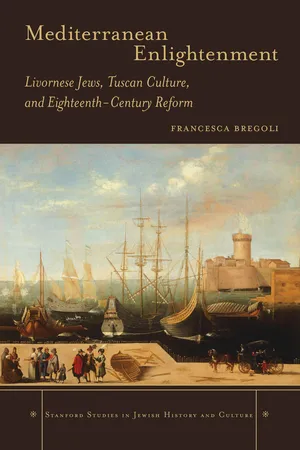
The Mediterranean port of Livorno was home to one of the most prominent and privileged Jewish enclaves of early modern Europe. Focusing on Livornese Jewry, this book offers an alternative perspective on Jewish acculturation during the eighteenth century, and reassesses common assumptions about the interactions of Jews with outside culture and the impact of state reforms on the corporate Jewish community. Working from a vast array of previously untapped archival and literary sources, Francesca Bregoli combines cultural analysis with a study of institutional developments to investigate Jewish responses to Enlightenment thought and politics, as well as non-Jewish perceptions of Jews, through an exploration of Jewish-Christian cultural exchange, sites of sociability, and reformist policies. Mediterranean Enlightenment shows that Livornese Jewish scholars engaged with Enlightenment ideals and aspired to contribute to society at large without weakening the boundaries of traditional Jewish life. By arguing that the privileged status of Livorno Jewry had conservative rather than liberalizing effects, it also challenges the notion that economic utility facilitates Jewish integration, nuancing received wisdom about processes of emancipation in Europe.
eBook - ePub
Mediterranean Enlightenment
Livornese Jews, Tuscan Culture, and Eighteenth-Century Reform
- 360 pages
- English
- ePUB (mobile friendly)
- Available on iOS & Android
eBook - ePub
Mediterranean Enlightenment
Livornese Jews, Tuscan Culture, and Eighteenth-Century Reform
About this book
Information
One
The Nazione Ebrea and the Tuscan State
A Fruitful Symbiosis
In February 1770, Livornese high society was treated to a sumptuous event: the weeklong festivities in honor of the wedding between the “most rich Jewish merchant,” Jacob Aghib, and his fiancée, Anna Aghib. The governor of the city of Livorno, its officials and notables, and the most esteemed merchants, all flocked to Aghib’s mansion, adorned with “pictures and furniture in the latest fashion,” each of its halls lit up with crystal and silver chandeliers. The Aghibs had arranged every detail with great care, intent on showcasing their generosity no less than their opulence and refinement. An orchestra entertained the merry crowd of Jews and gentiles, who feasted on sorbets and fruit preserves until a lavish dinner was served. On the last day of the festivities, the Aghibs delighted their guests with a “musical academy.” Renowned musicians and singers, one of whom was at the service of the Grand Duke in Florence, performed during the first part of the evening. The bride too, an amateur singer, “showed her good disposition for music.” The celebration was capped off with a ball, all the more pleasurable as liqueurs, fruit preserves, and sorbets were served all night long to the guests.1
Less than a month later, notice of another bountiful feast caught the attention of Livornese chronicler Pietro Bernardo Prato, who had reported on the festivities at the Aghib mansion. This time the host was Maria Elisabetta, widow of Captain Santo Anton Mattei. The guest of honor was Ventura Velletri, a Jewish woman, “previously wife of Joseph Ancona,” who on that day celebrated her conversion to Catholicism under the new name of Maria Elisabetta Fortunata, after her godmother.2
These two episodes, separated by only a few weeks, capture some of the complex and contradictory aspects of Livornese life in the eighteenth century. On the one hand, one of the city’s wealthiest trading families could liberally display their grandeur for seven days before fellow Jewish merchants as well as Christian authorities and notables. The Aghibs’ sophistication showed that little difference existed between Livornese Jews and non-Jews when it came to matters of art, music, furniture, or food. Christian guests shared the same dance floor as the port’s Jewish notables; they ate the same fruit preserves; they attended a musical performance by young Mrs. Aghib. On the other hand, an otherwise unknown Jewish woman, alone after the end of her marriage, made it to the local chronicle because of her decision to convert to Catholicism in the very city where Jews enjoyed liberties unparalleled elsewhere in Italy.3
The tension between integration and separation, toleration and prejudice was at the core of early modern Livornese Jewish life. Livorno, one of the most animated and dynamic mercantile centers in western Europe, offered unprecedented opportunities for religious and ethnic minorities in Catholic Europe, above all Jews. Literary descriptions of the city never failed to mention its peculiar assortment of different national groups, emphasizing its large Jewish population, with its ostensible control over the port’s trade. By the end of the century, Ann Radcliffe immortalized Livorno’s atmosphere as a carnevalesque masquerade of “persons in the dresses of all nations,” in her gothic romance Mysteries of Udolpho (1794).4 Exaggerated figures, circulated by French, German, and English authors without firsthand knowledge of the city’s demography, estimated that its Jewish inhabitants ranged from twenty-two thousand to ten thousand individuals, out of a total population of approximately forty-five thousand.5 The actual numbers were much lower, in fact, and the port’s Jewish residents did not surpass forty-five hundred souls.6
Despite its reputation as a beacon of toleration for all minorities, Livorno was a town with a deeply devout Catholic population, whose hostility to the visible Jewish enclave could flare up during Christian festivals or in moments of economic crisis. While the Papal Inquisition had limited reach in eighteenth-century Livorno in contrast to Rome or Mantua, Jews had to comply with its requirements in several matters. Christian wet nurses had to petition for a special ecclesiastic dispensation in order to work for a Jewish household, as in Mantua or Modena.7 So did Christian patients wishing to rely on Jewish doctors.8 Anti-Jewish incidents were relatively rare compared to other European contexts, but angry mobs attacked the Jewish neighborhood in 1722 and 1751.9 Political instability and the economic downturn that accompanied the revolutionary periods of the end of the century resulted in large-scale riots against Livornese Jews in 1790 and 1800.10 These grave episodes notwithstanding, Livornese Jews generally found sympathetic protectors in the Tuscan administration, willing to safeguard Jewish legal prerogatives and to actively defend the lives and homes of Livornese Jews.
Complexities and contradictions extended to the fabric of Jewish life itself. The Livornese community included widely diverse social components. It was home to the very rich and the very poor; to rabbis and doctors, to criminals and prostitutes; to merchants who gathered in one of the coffeehouses of the port before heading to the theater; to porters who worked in the docks; and to saintly kabbalists who spent their ascetic days in prayer and study.11 A high level of mobility characterized Livornese Jewish society. Itinerant religious figures and merchants passed through Livorno on their way to the Ottoman Empire, North Africa, or northern Europe. Levantine Jews wearing turbans and caftans mingled in the busy streets of the port with clean-shaven Western Sephardim in breeches and powdered wigs.12 Jewish observance defined family and communal life, yet some rabbis accused Livornese Jews of impiety because of their acculturation and economic prosperity.13 Social tensions within the nazione ebrea ran deep, although class differences did not engender radical ruptures in the communal fabric until the revolutionary and Napoleonic periods.
Through an examination of the nazione ebrea within both the Sephardi and the Tuscan contexts, this chapter investigates the tensions between Tuscan acculturation and Jewish specificities and the close utilitarian bonds that connected Livornese Jews with the Tuscan state. The exceptional status of Livornese Jewry explains its far-reaching integration and its simultaneous segregation.
Livornese Jewish Integration: Ideal or Reality?
The Jews of Livorno live together in peace and safety in fine homes among the nobles of the land. Their houses are made of stone; most of its people are merchants and notables. Most of them shave their beards and style their hair, and there is no difference between their clothes and those of the rest of the people. They speak the common language correctly and fluently. . . . They dwell peacefully and quietly, and pursue every occupation and business they desire. My heart gladdens and I am proud to see my brothers living securely in the midst of their [gentile] neighbors, without enemy or troublemaker.14
With these words Isaac Euchel (1758–1804), one of the leaders of the Prussian Haskalah, described the Jews of Livorno in a fictional travelogue published in the journal Ha-Measef in 1790. In Euchel’s depiction, Livorno was above all a place of freedom and opportunities, where Jews and gentiles coexisted peacefully as Livornese Jewry fulfilled its social potential in the pursuit of useful occupations. In the 1780s and 1790s, Livornese Jews, portrayed as the peak of Jewish social, economic, and cultural prosperity in Europe, turned into a model of the twin ideals of acculturation and retention of Jewish specificity promoted by the Haskalah. For Prussian maskilim like Euchel, the vision of Livorno provided a symbolic inspiration.15
Euchel’s perspective was not unique. Among non-European Jews, too, Livorno came to epitomize Western civilization, either desired or decried. For Sephardi modernizers like the Sarajevo-born, Livorno-based David Attias, thanks to their ability to embrace secular European culture the integrated Livornese compared favorably against Levantine Jews, whom he accused of backward ignorance and traditionalism.16 The Italian Jewish elite known as Francos, primarily of Livornese origin, was indeed instrumental in introducing Western values into Ottoman Sephardi society.17 In Tunisia, the flourishing mercantile community of expatriate Livornese Jews (known as Grana, from the Arabic name of Livorno), who retained a keen distinction from the indigenous Jews (Twansa), to the contrary earned a reputation for impiety and freemasonry among devout Tunisian Jews.18
Since the early seventeenth century, non-Jewish travelers too had marveled at the freedom of the Jewish inhabitants of the port. An early eighteenth-century French visitor called the city “paradise of the Jews.”19 Edward Gibbon described Livorno as “a veritable land of Canaan for the Jews,” while the Encyclopédie stated that “the Jews . . . regard Livorno as a new promised land.”20 Similarly to Jewish observers, the integration of Livornese Jews assumed different meanings, depending on the ideological leanings of non-Jewish authors, who were skeptical or supportive of such exceptional liberties but seldom indifferent to them. By the late eighteenth century, a local commentator remarked half-jokingly that it would be less risky to beat the Grand Duke of Tuscany than a Jew in Livorno.21 French and English writers noticed Jewish material success with surprise, fascination, and at times aversion.22 Still, for Giuseppe Gorani (1740–1819), a champion of Jewish integration, the freedom of Livornese Jews, who “enjoyed the same prerogative rights enjoyed by the other citizens,” turned them into “highly regarded” members of society, “distinguished by all the virtues pertaining to universal morality.”23
By the end of the eighteenth century, the nazione ebrea of Livorno had come to embody a story of effective Jewish integration into European society for both Jewish and gentile critics. Even more than early modern English or Dutch Jews, who enjoyed equally generous social and economic privileges, it was the community of Livorno—a thriving hub, but no London or Amsterdam—who epitomized the successful Jewish appropriation of values and behaviors associated with European civilization: social usefulness, morality, rationality. In the Mediterranean region, among the Sephardi communities of North Africa and the Balkans, Livornese Jews were perceived as truly “European” up to the early twentieth century. Even Italian historian Attilio Milano presented Livorno, in his monumental history of the Jews in Italy, as the sole oasis of Jewish toleration during the Counter-Reformation.24
Was this ideal of integration grounded in concrete facts? How many of these accounts were depictions exaggerated by foreign observers or distorted by ideological goals, and how much were they an accurate representation of Livornese reality? The origins, nature, and development of this community explain the role it came to play in Jewish imagination.
Jewish Freedoms in Livorno: The Livornina
Undoubtedly, the privileges enjoyed by Livornese Jews were extraordinary. These unique freedoms resulted from the transformations of early modern Tuscany and the growth of its Mediterranean maritime trade. It was the perceived commercial usefulness of Jewish traders that led the Medici government to invite them to settle in Livorno at the end of the sixteenth century, in the hope that their presence would boost the port’s economy.25 As other states, Tuscany recognized the global importance of Sephardi economic networks, ranging from the Ottoman Empire to northern Africa, and from northern Europe to the colonial world. Sephardi Jews and Iberian New Christians (the descendants of Jews who had been baptized in the Iberian Peninsula, also known as conversos) were respected as accomplished merchants endowed with large capital and part of a well-established trading diaspora.26
The establishment of a Jewish community in Livorno was a specific instance of a phenomenon evolving on a much grander scale, influenced by mercantilism, the prevalent economic doctrine during the sixteenth and the seventeenth centuries. Attracted by authorities that sought to control foreign trade and emphasized the economic interest of the state over the theological and legal qualms that had shaped Jewish policies in earlier periods, Jews of Iberian descent established new communities in port cities such as Livorno, Hamburg, Amsterdam, London, Recife, and New Amsterdam, a phenomenon which in turn drew New Christian...
Table of contents
- Cover
- Copyright
- Title Page
- Series Page
- Dedication
- Contents
- Acknowledgments
- Note on Spelling
- Introduction
- 1. The Nazione Ebrea and the Tuscan State: A Fruitful Symbiosis
- 2. Balancing Acts: The Unlikely Cultural Mediations of Joseph Attias
- 3. In Praise of Good Taste: Galilean Science, Critical Spirit, and Hebraic Studies
- 4. Entering the Medical Republic: Jewish Physicians and the Pursuit of the Public Good
- 5. Pious Care and Devotional Literature at the Time of Enlightenment Reform
- 6. Coffee and Gambling: Jewish Recreation and “National” Separation
- 7. Commerce and Jewish Culture: The Business of Hebrew Publishing
- 8. Economic Utility and Political Reforms: The “Jewish Question” in Livorno
- Conclusion. Enlightenment and Emancipation: Privilege and Its Discontents
- Appendix: Bibliographic Data
- Notes
- Bibliography
- Index
Trusted by 375,005 students
Access to over 1.5 million titles for a fair monthly price.
Study more efficiently using our study tools.
Frequently asked questions
Yes, you can cancel anytime from the Subscription tab in your account settings on the Perlego website. Your subscription will stay active until the end of your current billing period. Learn how to cancel your subscription
No, books cannot be downloaded as external files, such as PDFs, for use outside of Perlego. However, you can download books within the Perlego app for offline reading on mobile or tablet. Learn how to download books offline
Perlego offers two plans: Essential and Complete
- Essential is ideal for learners and professionals who enjoy exploring a wide range of subjects. Access the Essential Library with 800,000+ trusted titles and best-sellers across business, personal growth, and the humanities. Includes unlimited reading time and Standard Read Aloud voice.
- Complete: Perfect for advanced learners and researchers needing full, unrestricted access. Unlock 1.5M+ books across hundreds of subjects, including academic and specialized titles. The Complete Plan also includes advanced features like Premium Read Aloud and Research Assistant.
We are an online textbook subscription service, where you can get access to an entire online library for less than the price of a single book per month. With over 1.5 million books across 990+ topics, we’ve got you covered! Learn about our mission
Look out for the read-aloud symbol on your next book to see if you can listen to it. The read-aloud tool reads text aloud for you, highlighting the text as it is being read. You can pause it, speed it up and slow it down. Learn more about Read Aloud
Yes! You can use the Perlego app on both iOS and Android devices to read anytime, anywhere — even offline. Perfect for commutes or when you’re on the go.
Please note we cannot support devices running on iOS 13 and Android 7 or earlier. Learn more about using the app
Please note we cannot support devices running on iOS 13 and Android 7 or earlier. Learn more about using the app
Yes, you can access Mediterranean Enlightenment by Francesca Bregoli in PDF and/or ePUB format, as well as other popular books in History & Jewish History. We have over 1.5 million books available in our catalogue for you to explore.