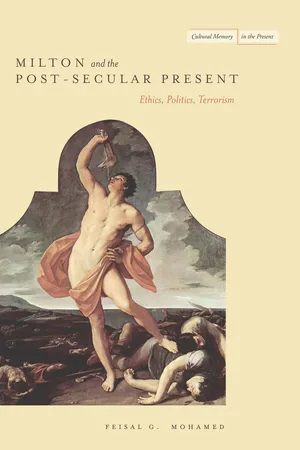
Our post-secular present, argues Feisal Mohamed, has much to learn from our pre-secular past. Through a consideration of poet and polemicist John Milton, this book explores current post-secularity, an emerging category that it seeks to clarify and critique. It examines ethical and political engagement grounded in belief, with particular reference to the thought of Alain Badiou, Jacques Derrida, Jürgen Habermas, and Gayatri C. Spivak. Taken to an extreme, such engagement produces the cult of the suicide bomber. But the suicide bomber has also served as a convenient bogey for those wishing to distract us from the violence in Western and Christian traditions and for those who would dismiss too easily the vigorous iconoclasm that belief can produce. More than any other poet, Milton alerts us to both anti-humane and liberationist aspects of belief and shows us relevant dynamics of language by which such commitment finds expression.
- 192 pages
- English
- ePUB (mobile friendly)
- Available on iOS & Android
eBook - ePub
About this book
Trusted by 375,005 students
Access to over 1.5 million titles for a fair monthly price.
Study more efficiently using our study tools.
Information
Publisher
Stanford University PressYear
2011Print ISBN
9780804776516
9780804776509
Edition
1eBook ISBN
9780804780735
1
‘Not but by the Spirit understood’: Milton’s Plain Style and Present-Day Messianism
Arguments for Milton’s ability to speak to our moment seem increasingly to refer to the rationalist thrust and parry of contending ideas in his work. In a 2008 article in the New Yorker, Jonathan Rosen avers that ‘[in] America, where God and the Devil live alongside Western rationalism, Milton seems right at home.’1 Milton scholars draw similar conclusions. Nigel Smith’s fine introduction, Is Milton Better than Shakespeare?, objects to a reading of the poet that places God too firmly in the center of his vision, arguing especially against the views of Stanley Fish and claiming that Milton is ‘both theistic and post-theistic, mono-theistic and polyglot.’2 ‘Milton matters,’ Joseph Wittreich claims in more sanguine terms, because ‘he forces us to reach beyond an axis of good and evil in the world ... to a more ambiguous reality.’3
I am not persuaded by this view, but it does alert us to aspects of Milton that might be overlooked by too narrow an emphasis on his theism. Perhaps a term that might productively describe Milton is ‘pre-secular.’ We hear everywhere in his writings the footfalls of those modes of thought predominant in secularism, but these are contained within and measured by a fundamentally non-secular system of belief. Implicitly at issue is the value of reason as a category significant to discussion of secularization. Turning away from the dubiously productive distinction between faith and reason, current studies point to secularism’s dissociation of belief and imagination.4 When natural order is secured by myth rather than knowledge we are in a frame of mind at odds with secularism. Biblical narrative governs Milton’s view of the world’s creation, progress, and ultimate end, though he gives space to the language of geographical exploration and scientific discovery. We shall see how Alain Badiou finds in Saint Paul a similar faith in the ‘pure fable’ of the Resurrection that is the standard by which law and language are measured.
If Milton is ‘pre-secular,’ he might be brought into productive dialogue with our post-secular moment, the most obvious symptom of which is the revanche de Dieu that seems to be awakening zeal in all religions across the globe and producing increasingly un-liberal theologies claiming, like the Reformation sects before them, repristination of religious ideals: whether the rise of Wahhabism; or the Catholic Church’s appointment of a pope decidedly of the global North and West; or the June 2008 assembly in Jerusalem of conservative Anglican divines threatening to split from the Communion in their ire over the openly gay American bishop Gene Robinson. Among these conservatives the Archbishop of Uganda, Henry Orombi, has articulated aims that will sound familiar to any student of the Reformation: ‘I want that we go back to the first love that the early Church had in Jerusalem ... that we go back to believing the word of God to be the word of God, as it is in the Bible.’5 (These splitters, however, themselves are split over whether to adopt Saint Paul’s anti-feminism with his anti-gay sentiments: the purest purists among them object to the ordination of women as bishops.)6
It is easy to object to a brand of religion that, like Spenser’s Ignaro, is ever looking backward in its progress. But the post-secular turn equally pervades current philosophy. This is not a moral equivalence—the authors in which I am interested claim no victims and repair to no ancient bigotries—but a discursive equivalence. This chapter will explore Milton’s primacy of belief alongside post-secular formulations, paying particular attention to the way in which the adoption of plain expression affirms that primacy—the dissociation of belief and imagination brings to mind Eliot’s ‘dissociation of sensibility’ with its attack on poetry residing in the realm of thought more than feeling. That attack is mistaken in taking aim at Milton. The privilege accorded to the plain style in Paradise Lost is an immediate expression of a felt truth received by divine illumination, and seems in Milton’s terms to represent poetry’s highest strain. Milton himself critiques a poetry that dissociates thought and feeling, the kind of poetry where emotional and intellectual richness are only literary. A similar relationship between style and truth can be found in current models of immanence. We will explore especially Michael Hardt and Antonio Negri, as well as Alain Badiou, with respect to the nature of truth and especially the democratic and anti-democratic dynamics of truth-claims. Particularly relevant is the model of democratic universality in which Badiou enlists Saint Paul’s fidelity to the ‘event’ of the Resurrection.
I. Plain style as epistemic ground in ‘Paradise Lost’
With Donne, style is faith: a measure of delivery that confesses his own inordinacy while remaining in all things ordinate. To state this is to affirm one’s recognition of his particular authority in having achieved the equation; one recognizes also such authority in Milton and Herbert. They are not, generally, otherwise to be equated.
—Geoffrey Hill, Style and Faith (2003)
There is a great deal to unpack in Geoffrey Hill’s characteristically rich comment on Donne, Milton, and Herbert: it encapsulates each poet’s relationship to language, which is also a relationship to faith (‘style is faith’), and how poetic authority resides in having achieved this ‘equation.’7 We must also see immediately the good sense of not otherwise equating the three poets. Donne shows us time and again that ordinacy in language is only ordinacy in language, mastery over a limited and limiting human system ever falling short in its attempts to incorporate divine Truth. This style corresponds to a faith where soteriological self-assurance is a temptation to be resisted—the lesson of the third satire is that our eternal fate depends upon a necessary doctrinal commitment of which we cannot be certain and for which no worldly authority can equip us. For Herbert style and faith are a stripping away of human confusion so that we can arrive at a Truth reminding us of the divine order beyond our grasp. This is the lesson on style of the ‘Jordan’ poems.
For Milton the equation of style and faith is more complex, for we must first ask, ‘Which style?’ There is perhaps no other poet who has at his command so broad a range of styles, from grand to plain. It is the former that has always been taken as his hallmark, earning Addison’s comment that Milton adopts the grand style ‘to give his Verse the greater Sound, and throw it out of Prose’—an observation made more feline in T. S. Eliot’s comment that Milton’s ‘poetry is poetry at the farthest possible remove from prose,’ and that he is ‘the greatest of all eccentrics. His work illustrates no general principles of good writing; the only principles of writing that it illustrates are such as are valid only for Milton himself to observe.’8
Leavis and Eliot tend to object to Milton’s style as excessively ornamented and big-mouthed—that it is grand in the way of rococo’s garish display rather than in the way of baroque sublimity. In his Origin and Progress of Language (1773–92), the Lord Monboddo more accurately observes that Milton’s style is both lofty and ‘chaste,’ that it is characterized by its compactness of expression and that no device, it seems, is used without effect. His pet example is Satan’s justification of his rule in book 2:
Mee though just right, and the fixt Laws of Heav’n
Did first create your Leader, next free choice,
With what besides, in Counsel or in Fight,
Hath bin achievd of merit, yet this loss
Thus farr at least recover’d, hath much more
Establisht in a safe unenvied Throne
Yielded with full consent. (18–24)
Milton departs from ‘natural’ word order, ‘taking advantage of the pronoun I having an accusative, and has placed it at the head of the sentence, at a great distance from its verb established.’ In that distance are ‘whole sentences concerning the laws of Heaven, the free choice of his subjects, the atchievements in battle and in council, and the recovery of their loss so far; and some of these are parentheses.’ Monboddo finds precedent for such separation in Horace, and argues that the intervening statements are not ‘idle words’ but ‘such as fill up the sense most properly, and give a solidity and compactness to the sentence, which it otherwise would not have.’ Word order and syntax thus not only lend ‘elegance and beauty’ to the passage, but also a ‘density of sense’;9 in his felicitous phrase, Milton’s style is ‘rounded, compact, and nervous,’ a collocation that captures well its tightly and intricately interlaced energies.10 That he connects these qualities especially to the oratory of Demosthenes—the measure of eloquence for Monboddo—and opposes them to the empty ornament that he locates in French influence on English prose style, qualifies the excessive ornamentation of which the moderns accuse Milton. As we use the term ‘grand’ style, it will be with awareness of Monboddo’s insight on its ‘chaste’ qualities.
We must also raise some questions of Monboddo, however, when we find him identifying as the apex of Milton’s style the speeches of Satan and the fallen angels in book 2, which he relates to the ‘manly eloquence’ and ‘high republican spirit’ of Eikonoklastes.11 That Satan’s republican spirit is so far from Milton’s own should lead us to be skeptical of equating the style by which the two are expressed. Much as readers of Paradise Lost have long relished the twists and turns of diabolical eloquence, Milton himself seems strongly to value plainly expressed truth. The early prose suggests that ornament and opacity are modes of human expression opposed to the flawless clarity of God’s word. By this standard Of Reformation declares that the ‘very essence of Truth is plainnesse, and brightnes; the darknes and crookednesse is our own’ (YP 1: 566); reform depends upon the casting off of the ‘pamper’d metafors’ of the Fathers in favor of the ‘transparent streams of divine Truth’ (YP 1: 568–69). The Reason of Church Government describes ornate poetry as appealing to those of a ‘soft and delicious temper who will not so much as look upon Truth herselfe, unlesse they see her elegantly drest,’ and who are distracted by ‘libidinous and ignorant Poetasters’ from ‘that which is the main consistence of a true poem, the choys of persons as they ought to introduce, and what is morall and decent to each one’ (YP 1: 817–18).
Plainness is of course central to Paradise Regained, which all but eliminates epic convention in Jesus’ straightforward dismissals of Satan. This seems for Milton a long-standing model of resistance to temptation, equally discernible in the Lady’s steadfastly moral, if also sententious, handling of Comus:
swinish gluttony
Ne’re looks to Heav’n amidst his gorgeous feast,
But with besotted base ingratitude
Cramms, and blasphemes his feeder. Shall I go on? (776–79)12
‘Please don’t,’ we might reply. This is Milton’s language, as the Lady terms it, of ‘sacred vehemence’ (Ludlow Mask 795), which is not to be confused with emotional vehemence. The force of this locution derives from its expression of truth, rather than any stimulation of passion—as opposed to the temptingly infectious energy of Comus’s brisk couplets: ‘The Star that bids the Shepherd fold/Now the top of Heav’n doth hold,/And the gilded Car of Day ...’ (93–95).
The most infamous example in Paradise Lost of a character who speaks unadorned truth is of course God the Father, whose lines on the Fall are as elegantly dressed as a kick to the mid-section:
ingrate, he had of mee
All he could have; I made him just and right,
Sufficient to have stood, though free to fall.
Such I created all th’ Ethereal Powers
And Spirits, both them who stood and them who faild;
Freely they stood who stood, and fell who fell.
Not free, what proof could they have givn sincere
Of true allegiance, constant Faith or Love,
Where onely what they needs must do, appeard,
Not what they would? what praise could they receive? (3.97–106)
It is easy to join William Blake in seeing this as Milton writing ‘in fetters’—as Milton simply not being himself—but to do so is to sell this most careful poet short, as though he feels something akin to Woody Allen’s character in Stardust Memories: ‘How can I play God? I don’t know what I’m doing, and I don’t have the voice.’13 We certainly see here an absence of those elements that Christopher Ricks has described as characteristic of Milton’s grand style. The syntax is not at all what we would expect: rather than flowing periods, there are six independent clauses in under ten line...
Table of contents
- Cover
- Title Page
- Copyright
- Dedication
- Contents
- Acknowledgments
- A Note on Texts
- Introduction
- 1 ‘Not but by the Spirit understood’: Milton’s Plain Style and Present-Day Messianism
- 2 Areopagitica and the Ethics of Reading
- 3 Liberty before and after Liberalism: Milton’s Politics and the Post-secular State
- 4 Samson, the Peacemaker: Enlightened Slaughter in Samson Agonistes
- 5 Can the Suicide Bomber Speak?
- Epilogue
- Notes
- Index
- Cultural Memory in the Present
Frequently asked questions
Yes, you can cancel anytime from the Subscription tab in your account settings on the Perlego website. Your subscription will stay active until the end of your current billing period. Learn how to cancel your subscription
No, books cannot be downloaded as external files, such as PDFs, for use outside of Perlego. However, you can download books within the Perlego app for offline reading on mobile or tablet. Learn how to download books offline
Perlego offers two plans: Essential and Complete
- Essential is ideal for learners and professionals who enjoy exploring a wide range of subjects. Access the Essential Library with 800,000+ trusted titles and best-sellers across business, personal growth, and the humanities. Includes unlimited reading time and Standard Read Aloud voice.
- Complete: Perfect for advanced learners and researchers needing full, unrestricted access. Unlock 1.5M+ books across hundreds of subjects, including academic and specialized titles. The Complete Plan also includes advanced features like Premium Read Aloud and Research Assistant.
We are an online textbook subscription service, where you can get access to an entire online library for less than the price of a single book per month. With over 1.5 million books across 990+ topics, we’ve got you covered! Learn about our mission
Look out for the read-aloud symbol on your next book to see if you can listen to it. The read-aloud tool reads text aloud for you, highlighting the text as it is being read. You can pause it, speed it up and slow it down. Learn more about Read Aloud
Yes! You can use the Perlego app on both iOS and Android devices to read anytime, anywhere — even offline. Perfect for commutes or when you’re on the go.
Please note we cannot support devices running on iOS 13 and Android 7 or earlier. Learn more about using the app
Please note we cannot support devices running on iOS 13 and Android 7 or earlier. Learn more about using the app
Yes, you can access Milton and the Post-Secular Present by Feisal Mohamed in PDF and/or ePUB format, as well as other popular books in Literature & English Literary Criticism. We have over 1.5 million books available in our catalogue for you to explore.