- 304 pages
- English
- ePUB (mobile friendly)
- Available on iOS & Android
About this book
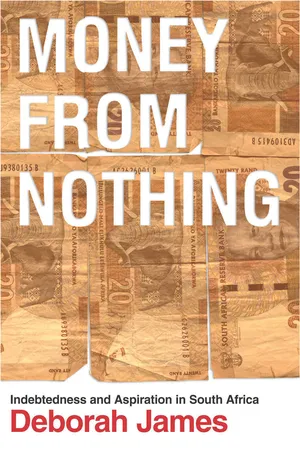
Money from Nothing explores the dynamics surrounding South Africa's national project of financial inclusionâdubbed "banking the unbanked"âwhich aimed to extend credit to black South Africans as a critical aspect of broad-based economic enfranchisement.
Through rich and captivating accounts, Deborah James reveals the varied ways in which middle- and working-class South Africans' access to credit is intimately bound up with identity, status-making, and aspirations of upward mobility. She draws out the deeply precarious nature of both the aspirations and the economic relations of debt which sustain her subjects, revealing the shadowy side of indebtedness and its potential to produce new forms of oppression and disenfranchisement in place of older ones. Money from Nothing uniquely captures the lived experience of indebtedness for those many millions who attempt to improve their positions (or merely sustain existing livelihoods) in emerging economies.
Frequently asked questions
- Essential is ideal for learners and professionals who enjoy exploring a wide range of subjects. Access the Essential Library with 800,000+ trusted titles and best-sellers across business, personal growth, and the humanities. Includes unlimited reading time and Standard Read Aloud voice.
- Complete: Perfect for advanced learners and researchers needing full, unrestricted access. Unlock 1.4M+ books across hundreds of subjects, including academic and specialized titles. The Complete Plan also includes advanced features like Premium Read Aloud and Research Assistant.
Please note we cannot support devices running on iOS 13 and Android 7 or earlier. Learn more about using the app.
Information
Table of contents
- Cover
- Copyright
- Title Page
- Dedication
- Contents
- List of Illustrations
- Acknowledgments
- Abbreviations
- Non-English Words and Phrases
- A Note on Currency
- Introduction: The Wellsprings of Consumption and Debt in South Africa
- 1. Indebtedness, Consumption, and Marriage: The New Middle Class
- 2. Regulating Credit: Tackling the Redistributiveness of Neoliberalism
- 3. âRide the Camelâ: Borrowing and Lending in Context
- 4. âYou Donât Keep Money All the Timeâ: Savings Clubs and Social Mobility
- 5. South Africaâs Credit Crunch: Narratives and Neighborhoods
- 6. âThe History of That House Keeps You Outâ: Property and the New Entrepreneur
- 7. New Subjectivities: Advice, Aspiration, and Prosperity
- Conclusion
- Notes
- Bibliography
- Index