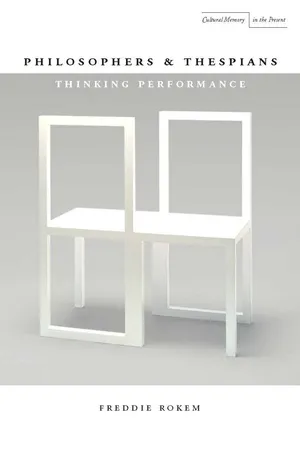
The interaction between philosophy and theater or performance has recently become an important and innovative area of inquiry. Philosophers and Thespians contributes to this emerging field by looking at four direct encounters between philosophers and thespians, beginning with Socrates, Agathon, and Aristophanes in Plato's Symposium and ending with a discussion between Walter Benjamin and Bertolt Brecht about a short text by Franz Kafka. Rokem also examines in detail Hamlet's complex and tragic split identity as both philosopher and thespian, as well as the intense correspondence between Friedrich Nietzsche and August Strindberg. His investigations—which move between the fictional and the historical—culminate in a comprehensive discussion of the notions of performance and performativity as derived from the discursive practices of philosophy and performance. At times competitive or mutually exclusive, these discourses also merge and engage with each other in creative ways.
- 248 pages
- English
- ePUB (mobile friendly)
- Available on iOS & Android
eBook - ePub
About this book
Trusted by 375,005 students
Access to over 1 million titles for a fair monthly price.
Study more efficiently using our study tools.
Information
Publisher
Stanford University PressYear
2009Print ISBN
9780804763509
9780804763493
eBook ISBN
9780804775885
PART ONE
ENCOUNTERS
1
The First Encounter PLATO’S Symposium AND THE ANCIENT QUARREL BETWEEN PHILOSOPHY AND POETRY
And then I came to the place where three roads meet.
—Sophocles, Oedipus Tyrannus
Crito, we ought to offer a cock to Asclepius. See to it, and don’t forget.
—Socrates’ last words as reported in the Phaedo
The earliest encounter between a philosopher and thespians that has been recorded in detail is Socrates’ meeting with the playwrights Agathon and Aristophanes. It takes place in Plato’s dialogue the Symposium, where the banquet celebrating Agathon’s victory at the Lenaean theatre festival in 416 B.C. is depicted. Plato portrayed in vivid detail the select group of Athenians gathered in Agathon’s house during the second night after his triumph. Through this portrayal, in particular he drew attention not only to the speeches eulogizing Eros presented on this occasion but also to the setting and the interactions among the participants at the event. The Symposium is an outstanding example of Plato’s abilities as a dramatic writer. Diogenes Laërtius even claimed that before turning to philosophy, Plato had been both a wrestler and a writer of tragedies: “He wrestled in the Isthmian Games—this is stated by Dicaearchus in his first book On Lives—and that he applied himself to painting and wrote poems, first dithyrambs, afterwards lyric poems and tragedies.”1 In the Symposium Plato has employed sophisticated narrative techniques and dramatic devices to promote Socrates’ philosophical ideas. However, at the same time, he has distanced himself from his admired teacher, and even severely criticized him.
Among Plato’s dialogues the Symposium clearly stands out as an excellent example of literary sophistication. Highlighted are the philosophical and ideological contents of the eulogies praising Eros and what they represent within the framework of the dialogue as well as within classical Greek culture (including examples from its rich corpus of dramatic literature). In addition the complex relationships between the speakers themselves and their behavior have been sharply placed in focus. These minute details are an integral aspect of Plato’s text, tightly weaving philosophical arguments and human behavior together, making them reflect and comment on each other simultaneously on many levels. The depiction of the encounter between philosophical and theatrical practices in the Symposium presents a showdown or a competition between the two practices, directly exemplified by the interactions between Socrates and the two playwrights Agathon and Aristophanes. Furthermore attention is drawn to the characteristics of their respective discursive practices as well as to their complex personal relationships. Plato’s dialogue weaves philosophical and literary issues together in complex juxtapositions that this chapter highlights from several vantage points.
Finally, however, I hope to show that the Symposium contains contradictory tensions that can probably never be fully resolved. At the same time as the Symposium (as an instance of Plato’s more comprehensive anti-aesthetic stance) directs a sophisticated attack against the two playwrights and the practices of theatre in general, by using sophisticated literary and dramatic techniques, it creates a comprehensive discursive universe, evoking intra- and intertextual intersections where the competitors become integrated within the constantly expanding dialogical encounter examined in this book. Plato ends the Symposium with a direct confrontation between Socrates, his philosopher-hero, on the one hand, and both Agathon, who wrote tragedies (though none of them have been preserved), and Aristophanes, who wrote comedies, on the other. This fact has major implications for the interactions between the philosophical and the thespian discourses, not only within the dialogue itself, but also within the more comprehensive philosophical and performative contexts highlighted. Finally, though in a very sophisticated and implicit manner, Plato also raises some serious doubts concerning Socrates’ philosophical authority as well as the integrity of his character. In order to untangle these complex contradictions, I begin by examining the ways in which the narrative techniques of the Symposium serve as a reflection of Plato’s philosophical ideas.
Philosophy and Narrative Technique
The Symposium is a brilliant poetic demonstration of Plato’s philosophy, showing that narratives are nothing but faint shadows of the events they depict (or are about), just as the objects in this world—like for example the chairs and the tables in our homes and classrooms, according to Plato’s theory of Ideas—are nothing but faded copies of the eternal Ideas of these objects. The narrative techniques of the Symposium mirror this philosophical argument, showing in effect that not even Plato’s own philosophical dialogue can fully represent the truth. The narrative presented in the dialogue is a report given by Apollodorus to an unknown interlocutor about the celebration in honor of Agathon. Apollodorus’s report is based on what Aristodemus, who was present at the party, has previously reported to Apollodorus. And since Apollodorus had just given an account of this celebration to another interlocutor called Glaucon a few days earlier, he says that “your question does not find me unprepared” (458, 172a)2 to tell what happened at the “gathering at Agathon’s when Socrates, Alcibiades, and their friends had dinner together [and tell] about the speeches they made on Love” (458, 172 b).
In the opening section of the Symposium, Apollodorus carefully informs his interlocutor (and us) that he had heard about these events from Aristodemus, one of Socrates’ ardent admirers, who had accompanied Socrates to the celebration (in Apollodorus’s careful formulation) “because, I think, he was obsessed with Socrates—one of the worst cases at that time” (459, 173b). Through its narrative technique—having one narrator present a report he has heard from another narrator—the dialogue is actually twice removed from the banquet that took place in Agathon’s house during the second night after his victory, which is the actual event, the “source” depicted in the dialogue. This corresponds to how Plato relates to works of art as being twice removed (just like the second night) from the truth, being copies of copies. This, he argues—for example, in book 10 of the Republic—is their essential flaw.
If Plato, on the other hand, had chosen to portray the events of the banquet in a purely dramatic form, which he did in many of his other dialogues, the narrative would of course not have reflected the Platonic theory of Ideas in this particular way. In its present form, the dialogue presents Apollodorus’s knowledge about the events of the banquet after Agathon’s victory as an epistemological investigation in literary form based on a complex chain of testimonies, transmitting knowledge about some “primal” truth. Such knowledge has to rely on earlier sources, which in some cases and for different reasons cannot be fully trusted. The narrators in Plato’s text (and indirectly Plato himself) openly admit that their memory is not always completely reliable. Before the first speech eulogizing Eros, presented by Phaedrus, Apollodorus even says: “Of course Aristodemus couldn’t remember exactly what everyone said, and I myself don’t remember everything he told me. But I’ll tell you what he remembered best, and what I consider the most important points” (463, 178a). After presenting what Phaedrus had said in his speech, Apollodorus adds: “There followed several other speeches which he couldn’t remember very well. So he skipped them and went directly to the speech of Pausanias” (465, 180c). Plato thus openly admits that there were participants and speakers at the banquet that the dialogue, as he himself has composed it, does not account for at all.
Plato has thus composed a dialogue wherein Apollodorus, the narrator, can give only a partial account of what happened at the banquet, based on the already partial report given by Aristodemus. Furthermore, as many critics have already pointed out, Socrates repeats this basic narrative gesture of relying on an earlier source by quoting Diotima’s explanations about Eros and thus transmitting her knowledge about Eros to the men assembled around the table. This creates an important gender shift in the dialogue, because after the women had been sent away in the beginning of the evening to enable the men to talk about Eros, Socrates reintroduces Diotima, a woman, as his own ultimate authority with regard to Eros. But since this report is contained within Apollodorus’s report, it potentially suffers from the same incompleteness that the report as a whole (namely, the dialogue as Plato composed it) intentionally is subjected to by Plato himself, as the ultimate author(ity) of this text. And as I will show later, there is an additional detail in Socrates’ report, from his conversations with Diotima, that even undermines his reliability and the philosophical core of the whole dialogue.
In both these cases—in Apollodorus’s as well as in Socrates’ account of what they have heard from others—Plato, by drawing detailed attention to the technicalities of the transmission of knowledge, radically problematized the ways in which oral reports and oral wisdom serve as a source of knowledge. The issue of Plato’s written representation of Socratic philosophy is far too extensive to be examined in detail, but it is noteworthy that when Eryximachus proposes that the participants at the celebration should each praise Eros, he significantly adds, “If you agree, we can spend the whole evening in discussion, because I propose that each of us give as good a speech in praise of Love as he is capable of giving” (462, 177c–d). Thus what Plato has penned is not only the oral philosophy of Socrates, but an event focusing on the spoken word—the “discussion”—that is transmitted through an intricate narrative chain.
Plato has reconstructed a situation in which, besides basing the narrative on Aristodemus’s partial report, he emphasizes that Apollodorus has also checked the details with Socrates himself to see if he has gotten them right (and this raises an interesting issue that I return to later). Furthermore Apollodorus mentions that only a few days before he tells his anonymous interlocutor about the banquet, he had told Glaucon about it. As it happens, Glaucon had already heard about it from another person, who in his turn had heard about it from someone called Phoenix. And Phoenix had mistakenly conveyed to this unnamed person that Apollodorus was also present at the banquet celebrating Agathon. This Apollodorus quickly refutes because, as he says, he was very young when the banquet itself took place. Plato has repeatedly interspersed small details drawing attention to the fact that the reports are unreliable approximations. And this is just as he claims in several other contexts that the copies of Ideas are unreliable with regard to the true nature of the Ideas themselves. In this respect the Symposium is quite radical because it indirectly questions Socrates’ philosophical practices by drawing attention to the unreliability of oral reports as they are presented in the Symposium.
In the Symposium Plato presents a radical critique of mimetic representation by pointing at its limitations, not by providing a direct philosophical critique as was done in many other contexts, most notably in the Republic. Instead Plato has gone to great pains to point out that all of the narrators / reporters—including Socrates himself—are only able to present a partial or slanted report of what really happened at the banquet, or in Socrates’ case during his meetings with Diotima. Thus this shows through the narrative technique itself that not only do narratives and dramatic representations fail to fully reveal or represent the truth, but philosophical ideas are subject to such limitations as well. Following Plato’s own philosophical ideas about art and mimesis, the narrative told by Apollodorus as it is presented in the dialogue—and to be exact, this report is actually what the dialogue consists of—is a faded, twiceremoved copy of the real events of the banquet. Thus what Plato actually shows in the Symposium is how the acquisition, the reproduction, and the transmission of knowledge depend on a complex narrative genealogy, a chain reaching backward to a source or an origin, just as, according to Plato, the objects in the world as we know them have their source or origin in the eternal Ideas, but without these objects being able to fully represent this origin.
The notions of genealogy and origin as problematized by Plato in the Symposium have several important implications for this study. Nietzsche and Benjamin, as well as Brecht, have in different ways formulated how tragedy, performance, and even philosophy were to be established as discursive practices. In The Birth of Tragedy from the Spirit of Music, Friedrich Nietzsche’s tragedy was conceived as a biological birth (Geburt). Walter Benjamin mobilized Plato’s Symposium as his template for the epistemological foundations, on the basis of which he investigates the German Tragic Drama and reconstructs its origin (Ursprung) in The Origin of German Tragic Drama. Bertolt Brecht’s notion of the Epic theatre as presented, in 1938, in his essay “The Street Scene: Towards a Basic Model for an Epic Theatre” comes closest to the notion of a chain of transmission of reports or testimonies like that depicted in the Symposium. According to Brecht, the Epic theatre originates from a situation in which “an eyewitness [is] demonstrating to a collection of people how a traffic accident took place.”3 In Plato’s dialogue the events at the banquet have been passed from Aristodemus, the direct witness, to Apollodorus who, after having actively verified the events with Socrates, is seen as a secondary witness, just as the spectators, according to Brecht, learn from the eyewitness report and then pass it on to other listeners, adding their own comments and conclusions, so that, according to Brecht’s formulation, the “bystanders are able to form an opinion about the accident.”4
The carefully designed opening section of the Symposium, which explores and examines the genealogy of the report about the banquet, serves as a warning. Although the text is composed by Plato himself, not all of its details can be fully trusted. In this instance it is even possible to talk about a “Platonic irony” through which Plato, at the same time as he presents Socrates as the source of true philosophical knowledge, undermines his own reliability through the use of this complex narrative technique of oral transmission. As I show in detail shortly, this radical ambiguity, indeterminacy in fact, between what actually happened at the party and the consciously limited possibilities of Plato’s philosophical dialogue to give a full report about it, comes to a head in the very last section of the dialogue.
After its investigatory beginning, the dialogue moves into a dramatic mode of presentation in which the speeches held at the banquet are presented as direct quotes. In this section, fully using the dialogue form in the generic sense, pr...
Table of contents
- Cultural Memory in the Present
- Title Page
- Copyright Page
- Dedication
- Praise
- Table of Contents
- Preface
- Introduction
- PART ONE - ENCOUNTERS
- PART TWO - CONSTELLATIONS
- Notes
- Index
- Cultural Memory in the Present
Frequently asked questions
Yes, you can cancel anytime from the Subscription tab in your account settings on the Perlego website. Your subscription will stay active until the end of your current billing period. Learn how to cancel your subscription
No, books cannot be downloaded as external files, such as PDFs, for use outside of Perlego. However, you can download books within the Perlego app for offline reading on mobile or tablet. Learn how to download books offline
Perlego offers two plans: Essential and Complete
- Essential is ideal for learners and professionals who enjoy exploring a wide range of subjects. Access the Essential Library with 800,000+ trusted titles and best-sellers across business, personal growth, and the humanities. Includes unlimited reading time and Standard Read Aloud voice.
- Complete: Perfect for advanced learners and researchers needing full, unrestricted access. Unlock 1.4M+ books across hundreds of subjects, including academic and specialized titles. The Complete Plan also includes advanced features like Premium Read Aloud and Research Assistant.
We are an online textbook subscription service, where you can get access to an entire online library for less than the price of a single book per month. With over 1 million books across 990+ topics, we’ve got you covered! Learn about our mission
Look out for the read-aloud symbol on your next book to see if you can listen to it. The read-aloud tool reads text aloud for you, highlighting the text as it is being read. You can pause it, speed it up and slow it down. Learn more about Read Aloud
Yes! You can use the Perlego app on both iOS and Android devices to read anytime, anywhere — even offline. Perfect for commutes or when you’re on the go.
Please note we cannot support devices running on iOS 13 and Android 7 or earlier. Learn more about using the app
Please note we cannot support devices running on iOS 13 and Android 7 or earlier. Learn more about using the app
Yes, you can access Philosophers and Thespians by Freddie Rokem in PDF and/or ePUB format, as well as other popular books in Letteratura & Critica letteraria nel teatro. We have over one million books available in our catalogue for you to explore.