- 264 pages
- English
- ePUB (mobile friendly)
- Available on iOS & Android
About this book
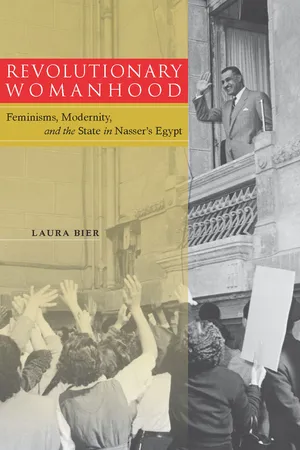
The first major historical account of gender politics during the Nasser era, Revolutionary Womanhood analyzes feminism as a system of ideas and political practices, international in origin but local in iteration. Drawing connections between the secular nationalist projects that emerged in the 1950s and the gender politics of Islamism today, Laura Bier reveals how discussions about education, companionate marriage, and enlightened motherhood, as well as veiling, work, and other means of claiming public space created opportunities to reconsider the relationship between modernity, state feminism, and postcolonial state-building.
Bier highlights attempts by political elites under Nasser to transform Egyptian women into national subjects. These attempts to fashion a "new" yet authentically Egyptian woman both enabled and constrained women's notions of gender, liberation, and agency. Ultimately, Bier challenges the common assumption that these emerging feminisms were somehow not culturally or religiously authentic, and details their lasting impact on Egyptian womanhood today.
Frequently asked questions
- Essential is ideal for learners and professionals who enjoy exploring a wide range of subjects. Access the Essential Library with 800,000+ trusted titles and best-sellers across business, personal growth, and the humanities. Includes unlimited reading time and Standard Read Aloud voice.
- Complete: Perfect for advanced learners and researchers needing full, unrestricted access. Unlock 1.4M+ books across hundreds of subjects, including academic and specialized titles. The Complete Plan also includes advanced features like Premium Read Aloud and Research Assistant.
Please note we cannot support devices running on iOS 13 and Android 7 or earlier. Learn more about using the app.
Information
Table of contents
- Cover
- Title Page
- Copyright
- Dedication
- Contents
- Acknowledgements
- A Note on Transliterations
- Introduction
- 1. Egyptian Women in Question: The Historical Roots of State Feminism
- 2. Between Home and Workplace: Fashioning the “Working Woman”
- 3. Law, Secularism, and Intimacy: Debating the Personal Status Laws
- 4. The Family Is a Factory: Regulating Reproduction
- 5. Our Sisters in Struggle: State Feminism and Third World Imaginaries
- Conclusion: The Legacies of State Feminism
- Notes
- Bibliography
- Index